
Artificial intelligence is not just shifting the paradigm in higher education; it is completely dismantling traditional assessment models. As AI capabilities surge past human limits, universities are facing an unprecedented crisis of academic integrity. The solution, according to one renowned mathematician? Stop fighting the AI and return to the analog basics.
The Death of the Take-Home Assignment
The concept of evaluating students based on homework is rapidly becoming obsolete. UC Berkeley mathematics professor Richard Borchards, a Fields Medalist, recently shared his stark realization that assignments in the AI world are virtually “worthless”.
The reasoning is simple: students have figured out that generative AI can effortlessly complete these assignments. Because professors are unable to accurately discern between a student’s original effort and an AI’s output, Borchards has entirely stopped grading homework based on correctness.
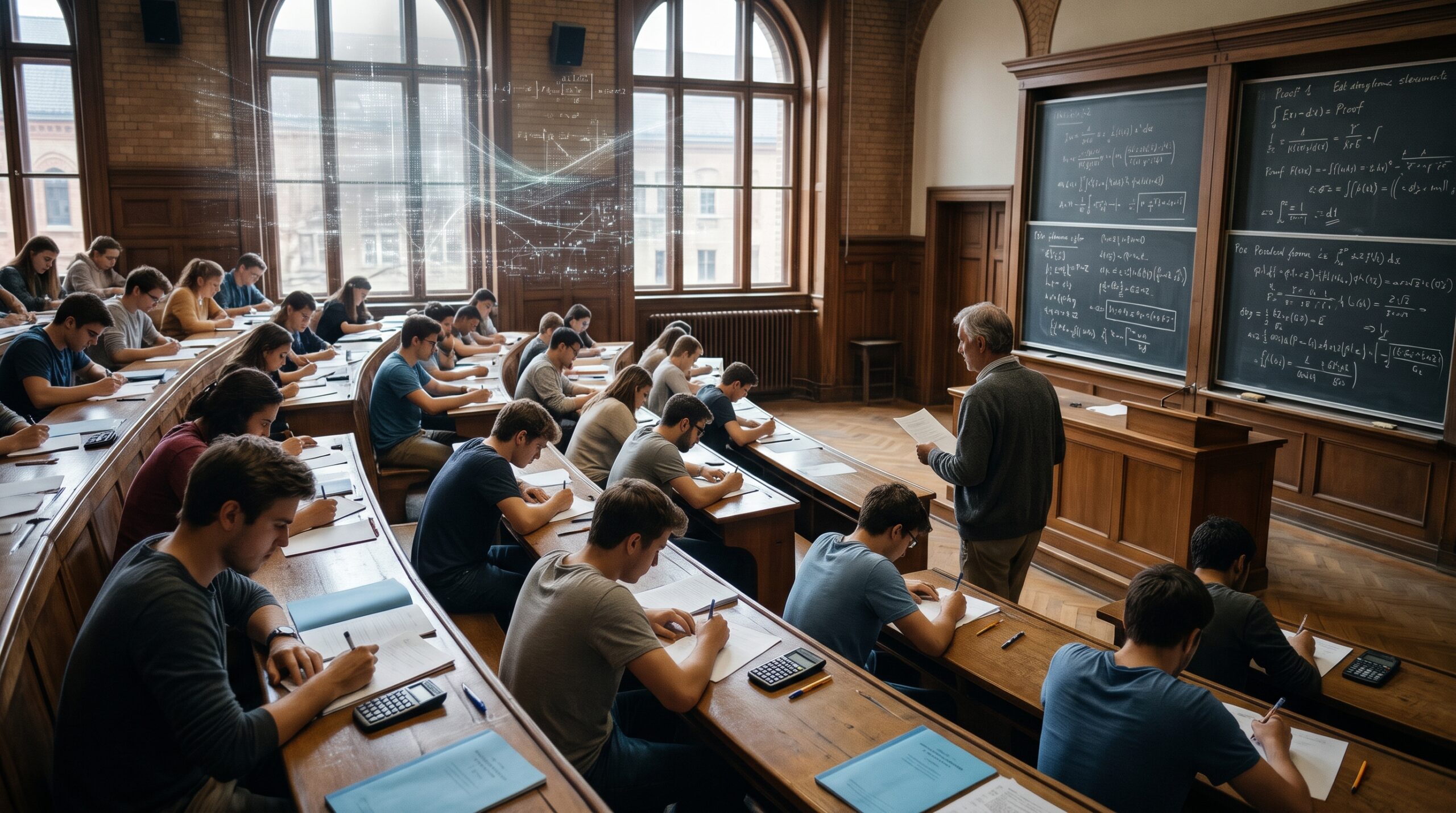
Instead, the only viable method for testing authentic knowledge is a regression to the past: in-person, heavily monitored classroom exams. The “old blue book way” has become the last defense against machine-generated academic success.
A Renowned Mathematician’s Concession
Perhaps the most startling revelation from the academic frontlines is the admission of defeat from top-tier intellects. When asked how a mathematician of his caliber is competing with AI, Borchards offered a brutally honest assessment: he isn’t.
“AI is already better than me at everything,” Borchards admitted. “It’s better at research, it’s better at teaching”.
Even the critical task of evaluating and verifying complex work is being outsourced. The deeply complicated mathematical proofs now produced by AI are frequently too difficult for human mathematicians to manually check. The solution is cyclical: professors are using AI to check the proofs generated by AI, effectively removing the human from the loop entirely.
The Crisis of Future Guidance
If artificial intelligence can outpace a Fields Medal-winning mathematician, what does that mean for the next generation entering university?
When asked what advice he gives to bright, incoming students about what to study to remain productive and competitive, Borchards was transparent about the uncertainty of the situation. He revealed that he had even prompted AI with this exact dilemma, and the AI itself admitted it did not know what would happen.
As digital humanism continues to evolve, academia is confronting a harsh reality. The debate is no longer about whether AI will change education, but whether human intellectual roles, even at the highest levels of academia, will survive the transition. As Borchards dryly noted, compared to the broader societal disruptions AI will cause, wiping out the job of a math professor might just be a minor problem.
Leave a Reply