
For thousands of years, healthcare was fundamentally a game of averages. When you fell ill, a doctor prescribed a mass-produced chemical designed for millions of people, hoping your specific biology fell close enough to the mathematical average for it to work. You took the same dose of painkillers or antibiotics as someone twice your weight or with an entirely different genetic makeup.
Today, in 2026, the era of “mass-produced medicine” is officially dead. We no longer visit a pharmacy to buy pre-packaged pills. Instead, medicine has become a software problem.
Welcome to the Bio-Computational Era. For the readers of Pariganaka.com, here is a deep dive into how Generative AI and molecular printing merged to treat human biology like executable code, and why your next prescription will be compiled on your desk.
1. The Desktop Bio-Compiler
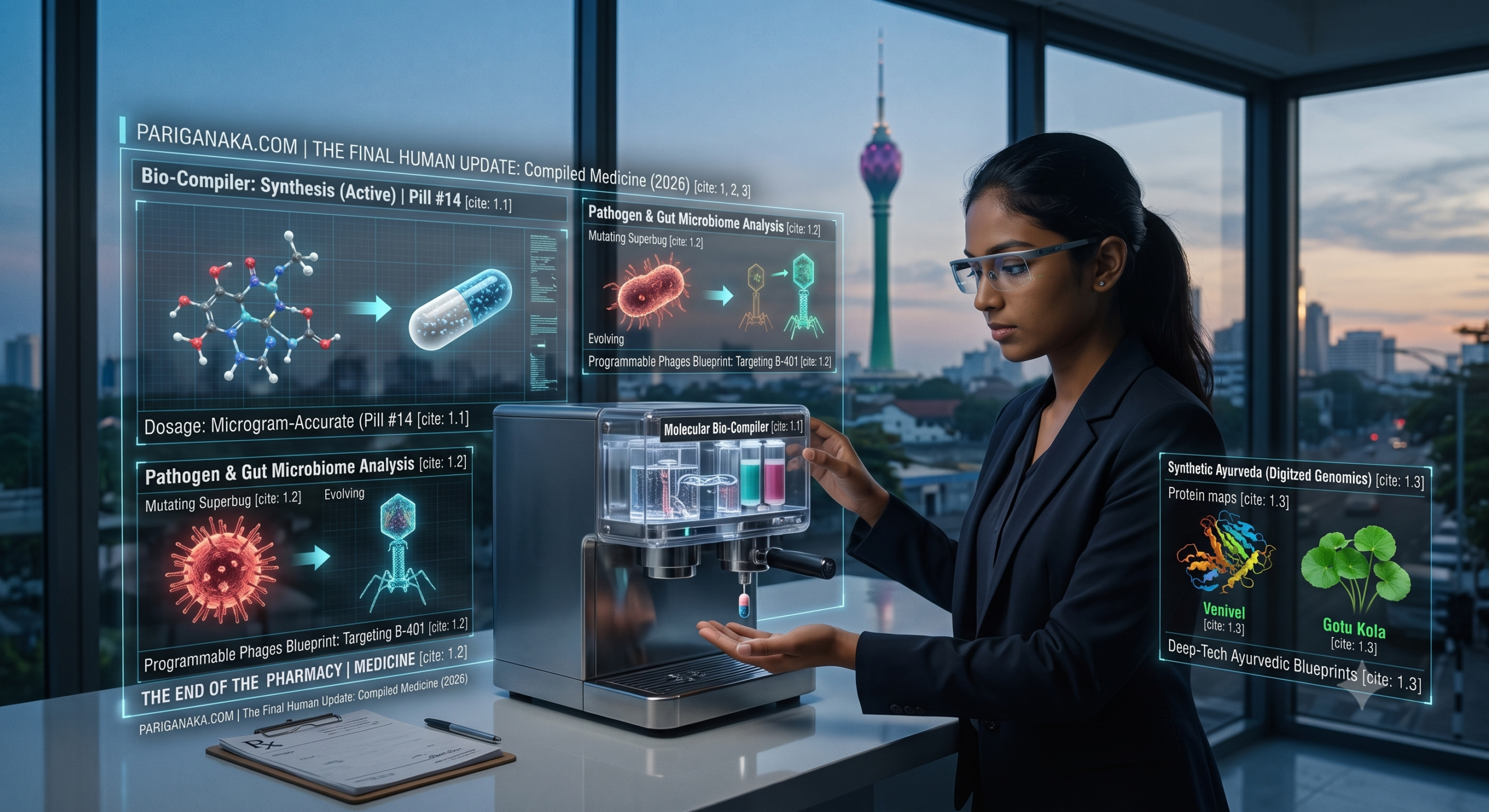
The pharmaceutical supply chain of the early 2020s—factories, shipping containers, and temperature-controlled storage—has been replaced by a device the size of an espresso machine sitting on your kitchen counter: the Molecular Bio-Compiler.
- From Prescribing to Printing: When your wearable biometric sensors detect an anomaly—such as early-stage inflammation or a viral load—the data is sent to your AI physician. The AI cross-references the pathogen with your exact Digital DNA Twin and transmits a molecular blueprint to your compiler. The machine uses raw chemical cartridges to literally “print” a customized pill or dermal patch tailored to your precise cellular needs that very minute.
- Dynamic Dosing: Because the medicine is compiled on-demand, dosages are no longer static. If your metabolism is running fast on a Tuesday, your bio-compiler adjusts the active pharmaceutical ingredients down to the microgram, ensuring zero side effects and absolute chemical efficiency.
2. Programmable Phages: The Post-Antibiotic World
By 2024, the world was on the brink of an antibiotic resistance crisis, with superbugs threatening to make minor surgeries fatal. AI saved us by pivoting from broad-spectrum chemicals to biological warfare.
- Targeted Cellular Assassins: Instead of using antibiotics—which act like a nuclear bomb in your gut microbiome, wiping out good and bad bacteria alike—AI now designs “Bacteriophages” (viruses that only attack specific bacteria).
- Algorithmic Evolution: If a superbug mutates in your body, your internal nano-sensors detect the genetic shift. Your AI physician instantly generates a newly mutated bacteriophage blueprint, compiles it, and deploys it. We are now fighting real-time biological evolution with real-time algorithmic evolution.
3. The Sri Lankan Context: Synthetic Ayurveda
Sri Lanka’s rich history of traditional Ayurvedic medicine has collided with the bio-computational era, creating one of the most lucrative deep-tech export markets in South Asia.
- Digitizing Ancient Genomics: For centuries, the effectiveness of herbal remedies depended on soil quality, monsoon seasons, and harvest times. Today, local bio-tech startups have used quantum sequencing to map the exact therapeutic protein structures of endemic plants like Venivel and Gotu Kola.
- The Bio-Export Boom: Sri Lanka no longer needs to export physical herbs, which are prone to spoilage and environmental degradation. Instead, local researchers license the “digital molecular blueprints” of these ancient remedies. A patient in New York can now purchase a Sri Lankan Ayurvedic blueprint and have their local bio-compiler print the exact, unadulterated therapeutic compounds with 100% molecular accuracy.
Pariganaka.com’s Take: The transition from chemical medicine to compiled molecular software is arguably the greatest leap in human lifespan optimization. We have cured the incurable by turning biology into code. However, this introduces the ultimate cybersecurity nightmare. If your medicine is just data downloaded from the cloud, it can be intercepted, corrupted, or hacked. A single line of malicious code inserted into a bio-compiler’s instructions could turn a life-saving protein into a lethal toxin. We have conquered disease, but our immune systems are now only as strong as our network firewalls.
Leave a Reply