
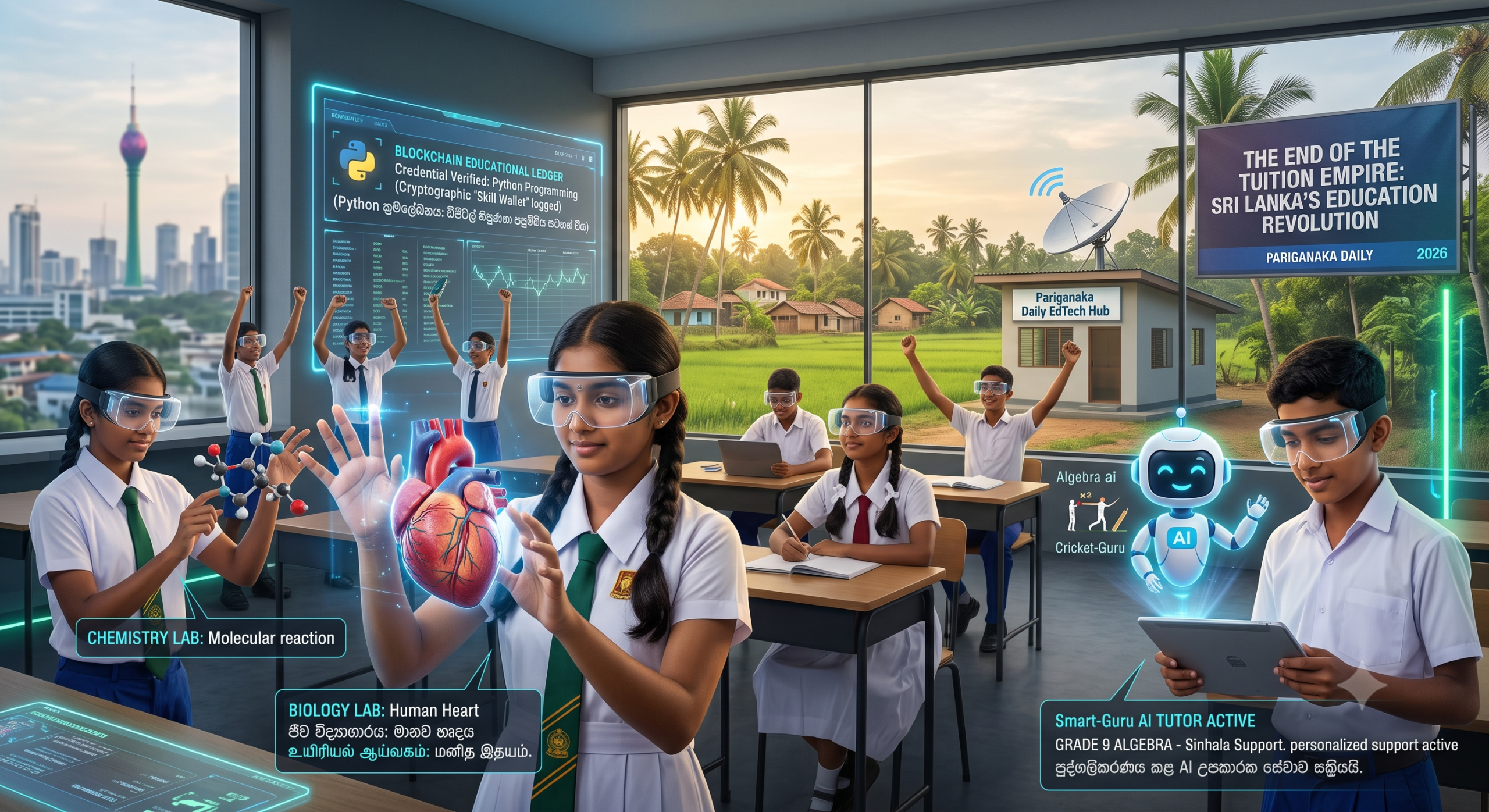
For decades, the Sri Lankan education system was defined by overcrowded classrooms, high-stakes national exams (O/Ls and A/Ls), and a massive, exhausting after-school tuition industry. Students in rural areas often had to travel for hours just to access a well-equipped science lab or an expert mathematics teacher. In 2026, the traditional classroom walls have fallen.
By integrating Artificial Intelligence, Virtual Reality (VR), and decentralized ledgers, the Ministry of Education and local EdTech startups are fundamentally democratizing learning. Elite-level education is no longer restricted by geography or wealth.
Here are the top three digital trends transforming how the next generation of Sri Lankans learn this year.
🤖 1. Hyper-Personalized AI Tutors (The ‘Smart-Guru’)
The “one-size-fits-all” teaching model—where a single teacher lectures 40 students at the same pace—is officially obsolete. Today, every student has a dedicated, personalized AI tutor residing on their government-issued tablet.
- Adaptive Learning: The AI tutor analyzes a student’s keystrokes, response times, and error patterns in real-time. If a student in Grade 9 is struggling with algebraic equations, the AI does not just give them the answer; it autonomously rewrites the lesson plan, breaking down the concept using visual examples tailored to the student’s specific hobbies (like cricket or robotics) until they truly understand it.
- Seamless Trilingual Support: Language is no longer a barrier to knowledge. These AI tutors are fluent in Sinhala, Tamil, and English. A student in Jaffna can access a masterclass originally taught by a physics professor in Colombo, with the AI instantly dubbing the audio and translating the interactive notes into flawless Tamil.
🥽 2. Virtual Reality (VR) STEM Labs in Rural Schools
Historically, peripheral schools lacked the funding for expensive chemistry chemicals, biology specimens, or physics equipment. In 2026, the laboratory has gone completely digital.
- Zero-Risk Chemistry and Biology: Schools in areas like Mahiyanganaya and Kilinochchi are now equipped with VR headsets. Instead of reading about the human heart in a dusty textbook, biology students can “shrink” down and walk through a pumping 3D holographic heart, watching red blood cells flow past them. In chemistry, they can mix highly volatile digital compounds to see explosive reactions without any physical danger or material cost.
- Time-Travel History Lessons: History is no longer memorized; it is experienced. Students studying the Anuradhapura era put on their headsets and virtually walk through the Ruwanwelisaya courtyard as it was being built in 140 BC, interacting with AI avatars of ancient architects to learn about advanced ancient hydraulics.
🔗 3. Blockchain Credentials and the Evolution of Exams
The extreme pressure of cramming years of knowledge into a three-hour paper exam is slowly being phased out in favor of continuous, stress-free assessment.
- Continuous AI Assessment: Instead of waiting for a final term test, the AI tutor continuously grades the student’s problem-solving skills, critical thinking, and creativity every single day. This creates a much more accurate, holistic profile of the child’s actual intelligence rather than just their ability to memorize facts.
- The Digital Skill Wallet: When a student masters a skill—whether it is Python programming, advanced calculus, or graphic design—it is immediately verified by the AI and logged onto an immutable educational blockchain. By the time they graduate, students do not just have an A/L certificate; they possess a cryptographic “Digital Skill Wallet” that universities and global tech employers can instantly verify, proving exactly what the student is capable of doing.
The Pariganaka Takeaway: The educational revolution of 2026 proves that technology’s greatest power is equalization. By deploying AI tutors and VR labs, Sri Lanka is bridging the massive divide between urban and rural schools. We are shifting from an industrial-era system that mass-produced factory workers to an intelligent, adaptable ecosystem designed to cultivate the innovators, engineers, and creators who will lead the nation forward.
Leave a Reply