
Do you remember what gaming used to feel like just a few years ago? You would walk up to a villager in a fantasy game, press a button, and they would repeat the exact same robotic sentence. You would memorize the paths of enemies, wait for lengthy loading screens, and eventually, after 40 or 50 hours, you would reach the end of the game. Once you beat it, the world was essentially dead.
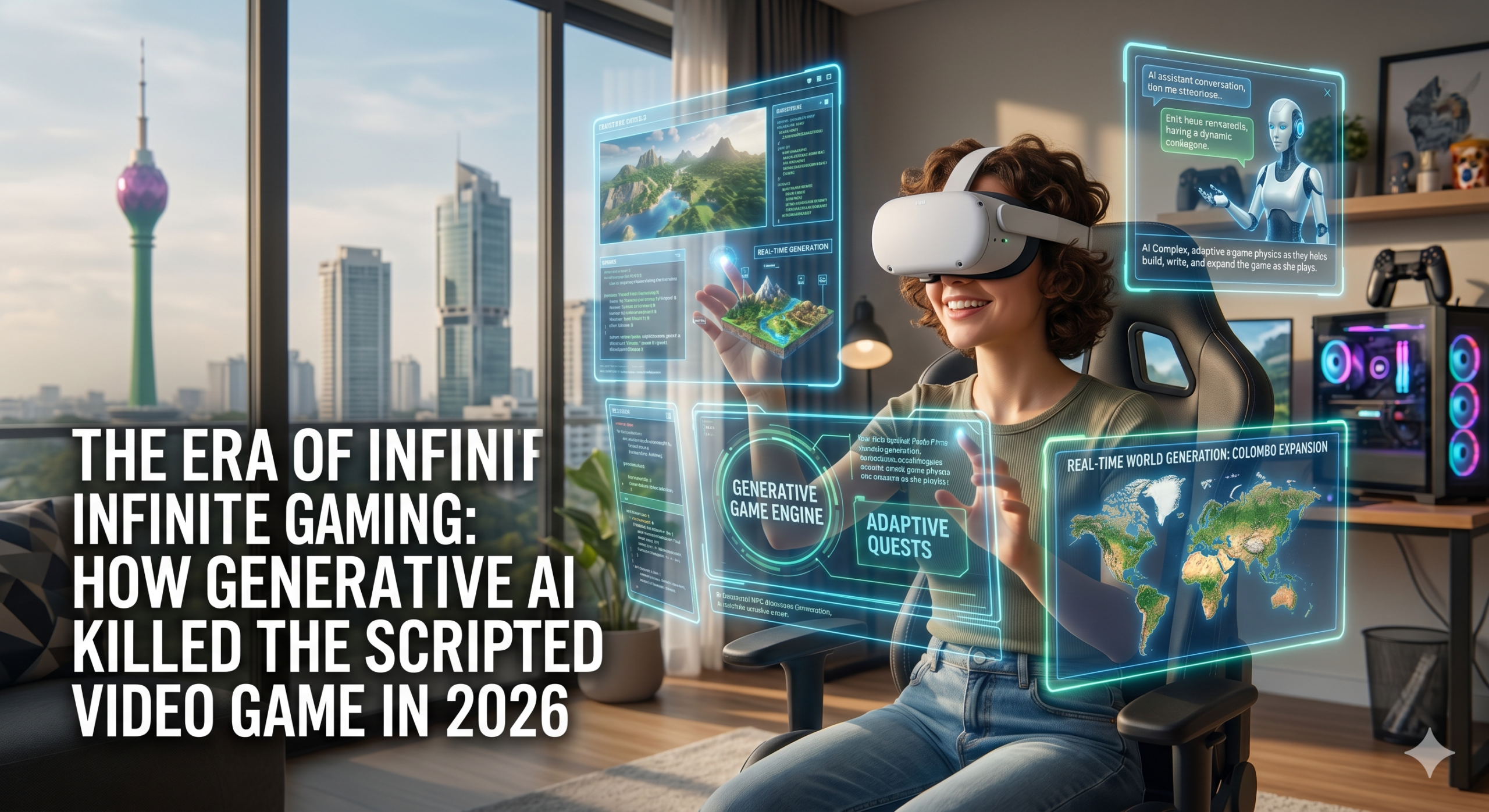
In 2026, the concept of a “finished” or “scripted” video game is rapidly becoming obsolete. We are currently witnessing the birth of the Generative Game Engine, a technology that uses Artificial Intelligence to build, write, and expand the game in real-time as you play it.
Here is why the video games of 2026 are no longer software you just play, but living ecosystems you step into.
🧠 NPCs with Real Minds
The biggest and most immediate change players are experiencing this year is the evolution of the Non-Playable Character (NPC). The days of pre-recorded voice lines and rigid dialogue trees are over.
Modern 2026 titles are integrating advanced Large Language Models (LLMs) and Agentic AI directly into the characters.
- True Memory: If you insult a shopkeeper in a game on Monday, they will remember your face, hold a grudge, and refuse to sell to you on Friday.
- Dynamic Voices: Voice acting is generated on the fly with perfect emotional inflection. You can use your actual microphone to speak to the characters naturally, and they will respond in real-time, holding a completely unique, unscripted conversation based on their personality parameters.
🌍 Worlds That Build Themselves
In the past, human developers had to manually draw every tree, code every quest, and design every dungeon. This took years and hundreds of millions of dollars.
Today, games are utilizing Neural Rendering and real-time world generation. You are no longer exploring a map that is stored on your hard drive; the AI is generating the landscape, the architecture, and the lore just over the horizon before you even get there. If you decide to walk off the main path into a random forest, the AI engine will instantly invent a forgotten ruin, populate it with enemies, and generate a deep, lore-accurate mystery for you to solve on the spot. No two players will ever have the exact same game world.
🎙️ The Player Becomes the Developer
Perhaps the wildest feature of 2026 gaming is “Intent-Based Modding.” You no longer need to know how to code to change the game.
Using the game’s built-in AI interface, you can simply pause and type (or speak) a prompt: “Turn all the enemy soldiers into giant, angry chickens, and change the weather to a heavy snowstorm.” The engine instantly compiles the assets, adjusts the game physics, and renders your request seamlessly without breaking the game.
The Bottom Line: The line between game developer and player has vanished. By handing the creative reins over to AI, 2026 has introduced the world to the “Infinite Game”—a digital world that grows, learns, and reacts to you dynamically, ensuring that the adventure truly never has to end.
Leave a Reply