
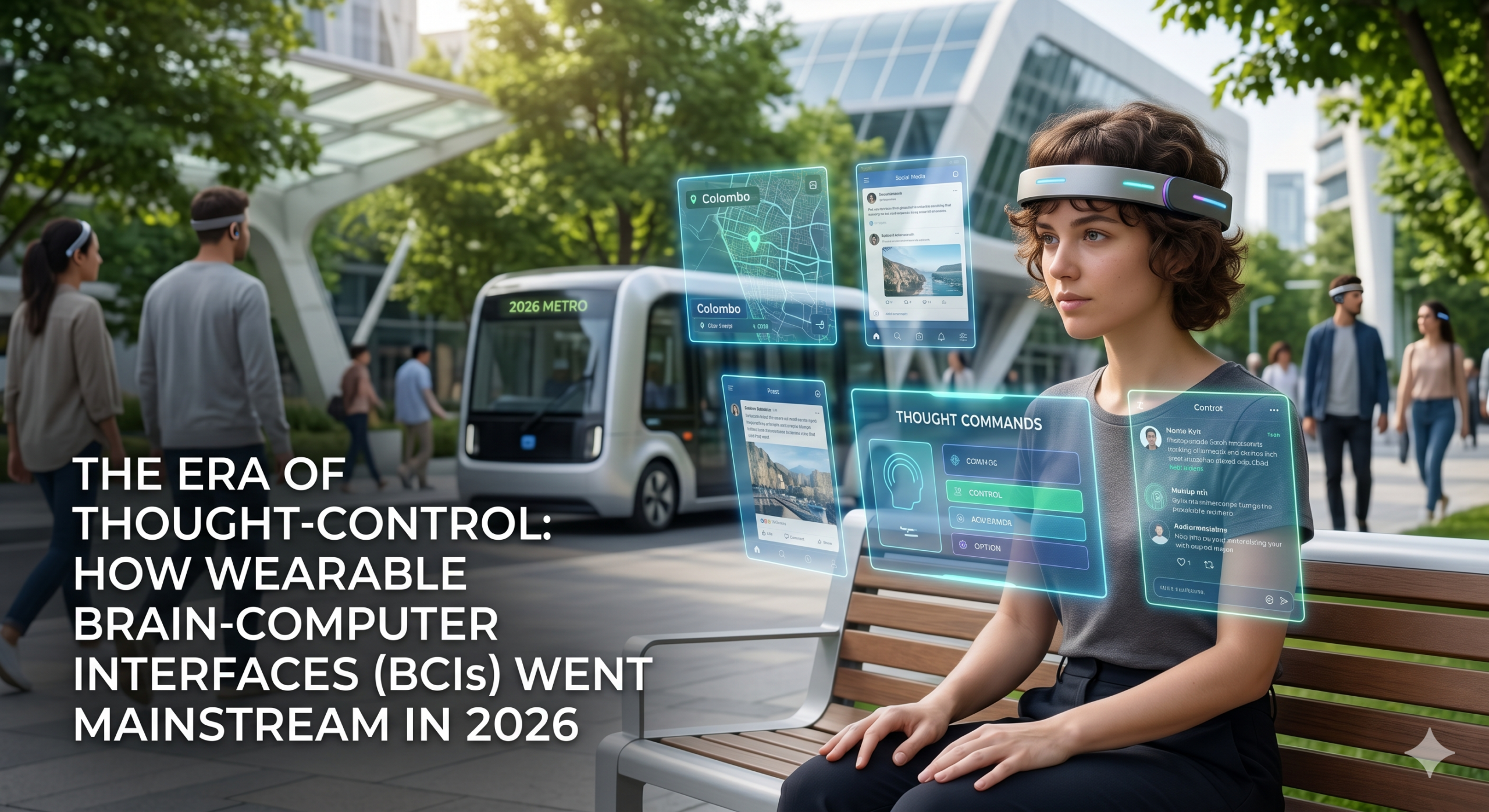
First, we clicked mice. Then, we tapped glass screens. A few years ago, we started yelling commands at voice assistants like Siri and Alexa. But let’s be honest: talking to your devices in a crowded bus or a quiet office is awkward, and swiping on a screen requires your full physical attention.
In 2026, the tech industry has finally cracked the ultimate human-machine barrier. We have entered the era of the Consumer Brain-Computer Interface (BCI). You no longer need to speak or type to control your devices; you just have to think about doing it.
Here is how “intent-based computing” is taking over the wearable market this year.
🚫 No Brain Surgery Required
When most people hear “mind-control tech,” they immediately think of invasive surgical implants like early iterations of Elon Musk’s Neuralink. While those are still doing miracles in the medical field for paralyzed patients, consumer tech has taken a completely different, non-invasive route.
The biggest releases in 2026 aren’t microchips in your brain—they are everyday accessories.
- Neural Wristbands: Devices that look just like a standard Apple Watch band, but are packed with advanced EMG (Electromyography) sensors.
- In-Ear EEG: Wireless earbuds that not only play music but press gently against your ear canal to read brainwave patterns.
🤫 The Magic of “Silent Speech”
How does it actually work? When you want to move your finger to swipe a screen, your brain sends an electrical signal down your spinal cord to your arm.
The new neural wristbands intercept that electrical signal at your wrist before your hand even moves. This enables a phenomenon called “Silent Speech.” You can mentally “say” a word to yourself, or imagine typing a text message, and the BCI translates those motor-neuron signals directly into digital text on your device. It feels like absolute magic. You can reply to a text message during a meeting while your hands are resting completely still under the table.
🔗 The Perfect Match for AR Glasses
As we covered in our recent article on the rise of AR Smart Glasses, the biggest problem with spatial computing was figuring out how to click on floating virtual objects without looking like you are swatting invisible flies in public.
Neural wristbands have become the ultimate companion to AR glasses. You can now walk down the street in Colombo, look at a virtual notification hovering in your glasses, and simply think about “swiping right” to dismiss it. The combination of eye-tracking (to see what you are looking at) and neural-tracking (to know what you want to do with it) has created a completely frictionless, invisible user interface.
The Bottom Line: The keyboard and the touch screen are finally starting to show their age. By tapping directly into our nervous system, 2026 is proving that the fastest and most natural way to interact with technology is to remove the physical interface entirely. The gap between human thought and digital action has officially dropped to zero.
Leave a Reply