
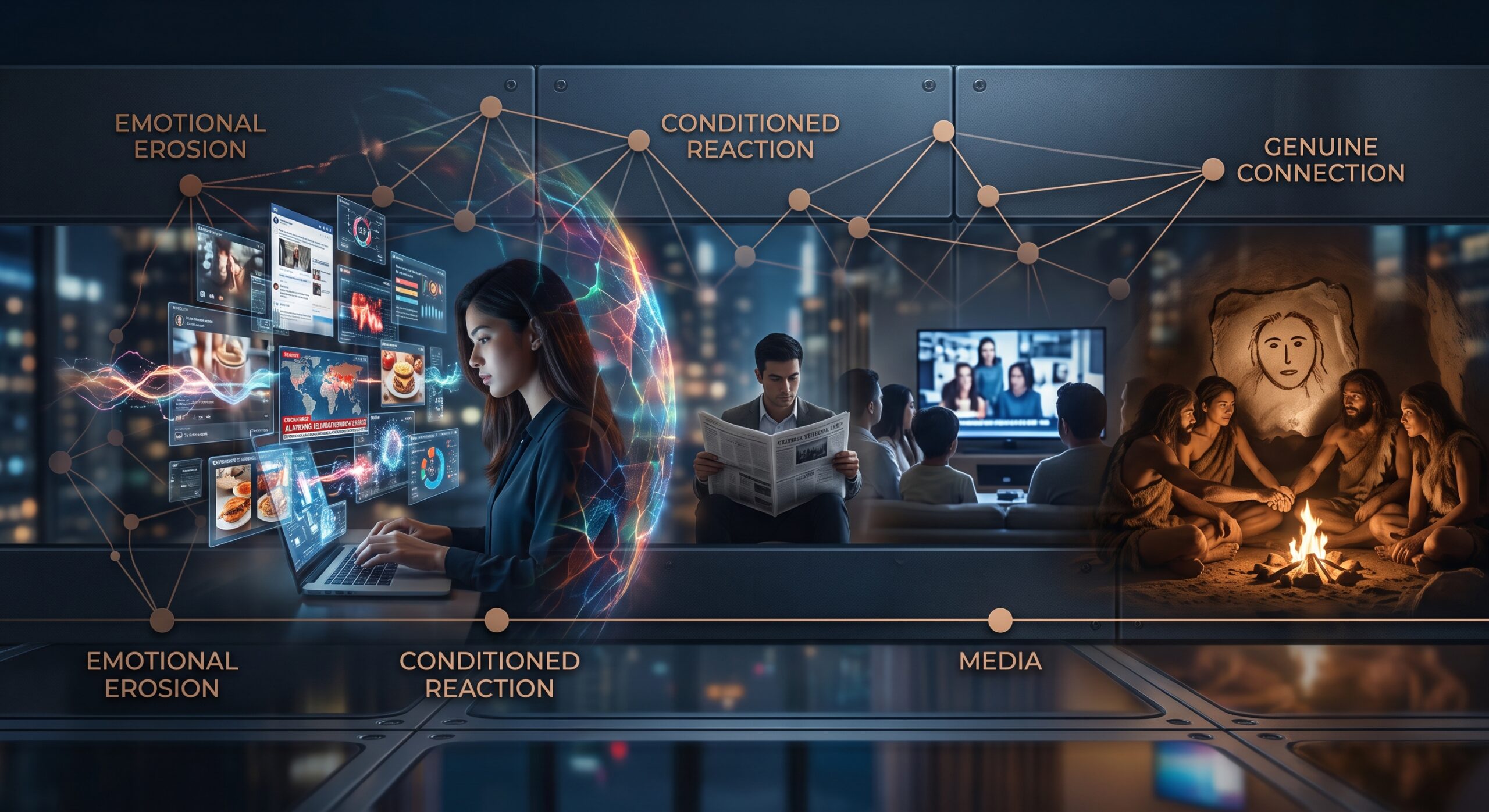
Have you ever noticed that during what should be the most intense moments of your life, you feel as if you are watching everything through a screen? An invisible barrier seems to separate you from your own emotional experience. A hug feels mechanical. An important personal achievement yields only a vague, fleeting satisfaction instead of the intense joy you expected.
If you are feeling emotionally anesthetized, you are not alone—and it is not a sign that you have become a cold or insensitive person. According to evolutionary perspectives, you are experiencing one of the most subtle and dangerous transformations of our era: the gradual erosion of our capacity to feel deeply.
The digital bombardment of our emotional system. Source: StockCake
The Evolution of Our Emotional System
For millions of years, the human emotional system evolved to process limited but deeply meaningful stimuli. Our ancestors lived in small groups where every social interaction carried weight. Every danger was a real threat, and every joy was directly connected to survival.
Imagine an 18th-century person receiving a handwritten letter from a loved one after a long journey. The arrival of that letter was an intense emotional event. They would feel the texture of the paper, recognize the unique handwriting, and read each word with total, undivided attention. That single letter could generate waves of emotion that lasted for days.
Now, compare that to how we communicate today. We check messages while walking, eating, or watching television. We are subjected to a constant barrage of “emotional microshocks”:
- An alarming news story about a global crisis.
- A photo of a friend on vacation that sparks envy.
- A work email that generates anxiety.
- A 15-second video that provokes automatic laughter.
In a matter of minutes, before you even brush your teeth, your brain processes more emotional variations than our ancestors experienced in an entire month.
The “Fast Food” of Human Emotion
The digital revolution is fundamentally altering our relationship with our own feelings. Modern entertainment and digital platforms are expertly engineered to hijack our neurochemistry:
- Series are structured to release dopamine at calculated intervals.
- Video games activate reward systems in patterns that keep you engaged, though not necessarily happy.
- Social networks are designed to provoke quick, superficial reactions that keep you scrolling.
We are being trained to consume emotions the same way we consume fast food—quick and intense in the first moment, but leaving a profound sense of emptiness soon after. Just as a diet of highly processed food dulls our palate to subtle flavors, “fast feeling” desensitizes our emotional system, causing us to lose our appreciation for the deeper, lasting feelings that give human life its meaning.
The mechanism behind this is rooted in how variable rewards hijack our brain chemistry.
Key insight: We are losing the capacity to distinguish between genuine, organically arising emotions and programmed, conditioned reactions engineered by algorithms.
The Death of Solitude and Deep Connection
Perhaps the most disturbing aspect of this transformation is how it alters our ability to connect with others. Deep human relationships—love, friendship, and compassion—are like symphonies. They unfold slowly, requiring varied movements, meaningful silences, and a capacity for sustained attention.
Today, solitude is rarely tolerated; it must immediately be filled with podcasts, music, or videos. Boredom is treated as an emergency to be resolved in seconds. Silent contemplation, once considered an essential human capacity, is now viewed as a problem to be fixed.
When you try to comfort a friend but feel impatient because the conversation is extending beyond a “normal” timeframe, or when you are with someone you love but part of your mind is anticipating your next phone notification, your capacity to sustain complex emotions has been compromised.
The Illusion of Knowledge
Ironically, we live in an era with unprecedented access to mental health resources. We have meditation apps, online therapy, and endless books on emotional intelligence. Yet, rates of anxiety, depression, and existential emptiness continue to climb.
This suggests the problem isn’t a lack of knowledge. Trying to solve our current mental health crisis by reading about emotional intelligence while continuing to consume digital “fast food” is like trying to cure malnutrition by reading about vitamins while exclusively eating highly processed junk. Knowledge cannot compensate for an emotional system that is constantly overloaded.
Reclaiming Our Emotional Ecosystem
During the Industrial Revolution, it took decades to realize that factories were polluting our physical environment. Today, we are facing digital emotional pollution, and we must develop practices to protect our inner ecosystem.
The good news is that the human brain is highly neuroplastic. Just as a musician who hasn’t played in years can recover their skill with practice, you can rebuild your emotional endurance.
Steps to rebuild your emotional capacity:
- Observe your consumption: Pay attention to which digital content truly nourishes your life versus what merely stimulates your reward system.
- Practice genuine presence: Resist the impulse to divide your attention between the person in front of you and your device.
- Tolerate the uncomfortable: Allow yourself to feel complete sadness or pure joy without immediately reaching for a distraction or a camera to capture the moment.
- Embrace silence: Create digital-free spaces where your thoughts and feelings can arise and resolve naturally.
Emotions are not just personal experiences; they are the foundation of empathy, art, and the wisdom needed to solve our greatest collective challenges. By consciously protecting our capacity to feel, we preserve what makes us fundamentally human.
The term “dopamine detox” (or dopamine fasting) is a popular conceptual framework, but biologically, it is a misnomer. You cannot actually “detox” from dopamine—it is an essential neurotransmitter that controls motor function, memory, and basic motivation. If your brain literally ran out of dopamine, you would be unable to move or function.
The protocol, originally popularized by clinical psychologist Dr. Cameron Sepah, is actually a rebranded form of Cognitive Behavioral Therapy (CBT) known as stimulus control. It is not about fasting from a chemical; it is about resetting your brain’s reward threshold by temporarily abstaining from highly stimulating, addictive behaviors (like endless scrolling, excessive gaming, or compulsive internet use).
Here is the scientific mechanism behind why this “reset” is necessary, and how it actually works.
The Science: Receptor Downregulation and Homeostasis
The core scientific principle behind a dopamine detox is homeostasis—the brain’s drive to maintain a stable internal balance.
When you experience a reward, dopamine is released in the brain’s mesolimbic pathway, traveling across synapses and binding to dopamine receptors to transmit the feeling of pleasure or motivation.
- The Overload: Digital stimuli like social media algorithms, video games, and processed foods are engineered to trigger unnaturally high and frequent dopamine spikes.
- Downregulation: To protect itself from this overwhelming neurochemical flood, the brain adapts by reducing the number of active dopamine receptors, or making them less sensitive. This process is called downregulation.
- Tolerance: Because you now have fewer active receptors, you need a stronger, more intense stimulus to feel the same level of baseline pleasure. This is why a simple walk in the park or reading a book suddenly feels intensely boring—your depleted receptors can no longer process the subtle dopamine release of everyday activities.
Visualize the Reset
This interactive model simulates how your brain adjusts receptor density based on the intensity of external stimuli. Notice how chronic, high-intensity stimulation forces the receptors to retreat.
Key insight: A dopamine detox doesn’t reduce dopamine; it gives your brain the necessary downtime to upregulate (grow back) its receptors, making you sensitive to natural, everyday joys again.
How a “Detox” Works in Practice
The goal is not sensory deprivation (you do not need to avoid talking to people, exercising, or eating). The goal is to break the habit loop of specific, impulsive behaviors.
According to Dr. Sepah’s original framework, the evidence-based approach involves targeting specific problematic behaviors:
- Identify the Trigger: Pinpoint the specific behavior that feels compulsive (e.g., checking social media, browsing news, playing mobile games).
- Time-Box Abstinence: Instead of a monk-like vow of silence, practice structured abstinence. This could mean keeping your phone out of the bedroom for the first and last hour of the day, or taking one full day a week completely offline.
- Embrace Boredom: The most critical part of the detox is allowing yourself to feel bored without immediately seeking a digital pacifier. This uncomfortable friction is the exact biological window where your brain begins upregulating its receptors.
- Substitute Behaviors: Replace the high-dopamine, passive consumption with low-dopamine, active engagement—reading a physical book, taking a walk without headphones, or cooking a meal.
By strategically removing the artificial spikes, you allow your brain’s natural reward system to recalibrate.
Want to know how to set up a personalized stimulus control plan?Yes
A successful stimulus control plan relies on environmental architecture, not willpower. The goal is to make the unwanted habit physically difficult to execute and the desired behavior the path of least resistance.
1.Audit the Habit Loop:Isolate the exact trigger.
Before changing anything, track your behavior for 48 hours to find the exact cue. Does the digital habit start when you feel stressed? Is it tied to a specific location (sitting on the couch) or time of day (right after lunch)? You cannot control a stimulus until you know exactly what it is.
2.Define Contextual Boundaries:Separate fast consumption from deep work.
When pulling together cyber, geopolitical, and tech updates for a 9:00 AM daily briefing, you have to be online and engaged with fast-moving media. However, deep work blocks—like outlining a three-hour AI curriculum or conceptualizing future technological eras—require a completely different environment.
Set up dedicated digital boundaries: use one web browser (e.g., Chrome) exclusively for fast research and news gathering, and a completely different browser (e.g., Firefox) with all social media and news sites blocked for deep work.
3.Engineer Environmental Friction:Make the bad habit physically difficult.
Willpower depletes; friction is permanent. If your phone is face-up on your desk while you work, you are draining cognitive energy just trying to ignore it.
- Physical friction: Put the device in another room, or place it inside a drawer out of your line of sight.
- Digital friction: Delete the apps from your phone and log out of the websites on your computer. Make yourself type in the password and complete two-factor authentication every single time you want to log in.
4.The Substitution Protocol:Replace, don’t just remove.
The brain hates a vacuum. If you successfully block YouTube, your brain will just automatically open Reddit or Twitter instead. You must map out exact alternative actions to execute when the craving hits.
| The Trigger (Cue) | The Old Habit (Response) | The New Substitution |
| Hitting a wall while writing code | Opening social media | Standing up to stretch or getting a glass of water |
| Finishing the morning briefing | Scrolling news sites endlessly | Reading a physical book or walking for 10 minutes |
| Feeling tired at 3:00 PM | Watching a quick video | Doing a 5-minute breathing exercise |
Commit to this structured environment for at least two weeks. Your brain’s reward threshold will naturally recalibrate as it realizes the artificial dopamine spikes are no longer easily accessible.
Leave a Reply