
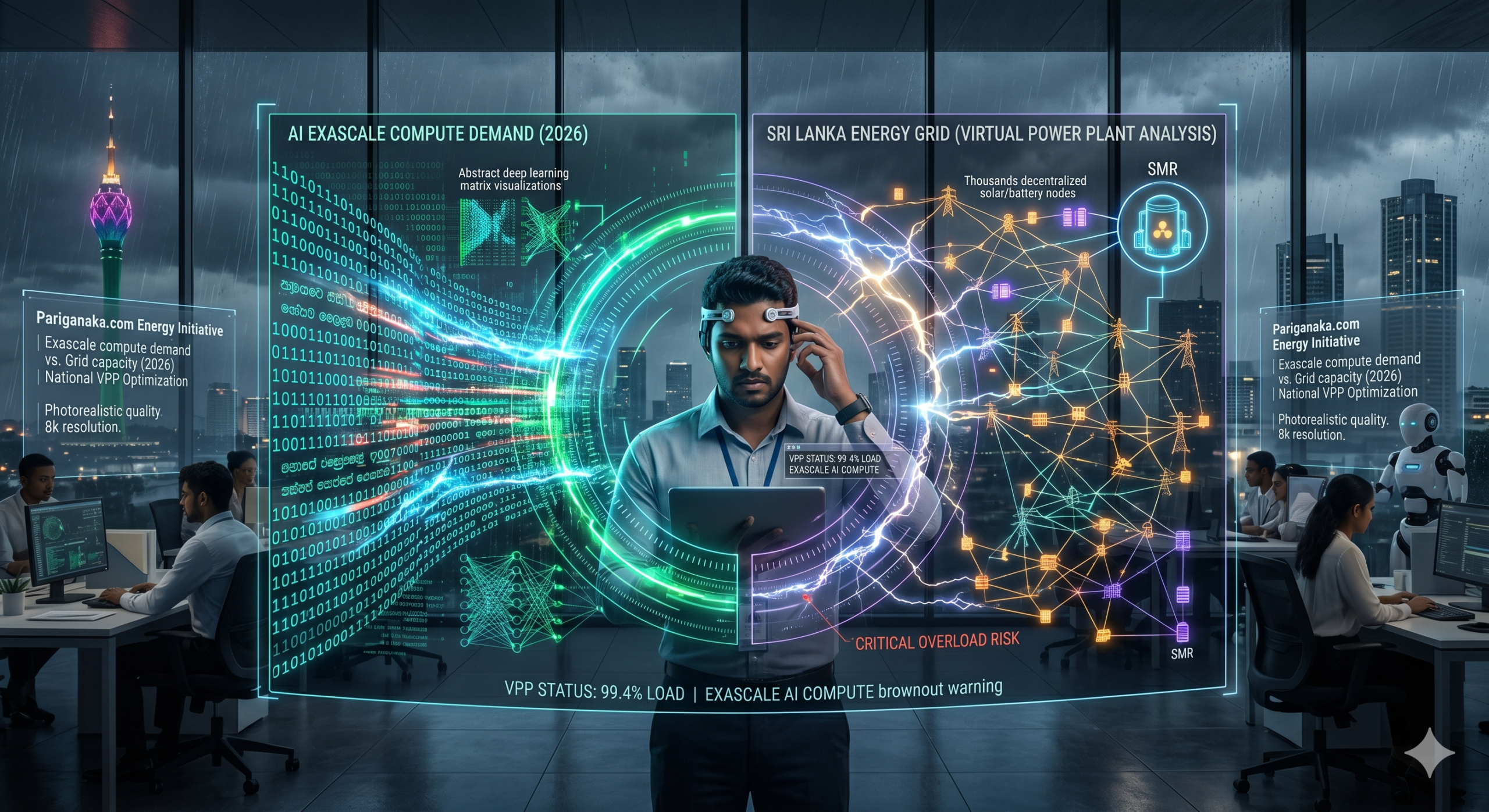
In the early 2020s, the tech world was obsessed with the “silicon shortage.” Everyone believed the biggest bottleneck to the future of Artificial Intelligence was manufacturing enough GPU chips. Fast forward to 2026, and the silicon supply chains have stabilized. Yet, the tech industry is facing an even more formidable wall—one that cannot be solved by simply building more factories.
The new bottleneck is Electricity.
As we transitioned from chatbots to massive, always-on Agentic AI and Embodied Robotics, the energy demands of the global internet skyrocketed. Today, AI data centers consume more electricity than entire mid-sized nations. We have entered the Exascale Compute Era, and it is forcing humanity to completely re-engineer how we generate, store, and distribute power.
For the readers of Pariganaka.com, here is a look at the invisible energy war happening behind the scenes, and how deep-tech is racing to keep the lights on.
1. The Appetite of “Always-On” Inference
To understand the crisis, we have to look at how AI actually operates.
- Training vs. Inference: A few years ago, the massive energy spikes came from training large models. Today, the drain comes from inference—the act of the AI actually thinking and generating responses. With billions of people using AI agents continuously for coding, generating 8K video, and managing their lives in real-time, the global compute load never sleeps.
- The Cooling Conundrum: These massive supercomputer clusters run incredibly hot. Traditional air-cooling systems failed years ago. Now, data centers are built at the bottom of freezing oceans or utilize advanced two-phase liquid immersion cooling just to prevent the processors from melting their own motherboards.
2. Deep-Tech Energy Solutions: Beyond Solar and Wind
Because wind and solar are intermittent (the sun sets and the wind stops), they cannot provide the absolute baseline stability required by a quantum-AI data center. The tech industry has had to fund its own radical energy solutions.
- Small Modular Reactors (SMRs): The biggest tech giants are no longer just software companies; they are nuclear power operators. In 2026, next-generation nuclear micro-reactors are being built right next to data centers. These SMRs provide 100% clean, zero-carbon, uninterrupted gigawatt power, operating safely without the massive footprint of traditional nuclear plants.
- AI-Driven Deep Geothermal: AI itself is helping solve the problem. Advanced algorithms have mapped the Earth’s crust with unprecedented accuracy, allowing autonomous drilling rigs to tap into deep geothermal heat anywhere on the planet, unlocking a limitless supply of clean, baseline terrestrial energy.
3. The Sri Lankan Context: Virtual Power Plants (VPPs)
For Sri Lanka, importing expensive fossil fuels to meet rising digital energy demands is no longer economically viable. Instead, the country is turning its entire grid into a giant, AI-managed battery.
- The Decentralized Grid: Thousands of homes and businesses in Sri Lanka now have solar panels and solid-state battery walls. Instead of a one-way flow of power from a central coal plant, the grid is now a decentralized network managed by a national AI infrastructure.
- Virtual Power Plants: When an AI data center in Colombo experiences a massive spike in demand, the AI grid instantly borrows micro-amounts of excess stored battery power from thousands of homes across the island, compensating the homeowners digitally via the e-Rupee in real-time. The grid is no longer a static machine; it is a living, breathing digital marketplace.
Pariganaka.com’s Take: We are living through the ultimate technological paradox. Artificial Intelligence is the most energy-hungry technology humanity has ever created, actively straining our global power grids to their absolute breaking points. Yet, simultaneously, AI is the only tool powerful enough to invent the next-generation batteries, design the nuclear fusion reactors, and optimize the smart grids necessary to save the planet. We are betting all our energy on the machine, trusting that it will invent a way to fuel itself before the lights go out.
Leave a Reply