
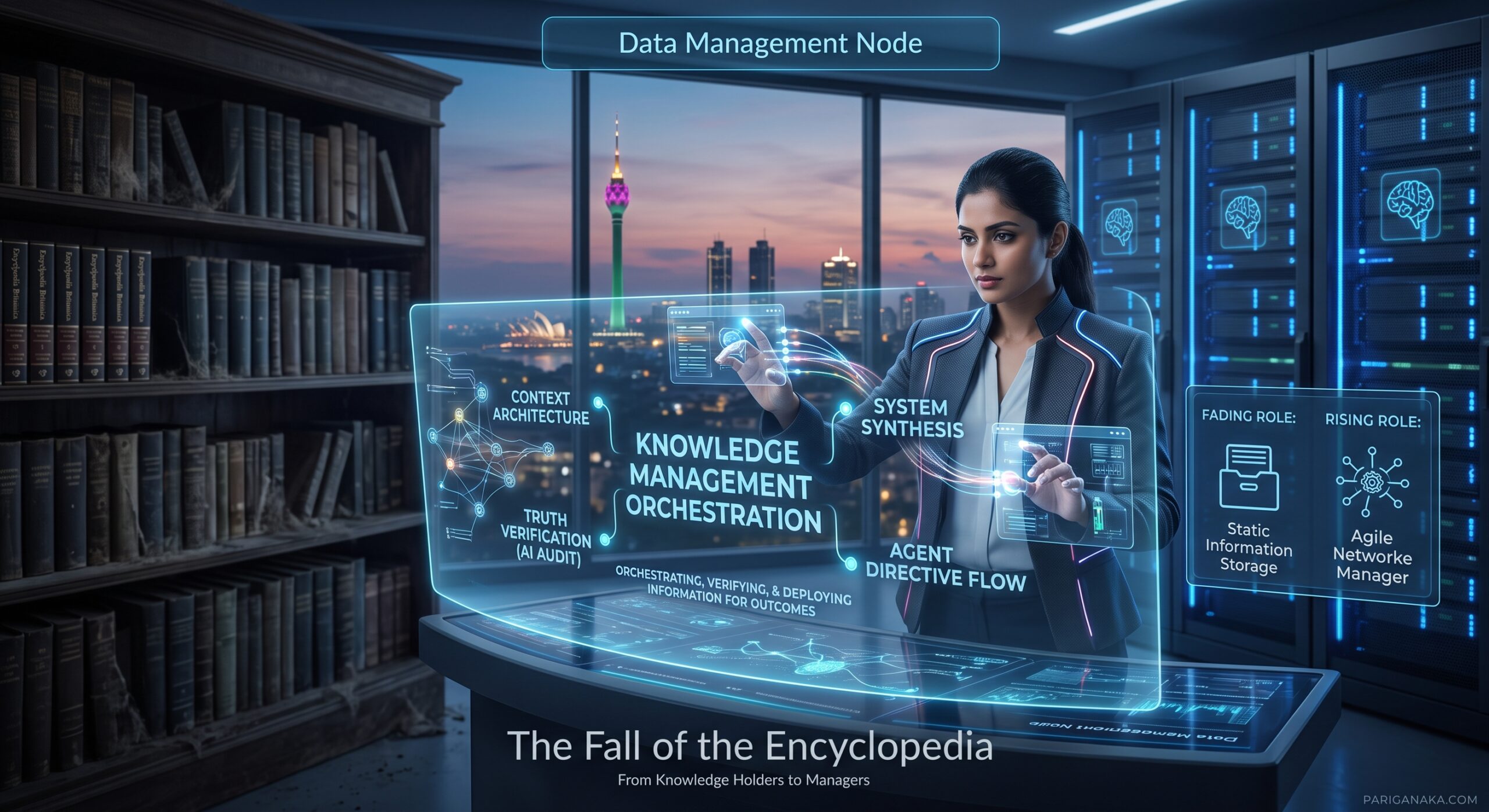
For generations, professional supremacy belonged to the human repository. The doctor who memorized every rare pathology, the lawyer who cited obscure case law from memory, and the programmer who retained thousands of library functions commanded the highest salaries. In a world defined by information scarcity, holding knowledge was the ultimate competitive moat.
Today, that moat has vanished. High-parameter artificial intelligence has commoditized information retrieval and routine synthesis to zero marginal cost. When any machine can surface, summarize, and format complex facts within milliseconds, simply “holding” information provides zero economic leverage.
We have entered an era where Knowledge Managers completely eclipse Knowledge Holders. The defining professional skill is no longer retaining facts, but orchestrating, verifying, and deploying information to drive real-world outcomes.
The Structural Divide
| Dimension | The Knowledge Holder (Yesterday) | The Knowledge Manager (Tomorrow) |
|---|---|---|
| Core Function | Information storage & retrieval | Curation, orchestration & context architecture |
| Cognitive Bias | Memorization and routine recall | Critical inquiry, synthesis & validation |
| Workflow | Answers pre-defined questions | Formulates high-value constraints & objectives |
| Role with AI | Competes against automated intelligence | Directs autonomous agents & data streams |
| Primary Value | What they remember | How effectively they govern information flow |
The Three Pillars of Modern Knowledge Management
1. Context Architecture and Problem Formulation AI models possess vast factual knowledge but zero situational awareness. They cannot perceive unspoken organizational politics, nuanced customer motivations, or regulatory trade-offs. The modern knowledge manager’s superpower is context architecture: transforming ambiguous, messy human challenges into precise parameters, system constraints, and prompt-level workflows that synthetic engines can execute.
2. Truth Verification in the Age of Synthetic Noise Because generative engines produce plausible hallucinations with the same confidence as empirical truths, unverified information has become a liability. Knowledge managers act as gatekeepers of ground truth. They build automated evaluation benchmarks, conduct rigorous boundary testing, and apply domain-specific discernment to isolate high-signal data from machine noise.
3. Dynamic Synthesis Over Static Silos Traditional specialists thrived inside strict disciplinary silos. In contrast, knowledge managers operate horizontally across systems. They understand how legal mandates affect software architecture, or how logistics constraints dictate product design. Their value lies in connecting disparate intelligence nodes into a coherent, functioning ecosystem.
The Organizational Rebalancing
Enterprises no longer need staff to serve as walking documentation. The modern enterprise requires agile operators capable of structuring proprietary knowledge graphs, deploying agentic workflows, and continuously auditing synthetic outputs.
Just as the advent of search engines rendered the memorization of phone directories obsolete, generative intelligence has ended the era of human data storage. The future does not reward the mind that stores the library; it rewards the strategist who knows how to direct the flow of its intelligence.
Leave a Reply