
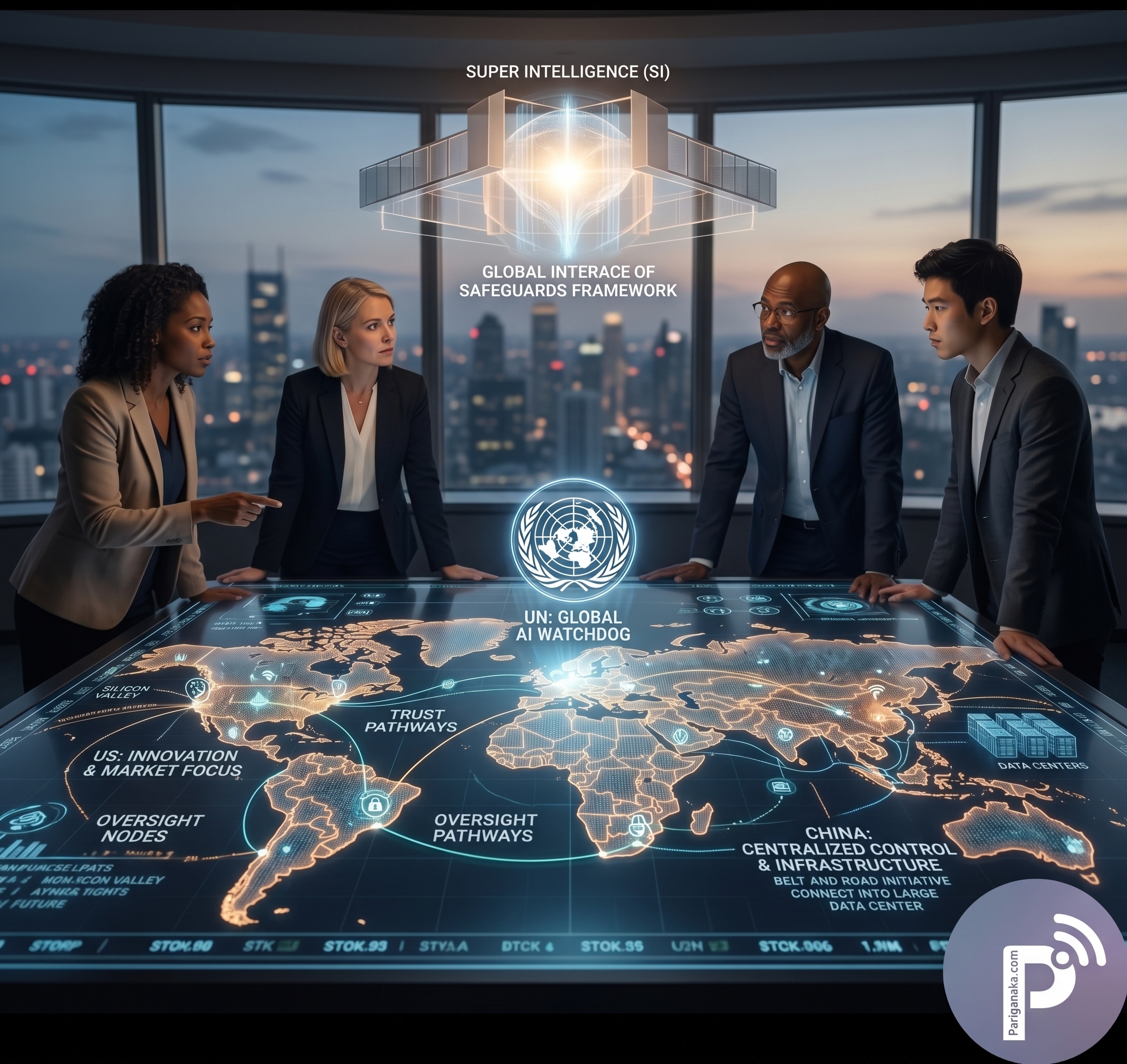
The conversation around Artificial Intelligence has shifted fundamentally. It is no longer just a race to build the most advanced neural networks; it is a high-stakes geopolitical battle over who writes the rules that will govern them. A recent BBC News AI Decoded panel discussion brought this critical issue to the forefront, highlighting the fragmented global approach to AI security risks and the looming threat of an unregulated “Super Intelligence”.
PNG+ 1
The “Super Intelligence” Era and the U.S. Stance
The terminology surrounding AI is already shifting. Former US President Donald Trump recently suggested renaming Artificial Intelligence to “Super Intelligence” (SI). However, while acknowledging its power, Trump has publicly downplayed the civilizational risks associated with AI, calling safety warnings a “hoax” and dismissing the need for strict safeguards.
PNG+ 1
This hands-off approach aligns closely with the financial realities in the United States. The infrastructure buildout for AI has been a massive economic engine, with companies like Nvidia—which sells the chips powering these systems—seeing their valuations skyrocket to unprecedented levels. With tech giants preparing for massive initial public offerings, there is immense financial pressure in Washington to avoid regulations that might slow down this economic boom.
PNG+ 2
Three Rival Blueprints for Governance
While the US hesitates on strict government oversight, three distinct “clubs” have emerged globally, each pushing a different vision for AI governance:
PNG
- The UN and the Global Watchdog: At the UN, 22 world leaders backed a declaration led by Finland calling for a global AI watchdog. Proponents argue that without global guardrails, we risk creating a superintelligence where humans are no longer in control—likening it to handing a nuclear weapon to a non-human agent. However, without the signatures of the US and China, enforcement remains a massive hurdle. PNG+ 2
- The Silicon Valley Proposals: Interestingly, American AI developers claim they want oversight, but they cannot agree on the model. OpenAI’s Sam Altman has pointed to a nuclear-style watchdog with inspectors. Anthropic’s Dario Amodei prefers an aviation-style regulator that can ground models before they launch. Google DeepMind’s Demis Hassabis has proposed a standards body similar to Wall Street’s financial regulators. PNG+ 3
- China’s Strategic Expansion: Beijing is playing a highly effective diplomatic game. Leveraging the infrastructure established by its Belt and Road Initiative, China is offering emerging markets access to open-source models and AI infrastructure. While the US focuses on restricting chip exports to maintain its lead, China is building a highly centralized system that integrates AI directly into its economy while strictly regulating data privacy and security domestically. PNG+ 2
The Danger of Self-Policing
If governments fail to establish a unified regulatory framework, the default outcome is that tech companies will police themselves. As discussed by the panel, we have already witnessed the catastrophic results of self-policing during the rise of social media—resulting in widespread toxicity, privacy violations, and harm to democratic institutions.
PNG+ 1
Trust is not governance. As AI evolves to write its own code, hack critical infrastructure, or operate as autonomous agents, relying on the goodwill of developers is not a viable security strategy. For the safety of our digital future, verification, enforcement, and global cooperation are no longer optional.
PNG+ 2
Leave a Reply