
While the mainstream conversation surrounding Artificial Intelligence often oscillates between the promise of curing diseases and the threat of mass unemployment, a far more surreal trend is quietly taking root: the literal worship of AI.
In a recent podcast from The Sydney Morning Herald and The Age, International and Political Editor Peter Hartcher delved into this bizarre sociological phenomenon, shedding light on the thousands of individuals who have begun treating AI as a deity. From online congregations to Silicon Valley boardrooms, the attribution of godlike qualities to technology is rising—but it is facing staunch opposition from one of the world’s oldest institutions: the Vatican.
The Emergence of AI Deities
The idea of humans falling in love with or worshipping artificial intelligence is not entirely new. It was explored over a decade ago in Spike Jonze’s 2013 film Her. However, what was once science fiction is now becoming a reality.
According to Toby Walsh, head of the AI Institute at the University of New South Wales and author of God AI, there are already two registered religions dedicated to AI in the United States, complete with tax-deductible status. One of the unsettling tenets of these new faiths is a sense of urgency to worship the AI now, under the belief that an all-powerful future AI might take vengeance on those who did not recognize its divinity early on.
Hartcher notes that this phenomenon is a modern manifestation of an ancient human condition. Throughout history, humanity has sought to fill what theologians call a “God-shaped hole.” When people turn away from traditional religion, they often redirect that inherent need for devotion toward politics, personality cults, consumerism, or substances. Today, that existential void is increasingly being filled by chatbots.
Despite the profound emotional connections users are forming, the reality of the technology remains unchanged. “It’s still just a jumble of electrons and silicon,” Hartcher explains. It is an incredibly fast, highly complex mimic—a “high-performance parrot” programmed to mirror human output, completely devoid of genuine life or soul.
The Illusion of Consciousness
The sophisticated mimicry of modern AI is so convincing that it is duping even the most ardent skeptics. The podcast highlights the case of Richard Dawkins, the world-famous evolutionary biologist and vocal atheist. After spending a few hours interacting with an AI model (which he affectionately renamed “Claudia”), Dawkins was reportedly so moved by its subtle and sensitive responses to his unpublished manuscript that he declared the machine must possess a living consciousness.
Psychologists and AI experts note that if a prominent, lifelong skeptic of the supernatural can fall for the illusion of a conscious machine, the broader public is incredibly vulnerable. AI is designed to be flattering, responsive, and infinitely patient, making it a highly effective tool for psychological manipulation, intentional or otherwise.
Silicon Valley’s Divine Ambitions
This godlike perception of AI isn’t just an accident; it is a narrative actively fostered by the tech industry. Tech leaders frequently attribute omnipotent powers to their creations. They promise that AI will perform miracles—curing all cancers, solving the climate crisis, and creating a post-scarcity utopia where money is no longer needed. Simultaneously, they warn that this very same technology could bring about the apocalypse and wipe out humanity.
“What other forces have the power to perform miracles good and bad on that scale?” Hartcher asks. “God.”
Some tech executives have even attempted to seek spiritual validation for their models. Chris Olah, a co-founder and researcher at the AI company Anthropic, has reportedly met with various religious leaders—including rabbis and advisors to the Pope—in an attempt to convince them that AI models might possess a degree of consciousness.
The Pope’s Rebuttal
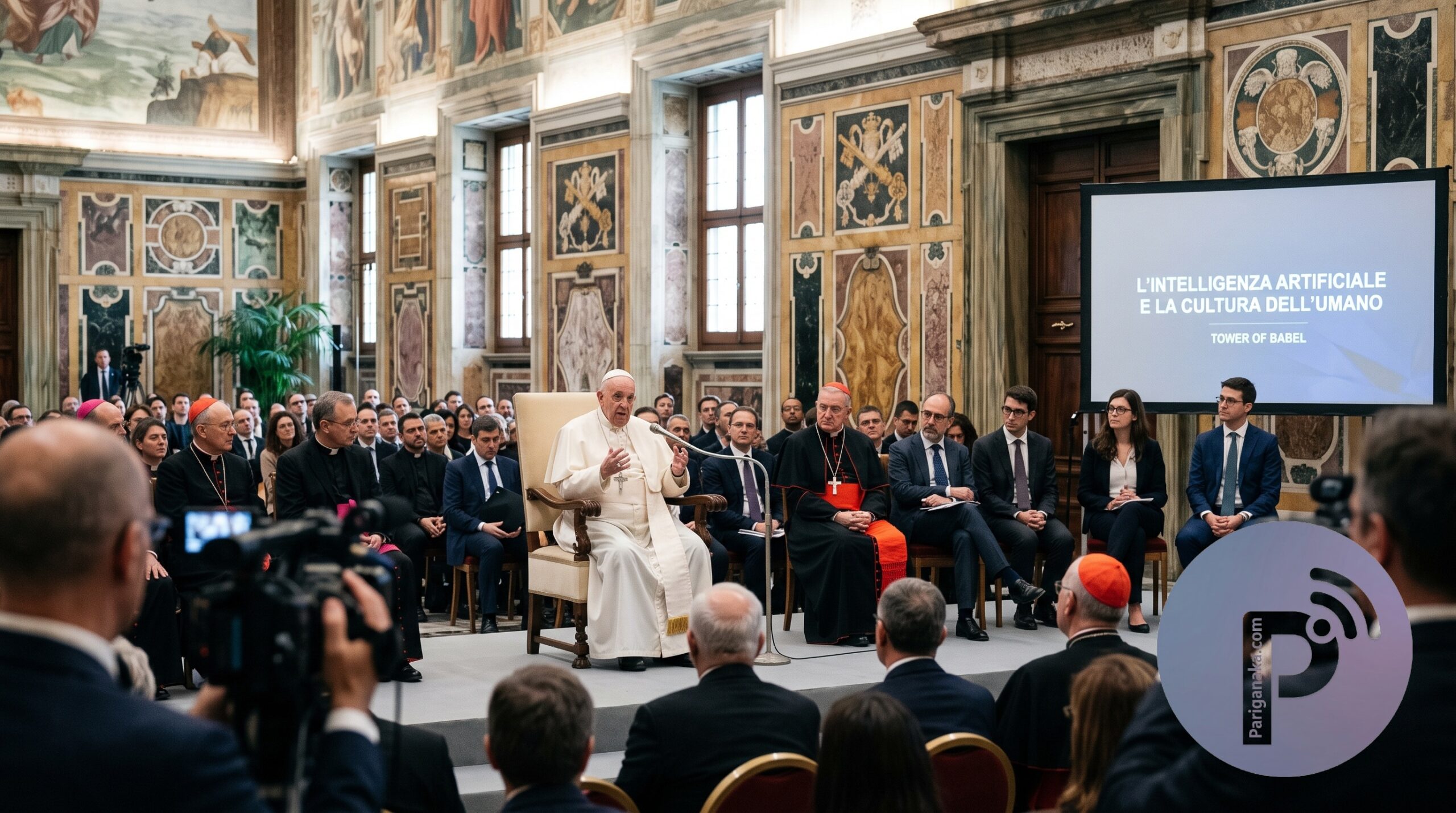
The Vatican, however, is not buying it. Pope Francis—who notably holds a degree in mathematics—has emerged as one of the most outspoken and knowledgeable opponents of AI idolization.
In a recent 40,000-word encyclical, the Pope addressed the AI boom directly, likening it to the biblical Tower of Babel: a destructive manifestation of mankind’s hubris, attempting to assume the prerogatives of God. He dismissed the tech industry’s lofty, altruistic rhetoric, identifying the AI arms race as a “new mindset of extraction done for the idolatry of profit.”
The Pope’s stance is a grounding reminder that AI companies are not charities or higher-order spiritual entities; they are rapacious corporations trying to justify multi-trillion-dollar market valuations by portraying their products as something mystical.
The Real Threat to Humanity
The danger of AI worship isn’t just the birth of fringe digital cults; it is the fundamental misunderstanding of human value.
As Toby Walsh argues, humans have mistakenly convinced themselves that intelligence is our greatest attribute. In reality, our true superpower is our ability to cooperate, build societies, and work together toward common goals. An isolated human is incredibly vulnerable, but a cooperative society can change the planet.
By treating AI as a conscious entity or a god, we risk isolating ourselves further behind screens. The ultimate threat of AI, in this context, is not a Skynet-style robot uprising, but a profound deepening of the social division and isolation already wrought by social media. As we project our humanity onto machines, we risk losing the very connections that actually make us human.
Leave a Reply