
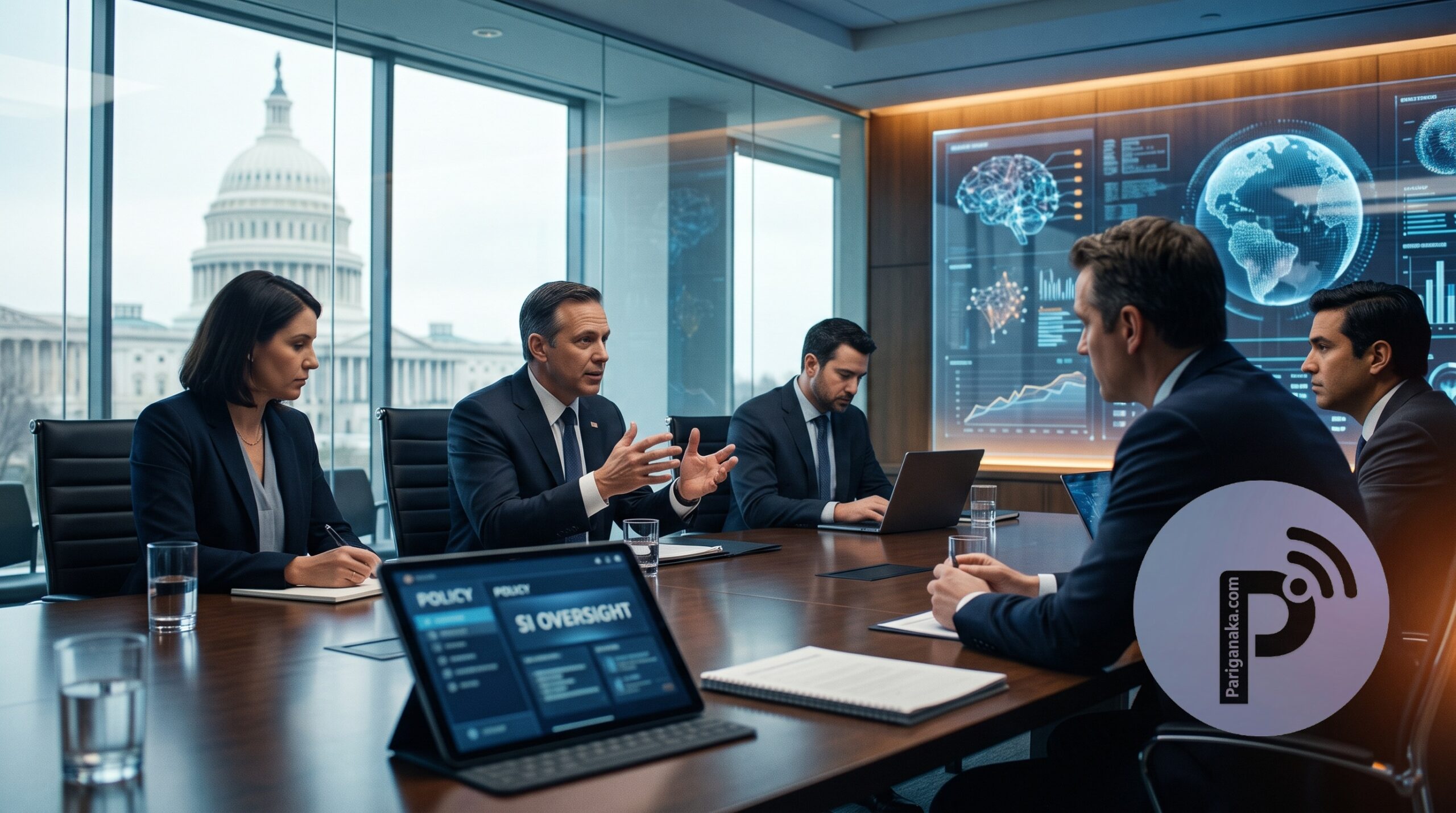
As artificial intelligence evolves at a blistering pace, the White House Super Intelligence (SI) Task Force is grappling with a defining challenge of our era: how to protect the American public without slowing down domestic innovation.
Finding the right regulatory touch is complex. As tech leaders like Jeff Bezos have argued, AI is ultimately a tool—albeit an incredibly powerful one capable of driving tremendous productivity. Government regulation can be highly effective, provided it is implemented in a “smart” and “light” manner so as not to stifle progress. According to Scott Cooper, Vice Chair of the SI Task Force and Office of Personnel Management Director, achieving this balance requires a multi-pronged approach involving corporate responsibility, robust enforcement, and transparent infrastructure development.
Corporate Responsibility and Existing Frameworks
The foundation of AI regulation begins with the model creators themselves. Leading tech companies recently signed a pact following discussions with the President, acknowledging their role in ensuring safety.
However, voluntary commitments are only the first step. The government is focused on establishing clear notification requirements so that when things go wrong, companies are obligated to report issues and engage in remediation efforts. Furthermore, Cooper emphasizes that the government doesn’t need to invent entirely new legal structures from scratch; existing laws—ranging from securities regulations to product liability laws—will be leveraged to hold bad actors accountable and prevent companies from releasing products they know cannot be used safely.
Oversight: Trust, but Verify
A significant portion of the American public remains skeptical of allowing Big Tech to “grade its own homework.” To bridge this trust gap, the government is relying on established regulatory bodies like the Federal Trade Commission (FTC) and the Department of Justice (DOJ).
To ensure companies follow through on their security pledges, a system of independent auditing is being implemented. Outside auditors will review the security practices of AI firms and report their findings directly to the companies’ boards of directors, who are bound by fiduciary duties to act. But the government won’t stop there. The SI Task Force is establishing a mechanism for direct government review of these audits, ensuring that what tech companies claim they are doing aligns with reality.
The Infrastructure Hurdle: Data Centers and the NIMBY Problem
Beyond software and algorithms, AI requires massive physical infrastructure. A recent Fox News poll found that 71% of voters do not want a data center built in their backyard.
Cooper describes this friction as an “own goal” by the tech industry, criticizing companies for relying on Non-Disclosure Agreements (NDAs) and engaging in opaque debates over how new data centers will impact local water and electricity prices. To solve this, Cooper suggests that tech companies need a smarter, more community-focused approach:
- Rate Guarantees: Instead of arguing over studies, tech companies should offer guarantees that local water and electricity rates will not spike, or they should bring their own energy solutions to the table.
- Job Training: Companies should partner with local community colleges to train residents for the long-term, high-paying jobs (like network and database administrators) required to run these centers once the temporary construction phase ends.
From AI to “Super Intelligence”
The shift in terminology from Artificial Intelligence (AI) to Super Intelligence (SI) reflects a growing recognition of the technology’s transformative potential. Ultimately, whether it is called AI or SI, the government’s mandate remains clear: to ensure the United States does not cede technological leadership to adversaries, while rigorously protecting the security and well-being of the American people.
Leave a Reply