
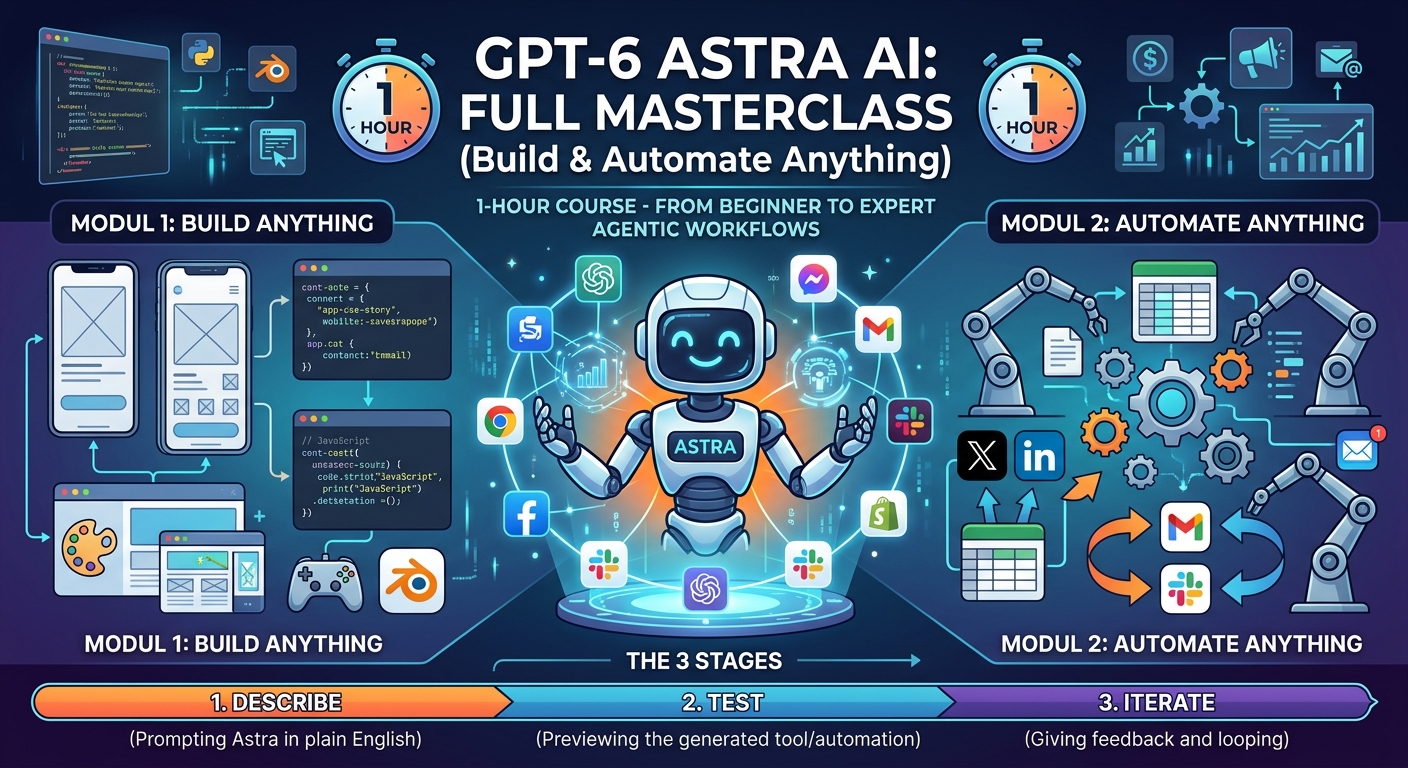
For over 15 years, managing web design, server architectures, and SEO campaigns has required intensive manual oversight. But as we navigate 2026, the artificial intelligence landscape has introduced a seismic shift. GPT-6 Astra is no longer just a chatbot; it is an agentic powerhouse capable of orchestrating complex workflows, controlling desktop environments, and writing full-stack code.
Whether you are generating technical content, designing web interfaces, or exploring the latent space of agentic AI, GPT-6 Astra has completely revolutionized the digital workspace. Based on a recent comprehensive masterclass by Julian Goldie, here is a breakdown of the GPT-6 Astra ecosystem and how you can leverage it to automate practically anything.
1. Accessing GPT-6 Astra: ChatGPT vs. Codex
To integrate GPT-6 Astra into your workflow, you must have an active Plus, Pro, Business, or Enterprise subscription. While it is accessible via the standard ChatGPT web interface, the true power for developers and digital strategists lies in the dedicated desktop application.
Inside the app, users can easily toggle between standard “Chat” mode and a specialized “Codex” mode. For building tools, designing websites, and running deep-level automations, Codex is the preferred environment as it offers a highly controlled, project-oriented workspace dedicated to building rather than just exploring.
2. Next-Gen Web Design and App Development
When it comes to web design, raw text prompts often yield bland, generic layouts that look distinctly AI-generated. To elevate your UI/UX design, you can feed Astra a screenshot of a layout you admire. Alternatively, you can connect Astra directly to open-source GitHub repositories like UIUX Pro Max to train it with advanced design skills.
For those venturing into app development, GPT-6 Astra can code out functional applications—such as a mobile fitness tracker—in a matter of minutes. To take it a step further, Astra can independently integrate backend databases like Superbase, allowing users to securely log in and store customized data without you needing to manually write complex backend authentication logic.
3. Programmatic Video Generation with Remotion
Visual media generation has moved far beyond simple image prompting. Astra acts as the central orchestrator, utilizing tools like ChatGPT Image 2.0 to generate base assets.
The real magic happens when you install Remotion, a free, open-source skill that allows Astra to generate and edit fully animated videos using HTML and code. By plugging in external APIs—like HeyGen—Astra can even create dynamic AI avatar videos complete with voiceovers and B-roll, all generated from a single text prompt.
4. Autonomous “Computer Use”
Perhaps the most striking capability of GPT-6 Astra is its native “Computer Use.” By utilizing the ChatGPT Chrome extension, Astra can effectively take control of your browser to perform tasks exactly like a human.
You can command Astra to navigate to a specific webpage, digest the on-page information, and automatically draft and publish a highly optimized post to community platforms or social media. It navigates buttons and scrolls through pages at blistering speeds, executing workflows much faster than traditional virtual assistants.
5. Cloud Routines and SEO Automation
Running local automations is powerful, but it inherently requires keeping your machine running and the Codex app open. The ultimate solution for digital scale is setting up “Cloud Routines.”
You can instruct Astra to run a recurring routine entirely in the cloud. For example, you can build an automated SEO pipeline where Astra conducts daily strategic research, generates content, and automatically pushes it to your domains via APIs. This transforms a manual SEO strategy into a 24/7 autonomous growth engine that requires zero daily oversight.
6. The Ultimate Setup: Agentic Operating Systems and Memory
To prevent digital sprawl, tool fatigue, and tab overload, power users are consolidating their workflows into unified Agentic Operating Systems like Hermes. In this setup, GPT-6 Astra operates as the core “brain,” seamlessly interacting with local models and customized workflows in one centralized dashboard.
To solve the notorious AI “context window” limitation, you can link Astra to an Obsidian vault—a free, markdown-based memory system. As you work, Astra autonomously updates your Obsidian files, creating a persistent “second brain” that continuously tracks your projects, preferences, and workflows.
The Bottom Line
GPT-6 Astra makes it clear that the future belongs to interconnected, agentic AI workflows. By embracing these modern automation techniques, digital creators and developers can transcend manual bottlenecks and focus their energy entirely on high-level strategy and innovation.
Leave a Reply