
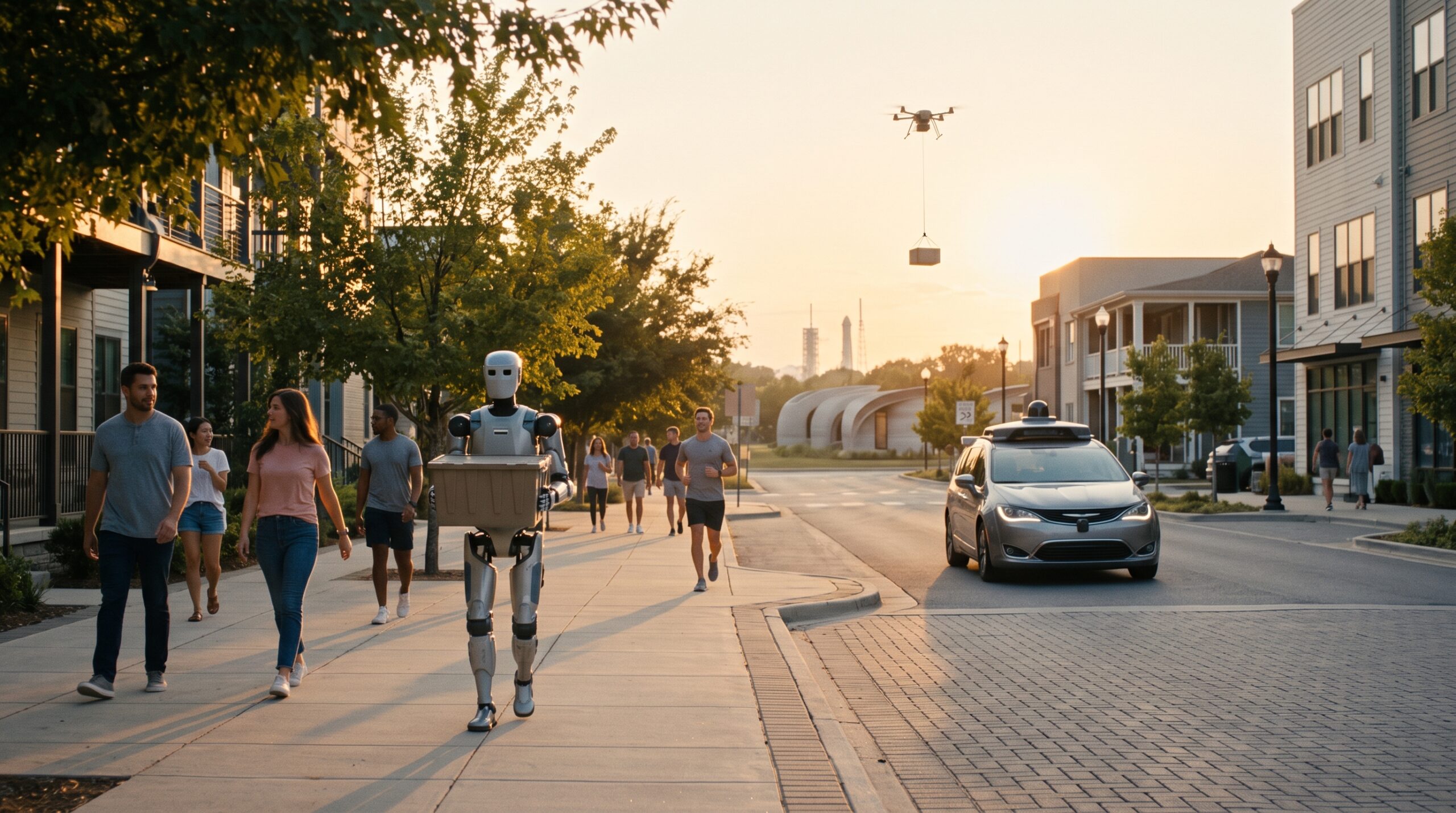
For over 15 years, Pariganaka.com has tracked the evolution of digital information and emerging technology, witnessing everything from the birth of the smartphone to the rise of generative AI. However, the most profound technological shift of our lifetime did not arrive with a single, dramatic announcement. Instead, it is happening quietly across dozens of industries simultaneously, as America builds the most highly automated system in human history.
From the skies to the factory floors, here is an in-depth look at the interconnected network of machines that are rapidly reshaping reality.
1. Reclaiming the Sky and the Streets
The old model of logistics is being completely rewritten. Across more than a dozen states, small, self-flying aircraft are replacing traditional delivery vans. Companies like Zipline have already completed over 1 million deliveries, flying more than 100 million miles to drop off everything from restaurant meals to life-saving defibrillators directly to doorsteps. These drones hover silently hundreds of feet in the air, lowering packages via cable in minutes.
On the ground, autonomous driving has transitioned from a localized test to a full-scale transportation network. Waymo has driven over 100 million fully driverless miles on public roads and now provides more than 250,000 paid rides every single week in major cities like Phoenix, San Francisco, Los Angeles, and Austin. Equipped with LiDAR, radar, and a 13-camera setup providing a 360-degree view, these vehicles react in a fraction of the time it takes a human driver, boasting a significantly better safety record.
2. The Humanoid Workforce
Perhaps the most striking visual of this new era is the deployment of humanoid robots into real-world factories. Unlike traditional factory robots that are bolted to the floor to perform a single repetitive task, humanoids like Figure, Digit, and Apollo are designed to navigate a world built for human bodies.
These machines walk on two legs, climb stairs, and handle dynamic tasks:
- Figure is actively handling sheet metal parts at a BMW plant in South Carolina.
- Digit (by Agility Robotics) is moving bins for shipping companies, supported by a new factory in Oregon capable of producing 10,000 humanoid robots a year.
- Apollo (by Apptronik) can lift 55 pounds and operates with swappable batteries to work virtually non-stop.
The true power of these robots lies in their shared “brain.” Thanks to advanced AI chips and models, if a single robot in a South Carolina warehouse learns a better way to grip a box, that lesson is pushed to the cloud and instantly downloaded by every other robot in the fleet overnight. The entire fleet gets smarter simultaneously.
3. Restructuring Foundational Industries
Automation is radically transforming foundational sectors like construction, agriculture, and medicine:
- Construction: In Texas, a company called Icon is using massive robotic arms to 3D-print entire neighborhoods. The machines lay down layers of concrete to build the walls of a home in under 24 hours, creating structures that are stronger and more energy-efficient than traditional wood framing.
- Agriculture: John Deere has deployed fully self-driving tractors that can plow fields through the night with no human in the cab. Meanwhile, Carbon Robotics has introduced a “laser weeder” that utilizes dozens of cameras and high-powered lasers to identify and eliminate over 100,000 weeds an hour without a single drop of chemical pesticide.
- Medicine: The Da Vinci surgical system has performed over 15 million procedures globally. The technology has advanced to the point where doctors can perform complex surgeries on patients located thousands of miles away, relying on real-time force feedback to literally “feel” the tissue through the machine’s controls.
The Bottom Line
From robotic dogs patrolling nuclear facilities to towering mechanical arms catching a 20-story rocket booster falling from space, the pieces of this automated future are already functioning in the real world.
It is crucial to remember that every single piece of technology mentioned here is currently at its worst version. Today is the clumsiest, slowest, and most expensive these machines will ever be. The drones will only get quieter, the robots will get cheaper, and the collective AI pipeline will grow exponentially smarter. The future didn’t just arrive; it went to work.
Leave a Reply