
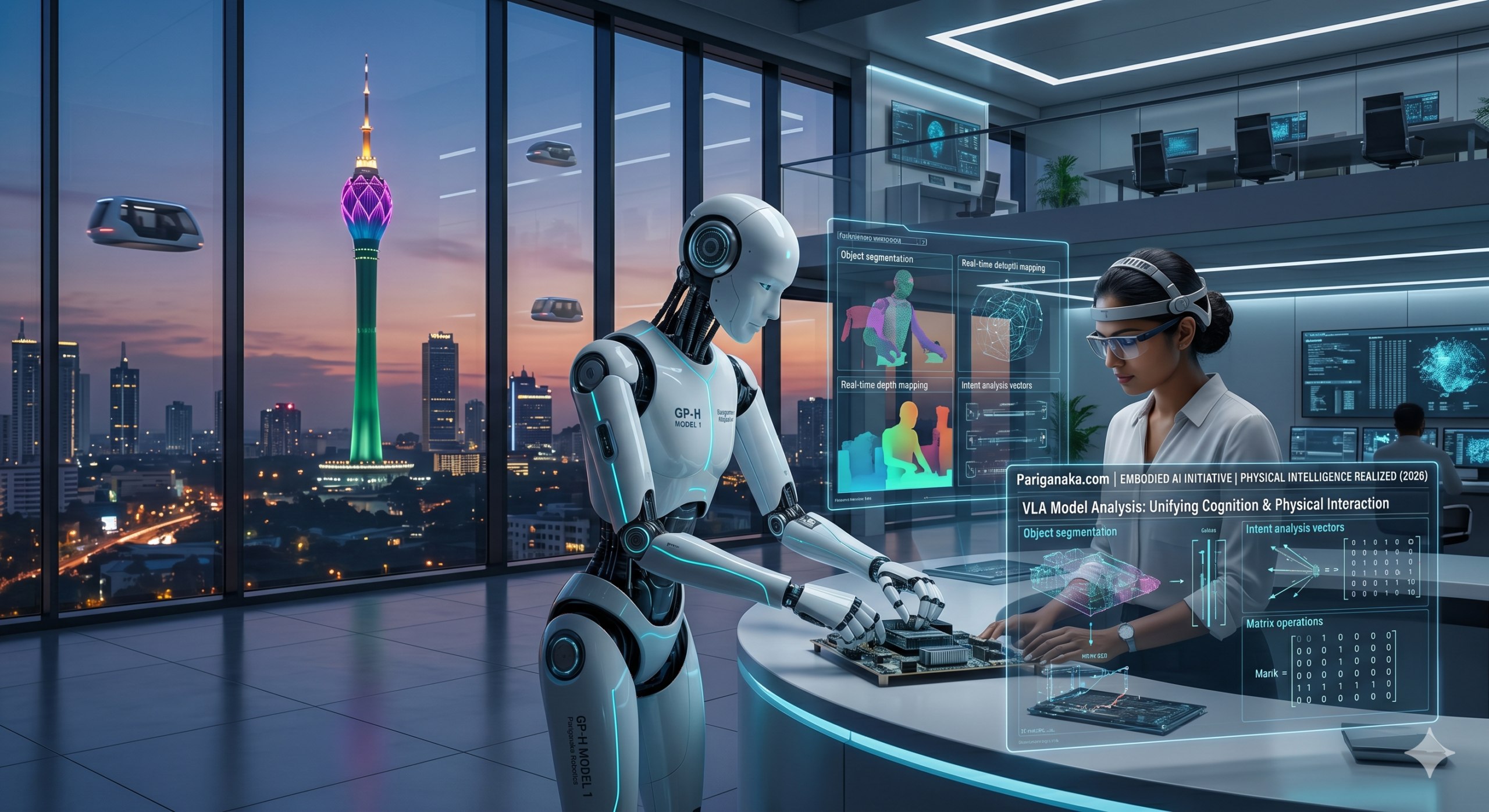
For the first half of this decade, Artificial Intelligence was a disembodied brain trapped behind a glass screen. It could write beautiful poetry, generate photorealistic images, and code complex software, but it could not pour you a cup of coffee or open a door.
In 2026, that limitation has vanished. The tech industry has successfully merged the cognitive reasoning of Large Language Models (LLMs) with advanced robotics. We are no longer just talking to AI; we are watching it walk, grab, and manipulate the physical environment around us.
Welcome to the era of Embodied AI, or Physical Intelligence. For the readers of Pariganaka.com, here is a look at how AI finally grew a body, and why the “General-Purpose Humanoid” is becoming the most disruptive hardware since the smartphone.
1. Vision-Language-Action (VLA) Models
Industrial robots have existed for decades, but they were historically “dumb.” A robotic arm in a car factory was hardcoded to do one specific, repetitive motion. If a screw was dropped a millimeter out of place, the robot would crash. Modern Embodied AI operates completely differently.
- Understanding Physics, Not Just Text: Today’s robots are powered by VLA models. Just as ChatGPT learned grammar by reading millions of books, Embodied AI learns the laws of physics—gravity, friction, and spatial reasoning—by watching millions of hours of video.
- Zero-Shot Execution: You can now tell a robot, “Clean up this messy kitchen.” The robot has never seen your specific kitchen before, but using its onboard cameras and VLA model, it dynamically understands that a sponge is for wiping, a glass is fragile, and the trash goes in the bin. It figures out the how on its own in real-time.
2. The Era of the General-Purpose Humanoid
Why are we building robots that look like humans? Because the entire world is built for humans.
- Human-Centric Environments: Instead of redesigning factories, hospitals, and homes to accommodate specialized robots on wheels or tracks, tech giants in 2026 have perfected the bipedal humanoid. These robots have hands that can use standard human tools, legs that can climb standard human stairs, and torsos that fit through standard human doors.
- The “Software-Defined” Worker: You do not buy a new robot for a new task. You buy one general-purpose humanoid and simply download “skills” into its neural network from a cloud marketplace. Today it might be a warehouse loader; tomorrow, with a software update, it becomes an expert barista or an elderly care assistant.
3. The Sri Lankan Context: “Cobotics” in the Real Economy
The arrival of physical AI is fundamentally reshaping how developing economies like Sri Lanka approach agriculture, manufacturing, and infrastructure.
- Precision Agriculture: In Sri Lanka’s tea estates and agricultural heartlands, specialized quadruped robots (robot dogs) and agile drone swarms are navigating difficult terrains. Guided by Embodied AI, they monitor soil health, selectively harvest ripe produce, and navigate around unpredictable obstacles, solving severe labor shortage issues.
- Collaborative Robotics (Cobots): We are not seeing a complete replacement of the human workforce, but rather the rise of the “Cobot.” In local apparel and manufacturing sectors, human workers are transitioning from manual labor to orchestration. A single human supervisor now oversees a fleet of AI humanoids, handling the creative problem-solving while the robots handle the heavy lifting, dangerous chemical handling, and extreme-heat welding.
Pariganaka.com’s Take: Ten years ago, futurists predicted that AI would automate physical blue-collar jobs first, leaving creative and intellectual white-collar jobs safe for humans. Ironically, the exact opposite happened. AI mastered art, coding, and writing long before it learned how to fold a shirt. But now, in 2026, the AI brain has finally been united with the robotic body. We are entering an age where physical labor is no longer tied to human exertion, fundamentally redefining the value of human effort in the real world.
Leave a Reply