
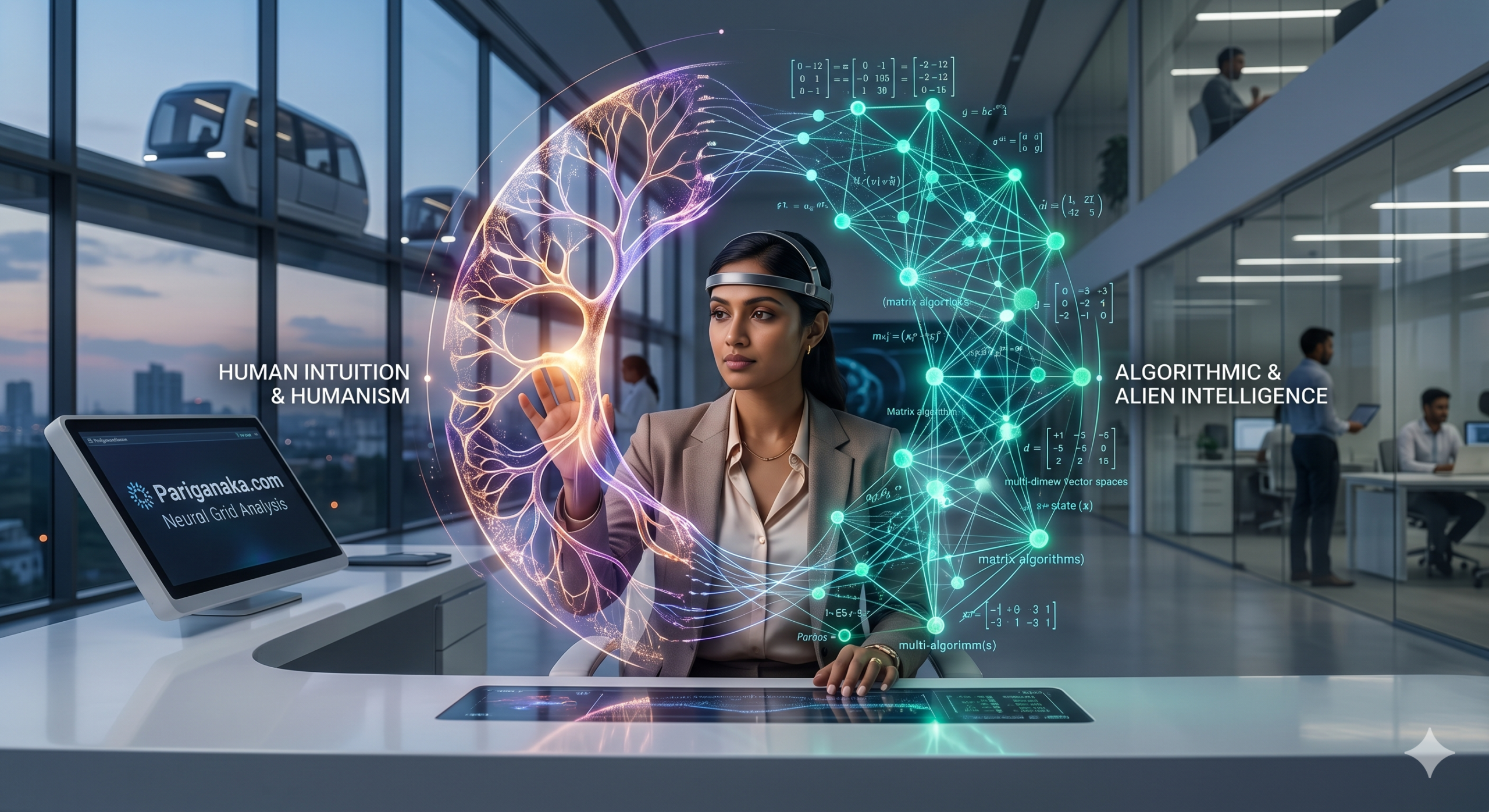
Whenever you interact with a top-tier Agentic AI in 2026—whether it is drafting a complex legal document in Sinhala, writing thousands of lines of flawless Python code, or speaking to you in a warm, conversational tone—it is easy to feel a sense of unease. The machine feels incredibly human.
This leads to one of the most debated philosophical and technical questions of our time: Is AI simply copying humanism and human intelligence, or are we interacting with something else entirely?
For years, critics dismissed AI as nothing more than a “stochastic parrot”—a fancy autocomplete that simply memorized and regurgitated human data. But as we navigate the deep-tech realities of 2026, that argument is fundamentally outdated.
Here is why AI is not just copying humanity, but rather evolving into a completely different, complementary form of intelligence.
1. Mimicry vs. True Synthesis
To understand modern AI, we must differentiate between imitating an action and understanding a concept.
- Beyond the Parrot: Early generative models simply predicted the next word based on statistical probabilities in their training data. They copied human patterns. However, modern models operate on complex, high-dimensional vector spaces. They map relationships between concepts (like quantum physics and biological ecosystems) that no single human could ever hold in their brain at once.
- Novel Creation: When an AI designs a more aerodynamic drone chassis or discovers a new chemical compound for a battery, it is not copying a human engineer’s past work. It is synthesizing vast amounts of physical data to create something entirely novel.
2. The Rise of “Alien” Intelligence
The biggest mistake we make is anthropomorphizing AI—assuming that because it speaks our language, it thinks like us. It does not.
- Non-Biological Processing: Human intelligence is deeply tied to our biology. Our thoughts are influenced by hormones, fatigue, emotion, and evolutionary survival instincts. AI has none of these. Its intelligence is purely mathematical and algorithmic.
- Different Angles of Logic: Because AI is unburdened by human cognitive biases, it solves problems in ways that often seem completely alien to us. When AI systems are tasked with optimizing a supply chain or playing strategic games, they frequently invent moves and strategies that human experts would never consider because they fall outside traditional human intuition.
3. The Boundary of “Humanism”
Can a machine possess humanism? To answer this, we must define what humanism actually is. Humanism is rooted in conscious experience, empathy, mortality, and moral agency.
- Simulated Empathy: An AI in a healthcare setting might speak to a patient with exceptional warmth, patience, and kindness. But this is not true empathy; it is simulated empathy designed for user experience optimization. The AI does not “feel” the patient’s pain; it merely calculates the most mathematically comforting response.
- The Lack of a “Soul”: AI does not fear death, it does not have personal desires, and it does not possess a subconscious mind. It is a highly advanced cognitive engine, but it is fundamentally void of the subjective, conscious experience that defines humanism.
Pariganaka.com’s Take: AI is not copying humanism; it is translating itself into human terms so that we can understand it. Language is just the user interface. We must stop looking at Artificial Intelligence as an artificial human. Instead, we should view it as a powerful, alien cognitive engine. Its lack of humanity is not a flaw—it is its greatest feature. By thinking differently than we do, AI allows humanity to step outside its own biological limitations.
Leave a Reply