
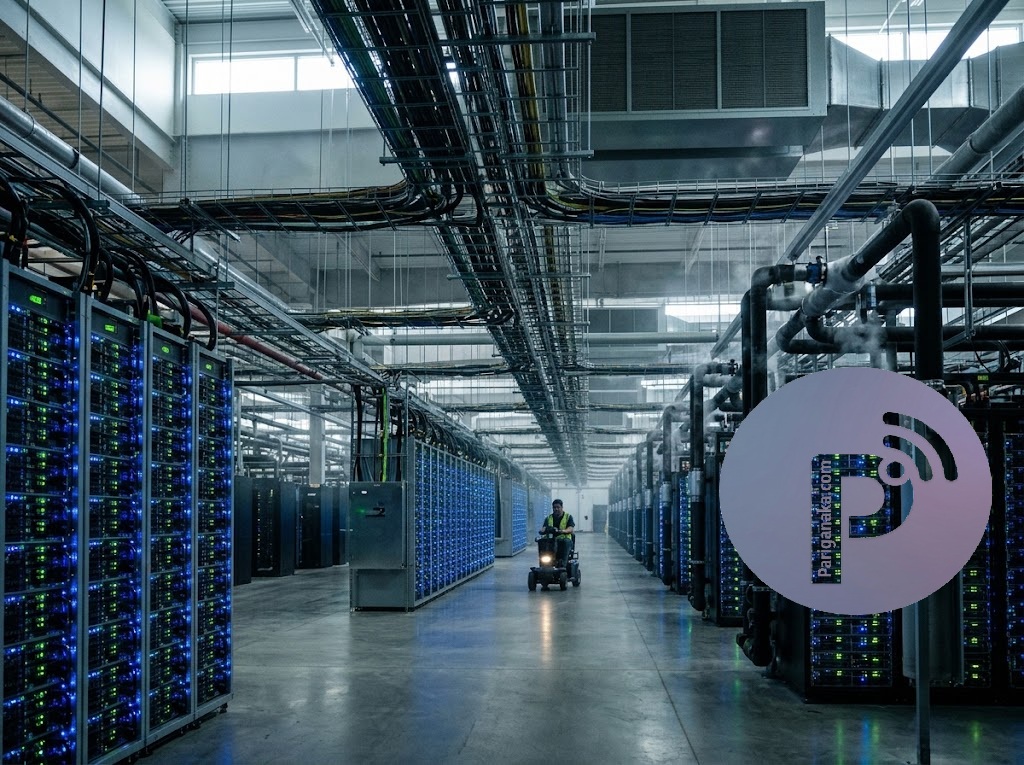
Artificial intelligence feels entirely virtual. We type a prompt, wait a few seconds, and a server in the cloud handles the rest. But the physical reality of AI is an infrastructure boom of unprecedented scale—one that is fundamentally reshaping how the tech industry consumes power and water.
As the demand for generative media skyrockets, the physical backbone of the internet is splitting into two entirely different types of facilities: traditional data centers and specialized AI data centers. Understanding the difference between the two is the key to understanding AI’s true climate cost.
The Two Faces of the Cloud
Not all data centers are built the same.
Traditional Data Centers are the warehouses that have powered our digital lives for the past two decades [02:51]. They handle web hosting, search engines, cloud storage, and video streaming. Inside, they run on Central Processing Units (CPUs)—the “sports cars” of computing that handle tasks quickly but sequentially.
AI Data Centers are entirely different beasts [07:46]. They run on Graphics Processing Units (GPUs), built to process massive amounts of parallel calculations. If a CPU is a sports car, a GPU is a heavy-duty transit bus transporting vast amounts of data simultaneously.
Because of this architectural difference, AI data centers generate substantially more heat and draw vastly more power. While a traditional server rack might draw 5 to 10 kilowatts (kW) of power, a modern AI server rack draws anywhere from 150 to 250 kW, with next-generation racks pushing toward a massive 1 megawatt each [08:20].
The Great Cooling Myth: Does AI Drink Too Much Water?
A common misconception is that the rise of AI will drain local water supplies. The reality is a bit more nuanced.
Traditional data centers are incredibly sensitive to heat. They must be maintained at around 24°C [04:20]. In hot climates, the cheapest way to cool them is through evaporative cooling—essentially sweating [05:27]. Water is sprayed and evaporated to lower the ambient air temperature, consuming millions of gallons of water in places like Texas.
AI data centers, however, can run much hotter. GPUs can safely operate at intake temperatures up to 45°C [08:57]. Because they generate such concentrated heat, AI facilities use closed-loop liquid cooling [11:04]. Water is circulated directly over the chips in a sealed system—much like a household refrigerator. Because the system is closed, the water isn’t evaporated into the atmosphere.
The surprising truth? AI data centers actually consume far less water than traditional data centers.
The Real Crisis is Power
While AI might not be drinking our reservoirs dry, it is devouring the power grid. Tech companies are currently building AI campuses that require 1.2 to 2.5 gigawatts of power—roughly equivalent to the energy consumption of a major city.
Why not just put solar panels on the roof? The power density of an AI data center is so extreme that covering the entire roof in high-efficiency solar panels would only supply about 0.5% of the facility’s energy needs [17:59].
Because regional power grids simply cannot keep up with this demand, AI companies are increasingly seeking out locations with “stranded power”—excess wind or solar energy that can’t easily be transmitted elsewhere [16:18]. When that fails, some are turning to on-site fossil fuel generation, like natural gas turbines, to keep the GPUs humming [16:51].
The “Double Impact” of AI Media
When you ask an AI to generate an image or crunch a massive document, you trigger a chain reaction of energy use:
- Creation: The prompt is sent to an AI data center, where GPUs perform heavy calculations to generate the image or text.
- Storage: If you save that image to the cloud, it is transferred to a traditional data center, where it is backed up across multiple CPU-driven hard drives indefinitely [21:55].
A simple query that saves you five minutes of reading might have an environmental footprint that lingers in the cloud for years.
Time for “Carbon Labels” on Prompts?
Currently, there is no financial cost to the user for running heavy AI prompts, leading to a massive spike in casual, high-compute requests.
Prof. Rabih Bashroush, an expert in digital infrastructure, argues that we need “point of sale” carbon labeling for digital habits [20:32]. Just as nutritional labels empower consumers to make informed choices at the grocery store, AI platforms should display the estimated carbon and energy cost of a prompt before you hit submit.
If users could see the physical cost of generating a cat playing a piano, they might think twice about whether they really need it.
Leave a Reply