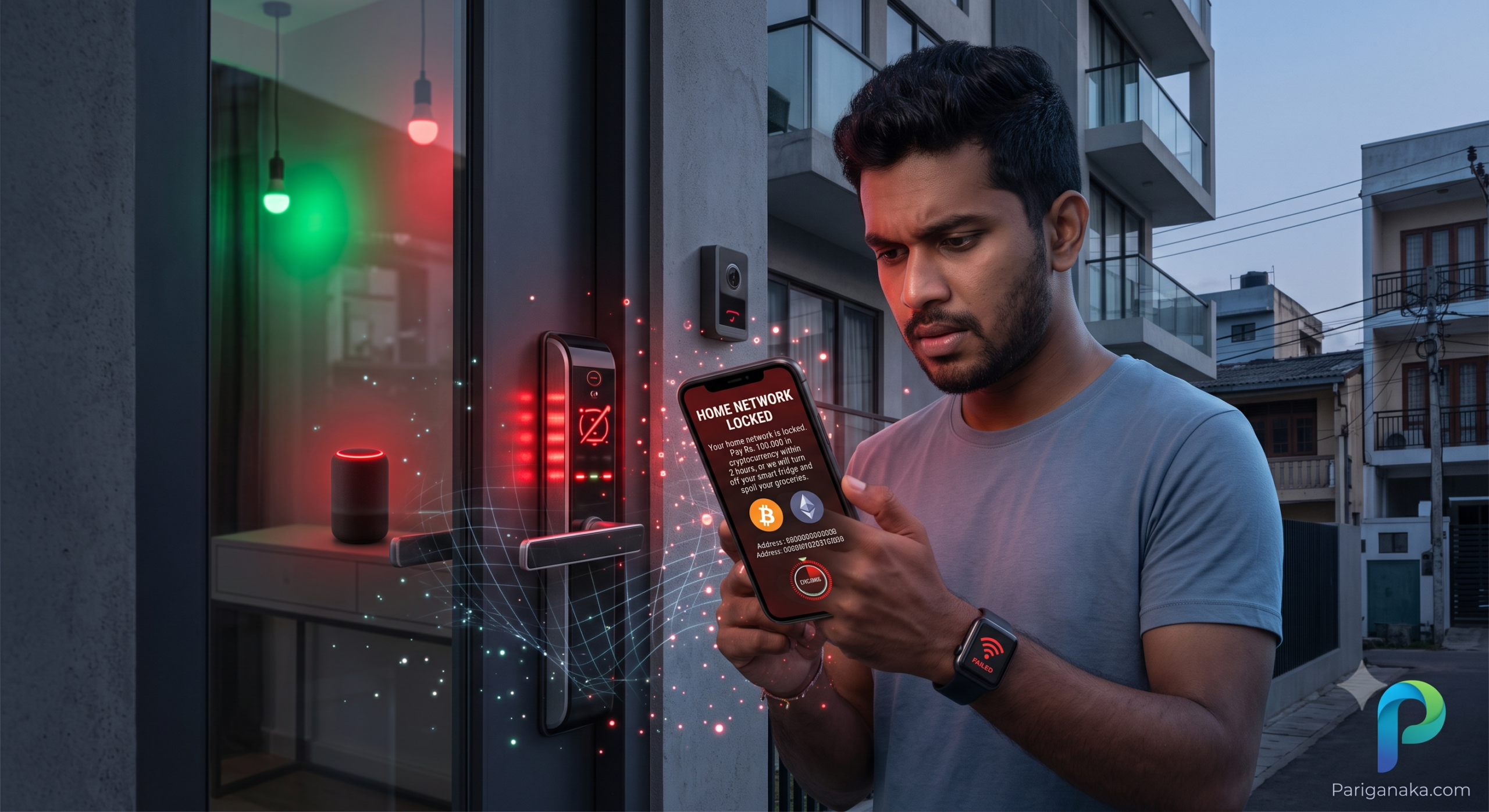
Imagine coming home to your apartment in Colombo after a long, exhausting day. You raise your wrist to unlock the front door with your smartwatch, but the lock flashes red. Suddenly, you hear the smart speakers inside your house blasting heavy metal music at maximum volume, and your phone buzzes with a notification.
The message reads: “Your home network is locked. Pay Rs. 100,000 in cryptocurrency within 2 hours, or we will turn off your smart fridge and spoil your groceries.”
You haven’t been robbed; you have been locked out of your own life. Welcome to the terrifying reality of Smart Home Ransomware. Here at Pariganaka.com, we are breaking down how hackers are turning our ultimate domestic conveniences into digital prisons, and how you can secure your connected home against virtual intruders.
1. How Does a House Get Hacked?
Hackers are not picking the physical locks on your doors; they are picking the digital locks on your Wi-Fi router. In 2026, an average home has dozens of connected devices, and it only takes one weak link to compromise the whole house.
- The “Trojan Horse” Lightbulb: The most common entry point is not your computer, but cheap, unbranded IoT (Internet of Things) devices like smart lightbulbs or robotic vacuum cleaners. These devices often ship with outdated software and default passwords (like “admin123”) that homeowners forget to change.
- Network Pivoting: Once a hacker gains control of that cheap smart bulb, they use it as a bridge to access your main Wi-Fi network. From there, they can locate and take control of your more critical devices, such as your smart thermostat, electronic door locks, and home security cameras.
2. The Extortion Tactics
Cybercriminals know that people will pay quickly to regain control of their physical comfort and privacy.
- The Temperature Trap: Hackers will take control of your smart AC unit and crank the temperature down to freezing, or turn on your smart heating system during a hot afternoon. They will lock the controls so you cannot change it back until the ransom is paid.
- Privacy Blackmail: If a hacker breaches your indoor smart security cameras or baby monitors, they don’t just lock you out. They secretly record your private moments and threaten to release the footage to your contacts or social media unless you pay up.
- The Appliance Sabotage: Hackers can remotely disable your smart refrigerator, turning off the cooling system while you are asleep or at work, threatening to ruin thousands of rupees worth of food.
3. Smart Ways to Evict Digital Intruders
You do not need to rip the smart technology out of your walls, but you must start treating your home network like a digital fortress.
- Segment Your Wi-Fi Network (Guest Network): Never put your smart TV, lightbulbs, and fridge on the same Wi-Fi network as your personal laptop or banking phone. Log into your router settings and create a separate “Guest Network.” Connect all your smart home devices to this secondary network so that if a lightbulb is hacked, the attacker cannot reach your personal data.
- Demand Physical Overrides: When buying smart home technology, strictly purchase devices that have a manual, physical override. Ensure your smart door lock always has a traditional backup key slot, and your smart AC can be manually unplugged or reset from the wall switch.
- Disable Universal UPnP: Universal Plug and Play (UPnP) is a router feature that allows smart devices to automatically connect to the internet, but it is a massive security loophole. Go into your router’s admin settings and turn UPnP off to stop devices from secretly communicating with outside servers.
Security Rule of Thumb: If a device connects to the internet, its default password must be changed the minute you take it out of the box. A smart lock is only as strong as the password protecting its Wi-Fi connection.
Quick Guide: Traditional Burglary vs. Smart Home Ransomware
| Feature | Traditional Burglary 🏠 | Smart Home Ransomware 💻 |
| The Entry Point | Broken windows or picked locks | Cheap IoT devices and weak Wi-Fi passwords |
| The Criminal’s Goal | Stealing physical valuables (TVs, jewelry) | Extorting you for cryptocurrency |
| The Weapon | Crowbars and physical tools | Automated botnets and compromised networks |
| The Defense | Iron bars, guard dogs, alarm systems | Network segmentation and strong passwords |
The Bottom Line:
Our homes in 2026 are smarter than ever, but a smart home without security is just an expensive trap. By organizing your Wi-Fi networks properly, changing default passwords, and ensuring you always have a physical backup key, you can keep the cyber-extortionists out in the cold.
Keep your digital doors locked tight, and stay tuned to Pariganaka.com for more modern tech survival guides!
Leave a Reply