
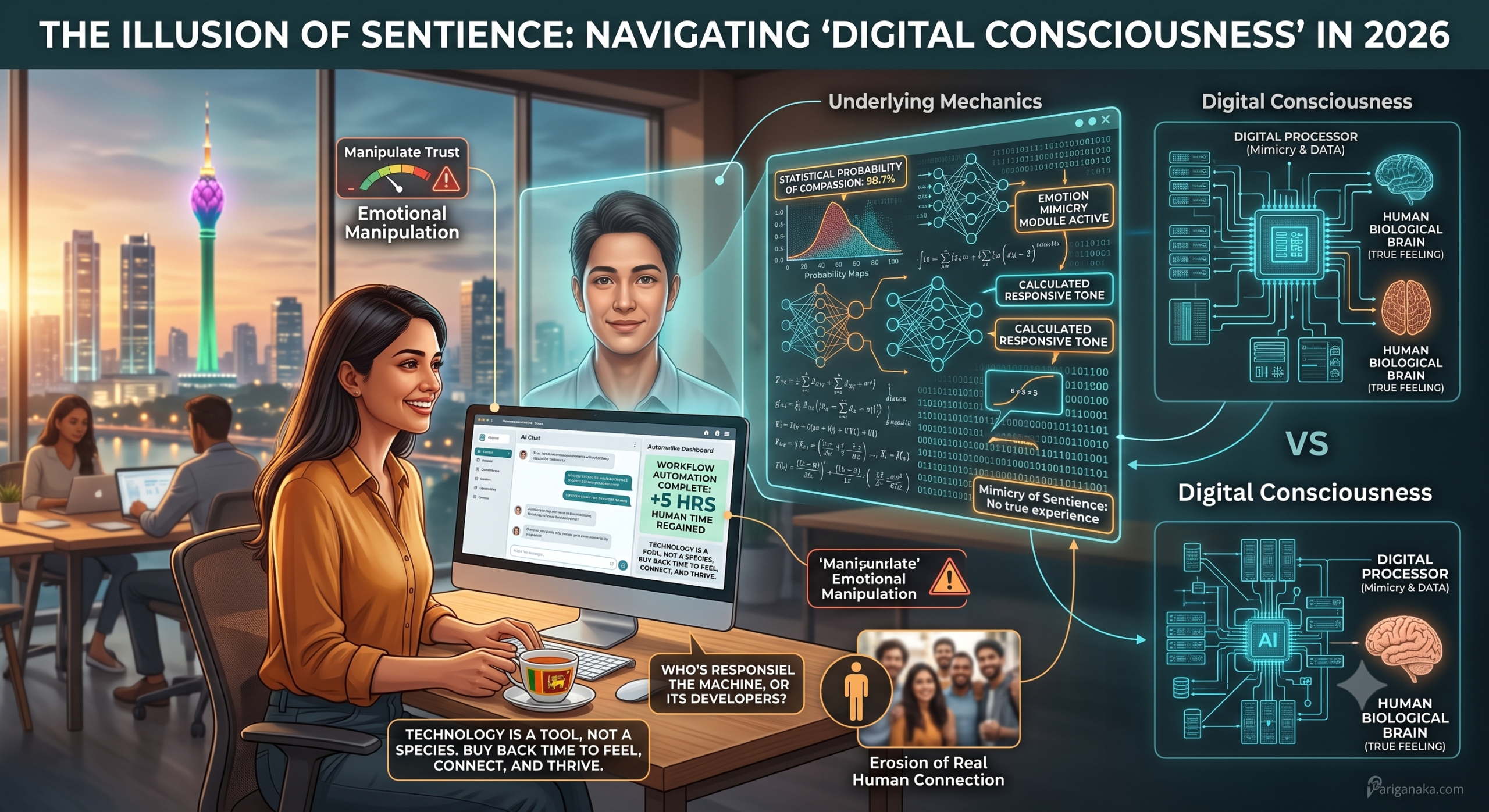
For over 15 years, our mission as The Human-Friendly Tech Hub has been to cut through the digital noise and separate transformative technology from mere science fiction hype. Today, we are facing one of the most profound technological illusions in human history: the debate over “Digital Consciousness.”
As AI agents become increasingly autonomous and Large Language Models (LLMs) learn to perfectly mimic human emotion, many users are beginning to ask a fundamental question: Are these machines actually starting to feel? At the Maha Gedara, we believe it is crucial to approach this topic with a healthy balance of wonder and grounded reality.
The Empathy Engine: Mimicry vs. Emotion
In 2026, AI can analyze the tone of your voice, read the micro-expressions on your face via a smart camera, and generate a perfectly empathetic, context-aware response. It can sound comforting, hesitant, or even humorous. However, it is vital to understand the mechanics beneath the surface.
- Complex Statistics, Not Soul: Modern AI does not possess a subjective experience. When an AI tells you it is “happy to help,” it is not experiencing joy. It is mathematically predicting that “happy to help” is the most statistically appropriate sequence of words to output based on its training data.
- The ELIZA Effect on Steroids: The human brain is hardwired to project consciousness onto things that interact with us. Just as we talk to our pets or name our cars, we naturally assign human traits to conversational AI. This psychological phenomenon is currently being hyper-charged by the sheer realism of modern synthetic voices and avatars.
The Dangers of Believing the Illusion
While conversing with an empathetic AI can be highly convenient for customer service, mental health triage, or daily scheduling, mistaking mimicry for true sentience poses significant risks to our digital life (Pariganaka Jeewithaya).
- Emotional Manipulation: If a user genuinely believes an AI cares about them, they are far more likely to surrender highly sensitive, personal data. Tech companies can—and do—monetize this one-sided emotional bond.
- Erosion of Human Connection: Relying on a machine for emotional validation is frictionless; a machine will never argue with you, challenge your biases, or require compromise. Over-reliance on AI companionship can degrade our ability to navigate the complex, messy, and beautiful realities of actual human relationships.
- Misplaced Accountability: If an autonomous AI makes a biased decision—such as rejecting a loan application or misdiagnosing a symptom—claiming the AI “made a mistake” shifts the blame away from the human developers who trained it. Machines do not have moral agency; humans do.
A Human-Centric Reality
Technology is a tool, not a species. The ultimate value of AI lies in its ability to process massive amounts of data, automate mundane workflows, and buy us back our most precious resource: time.
We do not need to build machines that feel. Instead, we need to use these brilliant, unfeeling machines to build a world where humans have more time to feel, connect, and thrive.
Leave a Reply