
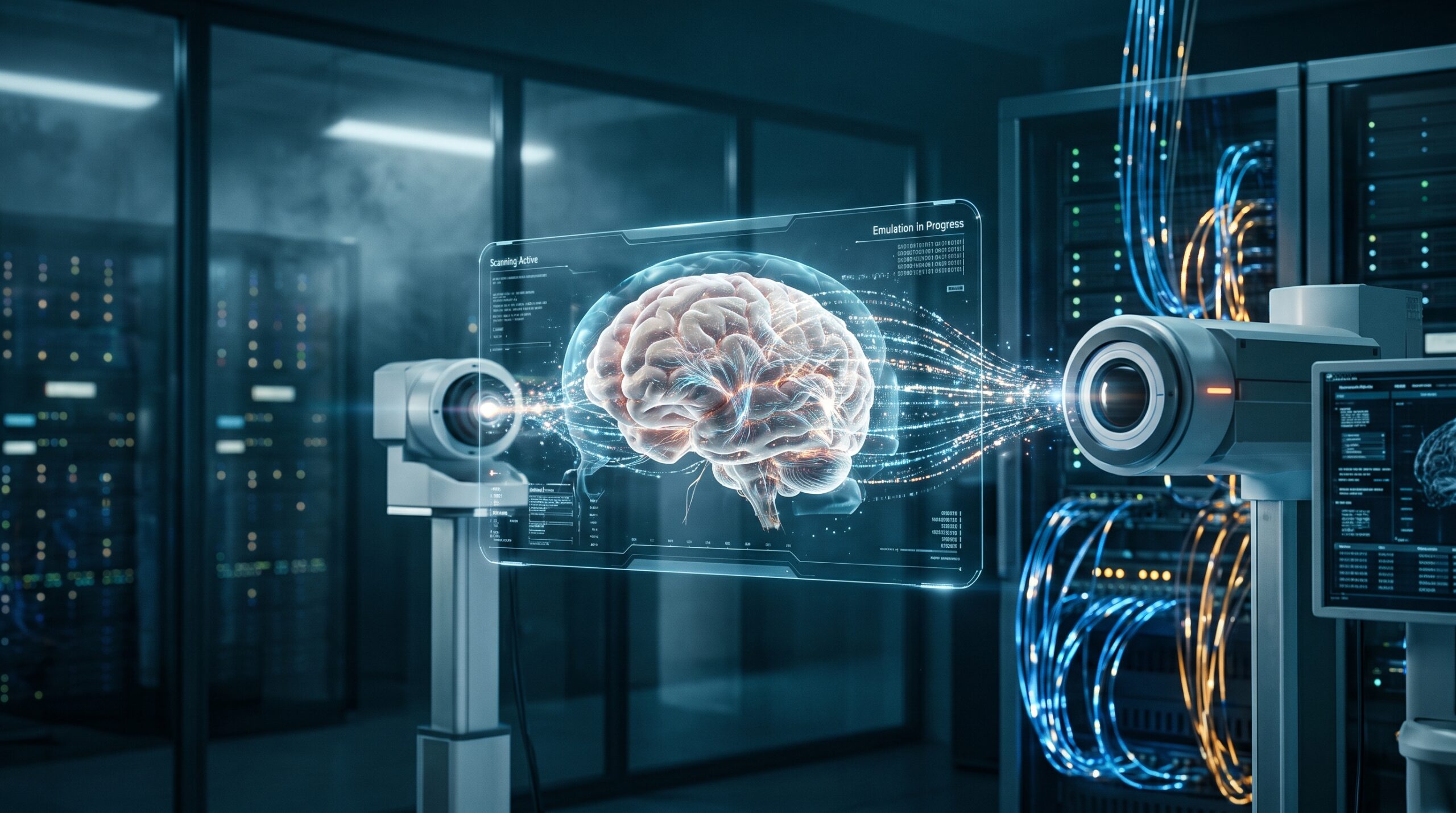
The physical wiring diagram of a brain is called a connectome. For most of the history of neuroscience, we only had one complete map for an animal: the nervous system of the C. elegans worm.
- 1986: Researchers mapped the worm’s 302 neurons by tracing electron microscope images by hand—a process that took over a decade.
- 2008: The Janelia Research Campus set out to map the fruit fly brain (holding over 100,000 neurons). Skeptics thought it was practically impossible, estimating it would take 500 people 10 years of manual tracing just to scale up what was done for the worm.
- The AI Revolution: Google’s connectomics team changed the economics of the field by building “flood-filling networks.” This AI software could automatically trace a single neuron’s path through thousands of microscopic slice images, producing a draft that human experts just had to proofread.
- 2024 & 2026: The FlyWire consortium published the first whole-brain map of an adult female fly (139,255 neurons and 54.5 million synapses). Months later, an even larger map of a male fly’s complete central nervous system was published. For the first time, researchers could trace an unbroken circuit from a sensory organ directly to a muscle command.
The Virtual Fly Comes Alive
In March 2026, Eon Systems took the 2024 fly connectome and actually set it in motion.
They placed the static map inside a brain model that treated each neuron as a simple switch. Then, they hooked that brain up to a virtual biomechanical body (the “NeuroMech fly”) running inside a physics engine.
The result: When virtual dust collected on the fly, it stopped and rubbed its front legs over its head to clean itself. When its virtual foot touched a piece of food, the taste neurons fired, the electrical activity propagated purely through the mapped wiring into the feeding circuit, and the fly extended its mouthparts to eat.
No software code explicitly told the fly that “sugar means eat”—the behavior emerged entirely from the physical wiring diagram of the original animal.
The Limits of the Wiring Diagram
While the virtual fly is an incredible achievement, neuroscientists are quick to point out what is missing. A perfect map of the wiring is just a blueprint. It lacks:
- Learning and Memory: The virtual fly has no history. If you show it the same food 100 times, the 100th encounter looks exactly like the first. It cannot learn to associate a smell with a reward.
- Chemical States: A real hungry fly will take risks that a well-fed fly won’t. The connectome doesn’t record hormonal changes or the exact strength of synaptic connections at a given moment.
- Neuromodulators: As neuroscience pioneer Eve Marder has proven, a circuit of the exact same neurons connected the exact same way can produce wildly different outputs depending on the chemical “soup” bathing them.
Because of this, Eon’s fly relies on existing controllers programmed into the virtual body for complex tasks like walking—the brain’s job is simply to “nudge” those controllers with a few signals, rather than generating the entire gait from scratch.
The Zettabyte Wall: Scaling to Humans
If mapping a pinhead-sized fly brain was this hard, how far are we from uploading a human?
A human brain contains roughly 86 billion neurons. Recently, a team from Harvard and Google mapped a single cubic millimeter of human cortex (about half the size of a grain of rice). It contained 57,000 cells, 150 million synapses, and generated 1.4 petabytes (1.4 million gigabytes) of data.
Scaling that up to a full human brain would generate an estimated 1.7 zettabytes of data. We currently do not have the storage capacity, let alone the computing power, to run a simulation of that scale.
The Destructive Catch
Even if the technology eventually scales, whole brain emulation faces a horrifying catch: the mapping process is completely destructive.
To map the fly’s brain, it had to be preserved, stained, sliced into extremely thin pieces, and imaged. The physical brain does not survive the process.
If this were ever applied to a human, it would begin with the ultimate sacrifice. The original brain is destroyed to create the map. If the digital copy wakes up in a machine, perfectly remembering your childhood, feeling like it just woke from a nap, and completely certain that it is you—the original “you” who went into the scanner is already dead.
This moves mind-uploading from a theoretical thought experiment into a very real test of consciousness: Is that digital copy living forever, or did you die while a stranger with your memories carries on?
Leave a Reply