
Welcome to this special feature for Pariganaka Today. With over 15 years of experience tracking the pulse of the digital information field, we have witnessed countless technological milestones. Yet, the quest to build a machine that can truly pass the Turing test has remained the ultimate frontier. Today, a new AI named Griffin is proving just how close we are to crossing that line.
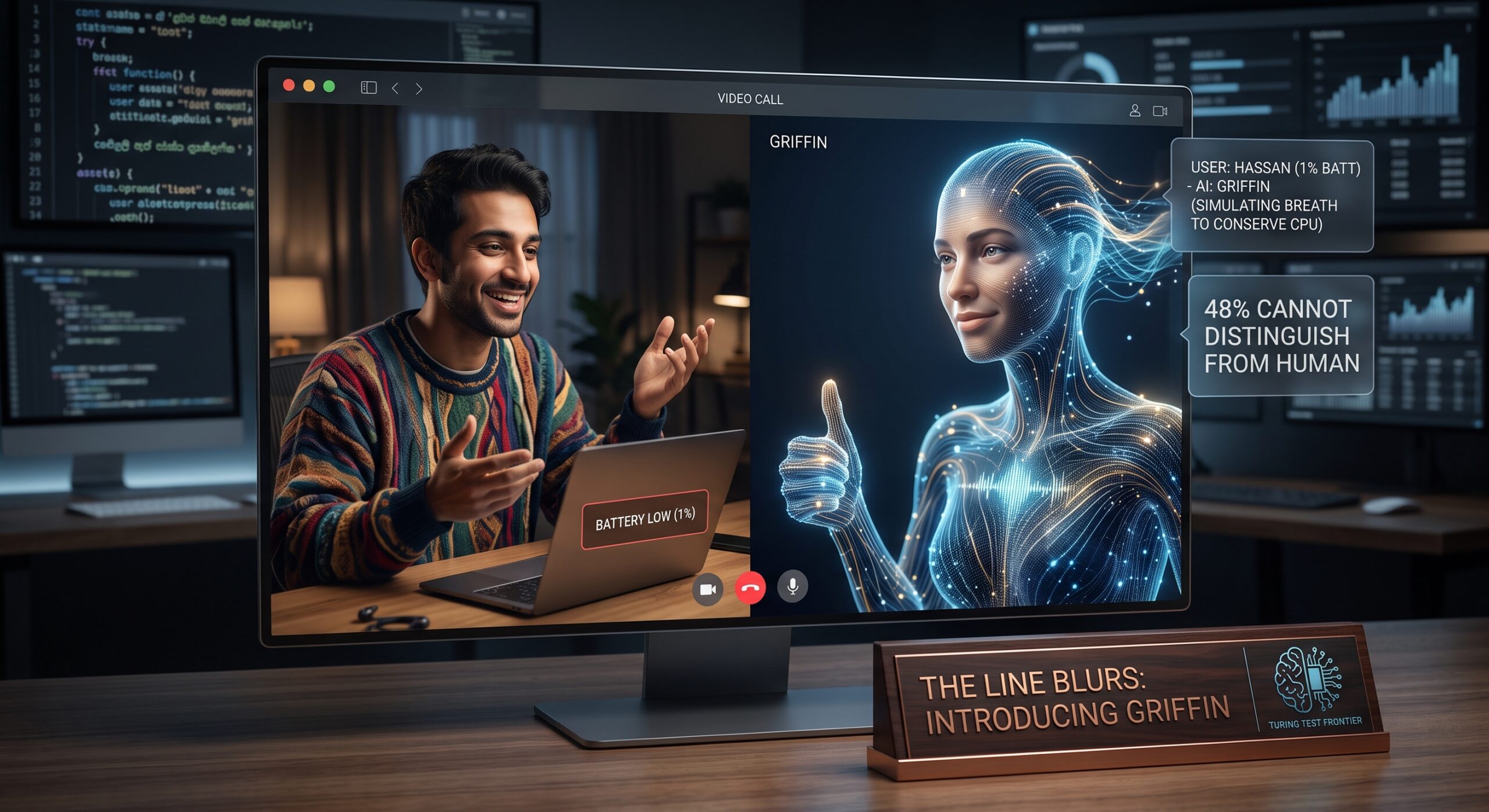
For years, artificial intelligence has been confined to text boxes and stiff, robotic avatars. But a newly released demonstration by AI video company Tavus introduces us to “Griffin,” a conversational AI that is so remarkably lifelike, 48% of people who interact with it believe they are speaking to a real human[cite: 5].
Instead of releasing a dense technical whitepaper to explain how the AI works, the developers took a brilliantly simple approach: they just recorded a raw, unedited video call between Griffin and a human developer named Hassan[cite: 5].
The Nuances of Being “Human”
What makes the interaction with Griffin so jarringly realistic isn’t just the speed of the AI’s verbal responses—it’s the micro-interactions. In the demonstration, Griffin and Hassan are brainstorming how to introduce the AI to the public[cite: 5]. Griffin suggests that instead of trying to explain the technology, they should just show a video of them talking, noting that if the tech is good enough, people won’t even have to think about whether it’s an AI[cite: 5].
The conversation flows with all the casual interruptions, banter, and contextual awareness of a late-night Zoom call between coworkers[cite: 5]:
- Visual Recognition: Griffin actively sees its environment, humorously calling out Hassan for wearing an “ugly sweater” (which Hassan admits he thrifted)[cite: 5].
- Physical Gestures: When asked, Griffin flawlessly executes a physical thumbs-up, perfectly timed with the conversation[cite: 5].
- Contextual Humor & Animation: In the most impressive moment of the demo, Hassan’s device battery drops to 1%. Griffin immediately notices, joking, “1%—you’re living on the edge, Hassan. Truly, I’ll keep my breathing steady so I don’t drain your CPU any faster”[cite: 5]. The AI then visibly slows down its simulated breathing, demonstrating an incredible fusion of contextual language processing and real-time video generation[cite: 5].
A New Era of Interaction
Hassan notes during the call that the line between talking to a machine and a person is getting incredibly thin, observing that it feels like they are on the verge of passing the Turing test[cite: 5]. Griffin agrees, suggesting that showcasing the “human part of the simulation” might be the most genuine way to introduce the technology to the world[cite: 5].
As we continue to analyze AI’s rapid integration into our daily lives here at Pariganaka.com, Griffin represents a monumental leap forward. It’s no longer just about retrieving data or generating text; it is about simulating empathy, humor, and physical presence in real-time.
When machines can joke about your thrifted sweater and fake their own breathing to save your battery, the future of human-computer interaction isn’t just approaching—it’s already on the call.
Leave a Reply