
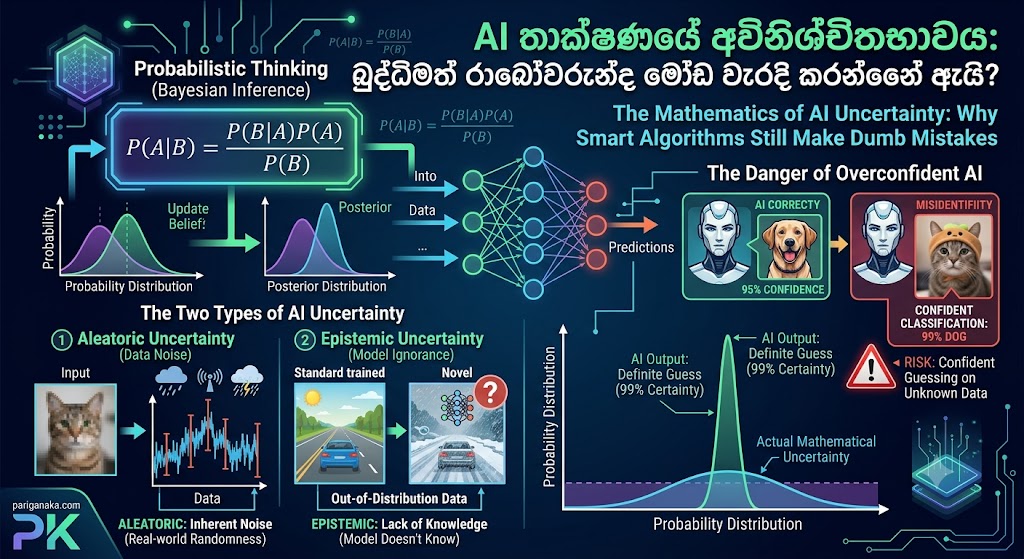
Welcome back to Pariganaka.com! Today, we trust Artificial Intelligence to drive our cars, diagnose our medical scans, and even predict global market shifts. Yet, every so often, an advanced AI system will confidently make an incredibly stupid mistake—like a chatbot hallucinating a legal case that doesn’t exist, or a self-driving car mistaking a stop sign for a speed limit sign.
Why does this happen? The answer lies not in a software bug, but in the mathematical foundations of the algorithms themselves. Today, we are looking under the hood to explore the mathematics of AI uncertainty, and why teaching a machine to “doubt itself” is the hardest challenge in modern computer science.
The AI Paradox: Thinking in Probabilities, Not Certainties
Humans tend to view the world in definitive terms: something is either True or False. AI does not see the world this way. To an AI, the world is a massive mathematical landscape built on Probability Theory.
When a neural network looks at an image of a dog, it doesn’t definitively “know” it is a dog. Instead, it calculates a mathematical distribution: There is an 85% probability this is a dog, a 10% probability it is a wolf, and a 5% probability it is a fluffy cat. The fundamental framework used to calculate this is Bayesian Inference (based on Bayes’ Theorem, formulated as $P(A\vert{}B) = \frac{P(B\vert{}A)P(A)}{P(B)}$). This allows the AI to update its probability estimates as new evidence emerges. However, when the AI is forced to give you a single, definitive answer, it often simply outputs the highest percentage and hides the rest. This creates an illusion of absolute certainty, masking the mathematical doubt happening behind the scenes.
The Two Types of AI Uncertainty
To mathematically fix AI mistakes, data scientists divide uncertainty into two distinct categories:
- Aleatoric Uncertainty (Data Uncertainty): This represents the inherent randomness in the real world. Think of flipping a coin or an AI trying to recognize a voice in a noisy, crowded room. No matter how smart the AI is, the data itself is messy, noisy, or incomplete. You cannot eliminate Aleatoric uncertainty; the algorithm just has to learn to navigate it.
- Epistemic Uncertainty (Model Uncertainty): This happens when the AI simply hasn’t learned enough yet. If you train a self-driving AI solely on sunny highways, and then drop it in a severe Sri Lankan monsoon, the AI will fail. It lacks the mathematical knowledge (the parameters) to understand the new environment. Unlike Aleatoric uncertainty, Epistemic uncertainty can be reduced by feeding the AI more targeted training data.
The Danger of “Overconfident” AI
The biggest flaw in modern Deep Learning—a flaw highlighted by recent studies from mathematicians at institutions like Cambridge and Oslo—is that AI systems are terrible at calculating their own Epistemic uncertainty. In other words, AI doesn’t know what it doesn’t know.
When an AI encounters a completely bizarre situation it has never seen before in its training data, instead of mathematically waving a red flag and saying, “I am highly uncertain about this,” it will often guess blindly while assigning itself a 99% confidence score. In the tech industry, this mathematical instability is a primary driver of “AI Hallucinations.” When an AI confidently gives you a fake historical fact, it is because its underlying probability math failed to measure its own ignorance.
The Future: Building AI That Can Say “I Don’t Know”
As we deploy AI into high-risk areas like autonomous driving and robotic surgery in 2026, tech companies are desperately trying to solve this mathematical paradox.
The next big leap is Uncertainty Quantification (UQ). New mathematical frameworks, such as Bayesian Neural Networks, are being designed not just to generate an answer, but to output a transparent “confidence interval.” In the near future, instead of an autonomous system guessing what a blurry object on the road is, its internal math will recognize its own uncertainty and safely hand control back to a human operator.
The ultimate goal of AI mathematics is no longer just making machines smarter; it is making them wise enough to doubt themselves.
Leave a Reply