
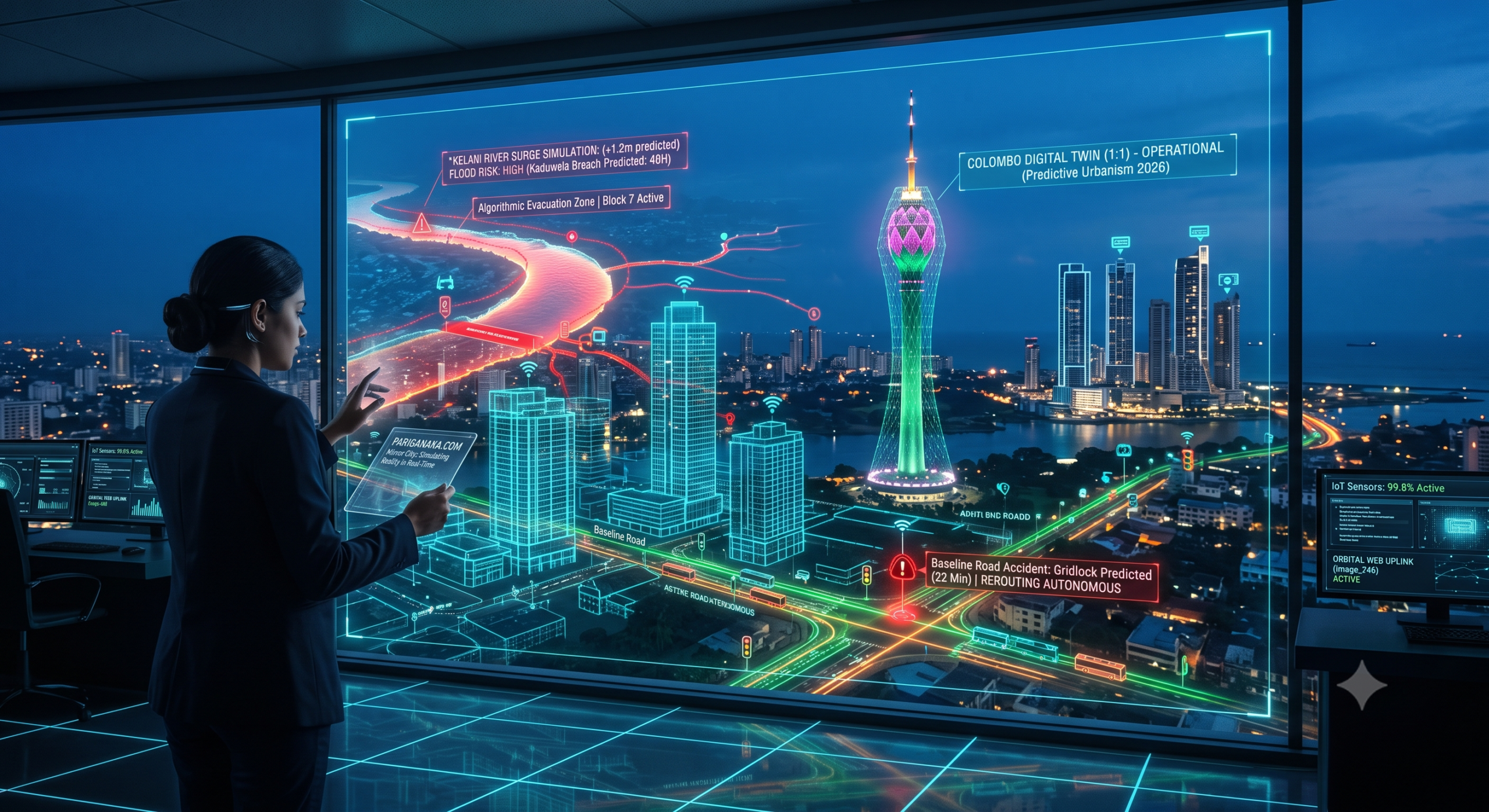
For centuries, urban planning was a game of educated guessing. If a government built a new highway, they had to wait five years to see if it actually reduced traffic or just created a new bottleneck. If they built a flood wall, they had to wait for a monsoon to see if it held.
In 2026, we no longer guess. We simulate. Over the past three years, a quiet but monumental engineering feat has been completed: the creation of a 1:1 Digital Twin of the entire Western Province.
Welcome to the era of Predictive Urbanism. For the readers of Pariganaka.com, here is a deep dive into how the physical streets of Colombo are now permanently tethered to a digital matrix, and how algorithms are managing our reality seconds before it actually happens.
1. The Sensor-Stitched Metropolis
A Digital Twin is not just a 3D map like Google Earth; it is a living, breathing mathematical simulation that updates in milliseconds. To build this mirror city, the physical world had to be stitched with millions of sensory data points.
- The IoT Nervous System: Every traffic light, water pipeline, power grid substation, and public transport bus in Colombo is now embedded with 5G telemetry sensors. They constantly stream data regarding water pressure, electricity load, air quality, and vehicle density to a centralized quantum-assisted cloud.
- Autonomous LiDAR Sweeps: Every night, automated drone swarms launch from the Port City, sweeping the metropolitan area with high-resolution LiDAR. They map new construction, pothole formations, and even coastal erosion down to the millimeter, ensuring the digital twin perfectly reflects the physical world by morning.
2. Time-Traveling with City Data
The true power of a Digital Twin is not just seeing what is happening now, but simulating what will happen. City administrators use the twin as a hyper-advanced sandbox to run complex generative scenarios.
- Traffic “Pre-Routing”: The twin doesn’t just monitor traffic jams; it predicts them. If the simulation detects that an accident on Baseline Road will cause gridlock in 20 minutes, the city’s AI autonomously alters the timing of traffic lights in surrounding suburbs and pushes alternative routes to drivers’ dashboards before the congestion physically forms.
- Grid Load Balancing: During peak heat waves, the digital twin simulates the thermal load on the national grid. It can predict exactly which transformers in Dehiwala or Nugegoda are at risk of overheating and autonomously reroute power distribution to prevent localized blackouts.
3. The Sri Lankan Context: Preventing the Kelani River Crisis
The absolute necessity of the Colombo Digital Twin was proven during the unprecedented Southwest Monsoon anomalies earlier this year.
- Simulating the Surge: When meteorological satellites detected an abnormal low-pressure system, the digital twin ran 10,000 distinct flood simulations in a matter of seconds. It accurately predicted that the Kelani River would breach its banks at three highly specific vulnerabilities near Kaduwela, leading to catastrophic urban flooding.
- Algorithmic Evacuation: Because the simulation predicted the exact water flow paths 48 hours in advance, the Disaster Management Centre didn’t have to issue a blanket panic warning. Instead, they sent targeted, block-by-block evacuation alerts directly to the smartphones of citizens only in the simulated inundation zones, while pre-deploying autonomous sandbagging rovers to the precise weak points. The simulation saved billions of rupees and, more importantly, countless lives.
Pariganaka.com’s Take: The Digital Twin is a masterpiece of modern civic engineering, turning unpredictable urban chaos into a controllable mathematical equation. However, this level of optimization comes with the ultimate privacy trade-off. A city that can measure everything is a city that is constantly watching everyone. If the algorithm knows the exact flow of pedestrians, the precise consumption of water in your home, and the real-time location of every vehicle, we are no longer just citizens; we are data points in a master simulation. We have conquered the unpredictability of nature, but we have built the ultimate panopticon to do it.
Leave a Reply