
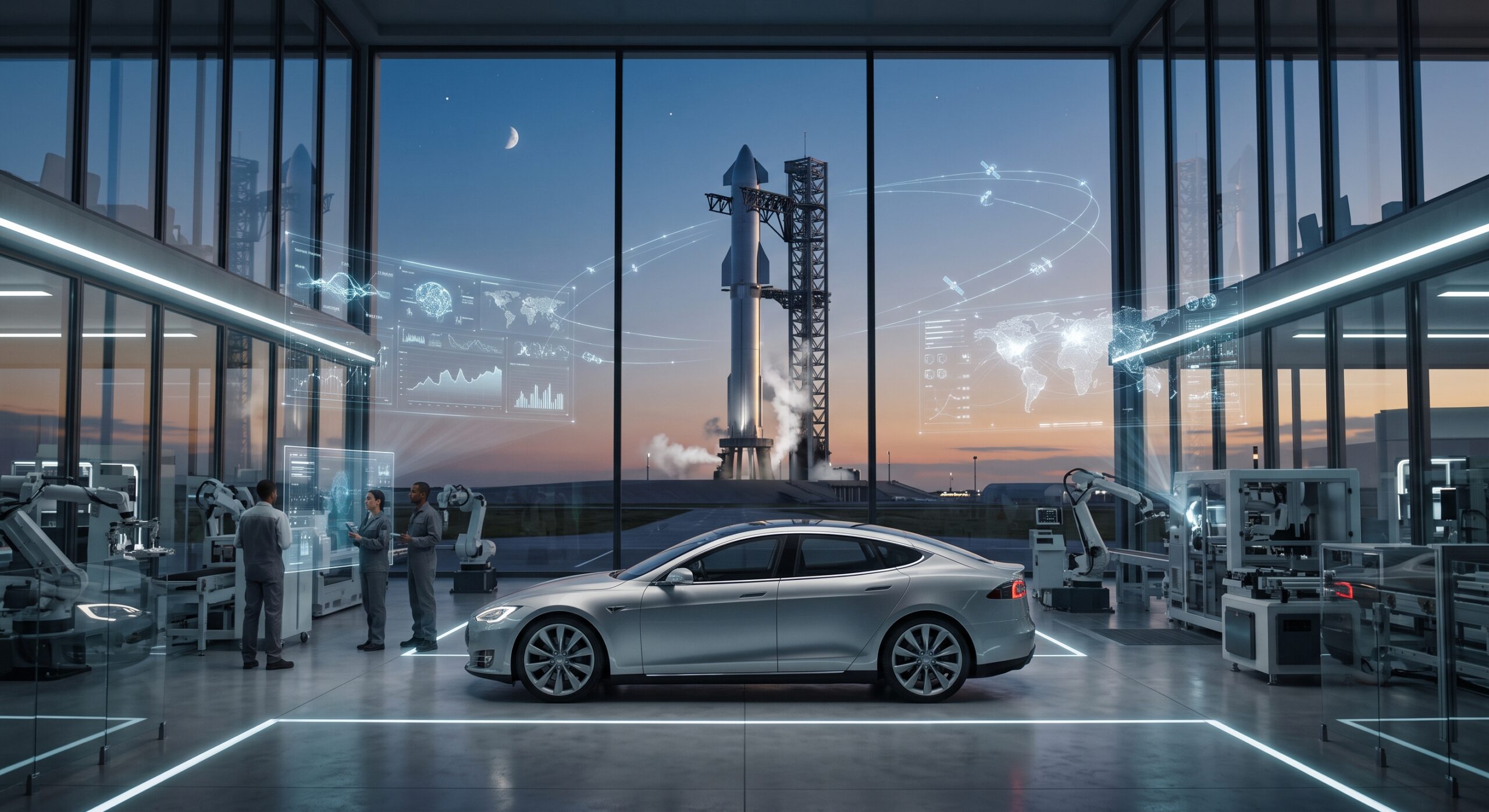
Elon Musk’s portfolio of companies is often viewed as a collection of isolated, futuristic bets, but the reality is a highly interconnected web of capital, manufacturing, technology, and personnel[cite: 6]. Known as the “Muskonomy,” this empire relies on the successes of one venture to fund and enable the next, weaving together software, rockets, electric vehicles, and artificial intelligence[cite: 6].
The Foundation: Software Exits and Capital
The origins of Musk’s physical manufacturing empire began in software[cite: 6]. His early ventures included Zip2, a local business listing service sold to Compaq in 1999, and X.com, which eventually became PayPal and was sold to eBay for $1.5 billion in 2002[cite: 6]. While Musk was replaced as CEO before PayPal’s final exit, his large equity stake provided him with substantial personal capital[cite: 6]. More importantly, these successes gave him the crucial credibility needed to recruit top-tier engineers for his subsequent, high-risk ventures[cite: 6].
SpaceX: From Surviving to Scaling
Founded in 2002, SpaceX was built on the goal of making spaceflight cheaper by questioning traditional aerospace assumptions—a method Musk refers to as “first principles” thinking[cite: 6].
- The Turning Point: After three consecutive failures, the Falcon 1 rocket successfully reached orbit in September 2008[cite: 6].
- The NASA Lifeline: A $1.6 billion contract from NASA in 2008 to fly cargo missions to the space station provided SpaceX with milestone-based funding, a credible order book, and institutional trust[cite: 6].
- Reusability and Starlink: By landing and reusing the Falcon 9’s first stage, SpaceX drastically lowered the cost of launches[cite: 6]. This high flight rate enabled the creation of Starlink, a low-orbit satellite internet network[cite: 6].
- The Financial Engine: By mid-2026, Starlink boasted roughly 12 million subscribers paying an average of $66 a month[cite: 6]. In the second quarter of 2026 alone, Starlink generated $4.3 billion in revenue and $1.7 billion in operating profit, effectively subsidizing the hardware-heavy space segment[cite: 6].
Tesla: Manufacturing Reality and Future Bets
Musk joined Tesla in 2004, taking on the brutal reality of physical vehicle manufacturing[cite: 6]. The company struggled severely during the production ramp-up of the mass-market Model 3[cite: 6]. Tesla had to walk back its ambitious automation plans, pulling out robots in favor of manual processes to clear production bottlenecks[cite: 6].
While Tesla’s vehicle deliveries slightly declined in 2025, its energy storage business has become a quiet powerhouse, deploying 46.7 gigawatt-hours of massive battery packs to utility companies in 2025 (a 49% increase)[cite: 6]. Today, Tesla’s massive market valuation is not tied to its slim automotive operating margins (which hovered around 1.4% in early 2026), but rather to its future bets on autonomy and robotics[cite: 6]:
- Cyber Cab: Tesla’s robo-taxi service, running without steering wheels, launched paid rides in Austin in September 2026[cite: 6].
- Optimus: A humanoid robot designed to navigate environments built for human bodies, which Musk expects to drive most of Tesla’s future value[cite: 6].
The AI Integration: xAI and the Big Merger
In February 2026, a massive restructuring merged SpaceX with xAI (the AI lab behind the Grock chatbot) and the social network X[cite: 6]. This all-stock deal valued SpaceX at $1 trillion and xAI at $250 billion[cite: 6]. SpaceX is no longer just a rocket and internet company; it is a major AI player[cite: 6].
The financial footprint of this shift is massive. In Q2 2026, SpaceX allocated $15.8 billion—roughly 86 cents of every dollar of capital expenditure—into AI projects[cite: 6]. This computing scale has allowed SpaceX to rent out data center access to AI competitors like Anthropic and fuel the acquisition of the popular AI coding tool Cursor for $60 billion[cite: 6].
The Next Frontier: Terrafab and Orbital Data Centers
To avoid becoming bottlenecked by external chip suppliers, Tesla and SpaceX announced “Terrafab” in March 2026[cite: 6]. With an initial phase costing $16.8 billion, this joint venture in Texas aims to manufacture advanced logic, memory, and packaging chips for robots, cars, and future computing needs[cite: 6].
One of the most radical applications for these chips is orbital computing[cite: 6]. Driven by the massive energy demands of terrestrial data centers, SpaceX intends to launch data centers into space to take advantage of constant solar power and zero grid constraints[cite: 6]. However, this plan entirely hinges on the success of the massive Starship rocket, as launch costs must drop to a few hundred dollars per kilogram to make orbiting computers financially viable against Earth-bound data centers[cite: 6].
Management, Control, and Key Person Risk
The entire Muskonomy is held together by an intense operating model[cite: 6]. Musk utilizes a five-step engineering method: question requirements, delete unnecessary parts, simplify, speed up the cycle, and automate last[cite: 6]. He maintains absolute authority over private entities; at SpaceX, his super-voting shares give him 82% to 85% of the voting power, preventing shareholder revolts over decade-long bets like Starship[cite: 6].
However, this structure creates immense “key person risk.” Because Musk serves as the central node, his personal time, public statements, and controversies present a shared exposure across all his companies[cite: 6]. As these companies increasingly depend on each other—from Tesla selling batteries to SpaceX, to SpaceX manufacturing chips for Tesla—the empire’s strength in integration is also its biggest vulnerability[cite: 6].
Leave a Reply