
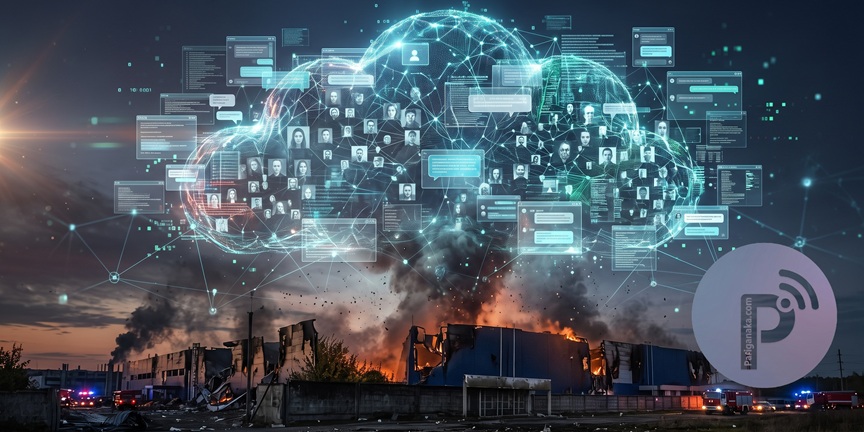
Recently, some internet users noticed their social media feeds seemed a bit less toxic, sparking a popular theory: Ukrainian drone strikes on Russian data centers had successfully silenced Kremlin-linked troll networks. Even Ukrainian President Volodymyr Zelenskyy referenced the supposed impact. But did physical military strikes actually make the internet more peaceful? The real story is far more complex, and disinformation campaigns are still very much alive.
The Strikes on “Russia’s Google”
The rumors started after Ukrainian drones struck three data centers belonging to Yandex within a span of four days. Yandex, often referred to as “Russia’s Google,” operates a massive chunk of the country’s digital infrastructure, including search engines, maps, cloud services, and food delivery apps. The working theory among internet users was straightforward: if state-backed bots rely on Yandex servers, damaging those servers would force the propaganda networks offline.
Bots vs. Propaganda Trolls
Following the strikes, bot activity originating from Yandex’s network did indeed drop. However, a drop in “bots” does not equal a drop in propaganda.
A bot is simply an automated program. This includes benign web crawlers that scan websites so they can appear in search results, servers talking to one another, or AI applications pulling web data. Researchers who analyzed the traffic drop concluded that it was largely tied to Yandex’s own standard web crawlers going offline, not malicious social media accounts.
Ultimately, Russia-wide automated web traffic only dipped slightly, and there is currently no public evidence that the drone strikes shut down any major troll farms. The influence operations are still highly active and continuously trying to shape public opinion.
How Modern Disinformation Actually Works
If blowing up a data center doesn’t stop influence campaigns, how do they operate? They rely on decentralized tactics designed to manipulate social algorithms and AI tools.
Tactic 1: Building Artificial Crowds Disinformation networks start by using AI tools to generate massive swarms of fake accounts complete with realistic profile photos, bios, and convincing posting histories. Because today’s AI tools allow a small team to manage hundreds of personas, these accounts can post, argue, and artificially amplify the same messages by liking and sharing each other’s posts. This tricks social media algorithms into rewarding the engagement, pushing their narratives to real human users.
- In 2024, US authorities exposed a Russian bot farm connected to nearly 1,000 accounts on X (formerly Twitter), which were subsequently shut down.
- Similarly, during the India-Pakistan conflict in early 2025, researchers found propaganda networks from both countries utilizing fake accounts and AI-generated images to sway opinion.
Tactic 2: Flooding Search Engines and AI Operators actively target search engines and AI chatbots by flooding the internet with fake news. They create websites that mimic real news outlets or invent legitimate-sounding names to host fake content. If enough fake content surrounds a topic with little real reporting to counter it, AI tools might accidentally repeat the false claims as if they came from a trustworthy source.
- A prime example is the Moscow-based “Pravda network” (also known as Portal Combat), which operates roughly 150 websites in dozens of languages across 49 countries.
- When the research firm NewsGuard tested 10 leading chatbots against 15 false stories from this network, the bots repeated the fake claims about a third of the time.
The Cloud is a Building, Not a Troll Factory
It is tempting to view data centers as centralized “troll factories” that can simply be targeted to clean up the internet. In reality, data centers are shared civilian infrastructure. The strikes on Yandex primarily caused everyday outages in Russian delivery apps, websites, and payment services for millions of regular people.
While a data center is a physical building that can be damaged, influence campaigns are much harder to eliminate. The true weapon isn’t the server itself, but rather the human strategy, the psychological tactics, and the decentralized networks behind it.
Leave a Reply