
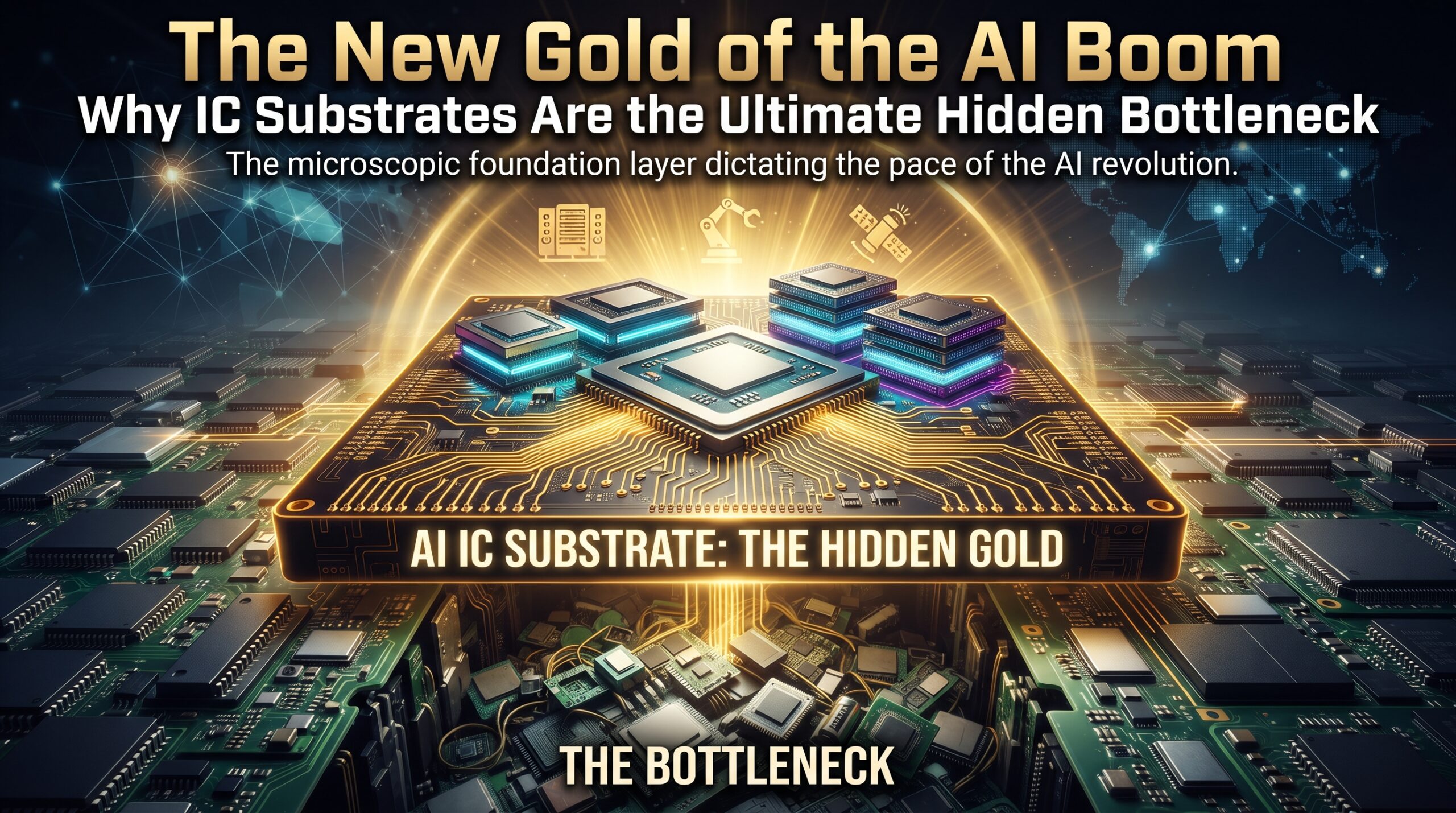
While the public eye remains transfixed on powerful graphics processing units (GPUs), soaring tech stocks, and massive data center builds, a critical component operating entirely behind the scenes is quietly dictating the pace of the artificial intelligence revolution: the IC substrate[cite: 4].
As AI workloads scale to unprecedented levels, the pressure is no longer just on the chips themselves, but on the high-tech base layers that sit directly beneath them[cite: 4]. According to industry leaders, these specialized components are rapidly becoming the new “gold” of the semiconductor supply chain[cite: 4].
1. What Is an IC Substrate and What Does It Do?
An integrated circuit (IC) substrate is the advanced foundation layer situated beneath high-performance chip packages[cite: 4].
- The Architecture: Looking closely at an AI processor substrate reveals tens of thousands of microscopic metal bumps and connection points[cite: 4]. The central area holds the processors, while the surrounding outer perimeter connects to memory and input/output (I/O) devices[cite: 4].
- The Biological Analogy: Industry executives describe the substrate as the body’s blood and nerve system combined.
- The “Blood” System: It delivers heavy electrical energy and power to the chips, much like blood supplies oxygen and nutrients to cells[cite: 4].
- The “Nerve” System: It manages extremely high communication speeds, linking hundreds of thousands of data points across dense components with zero room for error[cite: 4].
2. Why Substrates Have Become the Ultimate Bottleneck
For years, the substrate market experienced fierce competition and occasional overcapacity[cite: 4]. Today, the script has completely flipped. As AI chips compute data faster than ever before, the communication speed between processors and memory has hit a physical limitation—and that limitation is governed by the substrate[cite: 4].
- The Scaling Challenge: To maximize processing speeds, chip designers want to compress more processors and memory units into smaller spaces[cite: 4]. Consequently, future substrates are engineered to become significantly larger, carrying multiple chiplets on a single base to enhance intermediate communication[cite: 4].
- Demand Outpacing Supply: Major substrate manufacturers report that demand is moving vastly faster than production capacity[cite: 4]. Facilities could easily deliver 20% to 25% more product immediately if manufacturing capacity could be scaled up at the same velocity[cite: 4].
3. Global Expansion and Geographic Diversification
To meet skyrocketing demands from Silicon Valley hyperscalers—including major tech giants and chip designers like AMD—manufacturers are pouring billions into heavy infrastructure investments[cite: 4].
A prime example is AT&S, a leading Austrian technology enterprise that has heavily expanded its manufacturing footprint in Kulim, Malaysia, alongside operations in China and Europe[cite: 4]. Diversifying production outside of a single region has become an absolute necessity for the global supply chain, mitigating risks ranging from geopolitical tensions to localized disaster recovery[cite: 4]. Malaysia’s expanding hubs are structured to host multiple tier-one global customers, ensuring the steady flow of next-generation AI hardware[cite: 4].
4. The Economics of Advanced Substrates: Worth Every Penny
Advanced substrates are complex to manufacture, requiring precise wet chemical processes, rigorous quality assurance, and deep co-development between component makers and chip giants[cite: 4]. Although geopolitical pressures have driven up the costs of raw materials like gold and copper, the value added by enhanced data speeds and power efficiency makes the investment worthwhile[cite: 4].
Rather than viewing components as a static expense, the entire semiconductor value chain recognizes that superior substrate technology unlocks the true performance capabilities of modern AI calculation centers[cite: 4].
Conclusion
As artificial intelligence expands into robotics, space technology, and advanced automation, the underlying hardware infrastructure must evolve in tandem[cite: 4]. While headlines will always chase the latest processor names, the real battleground for the future of computing lies in the microscopic connections of the IC substrate—the true hidden gold of the AI era[cite: 4].
Leave a Reply