
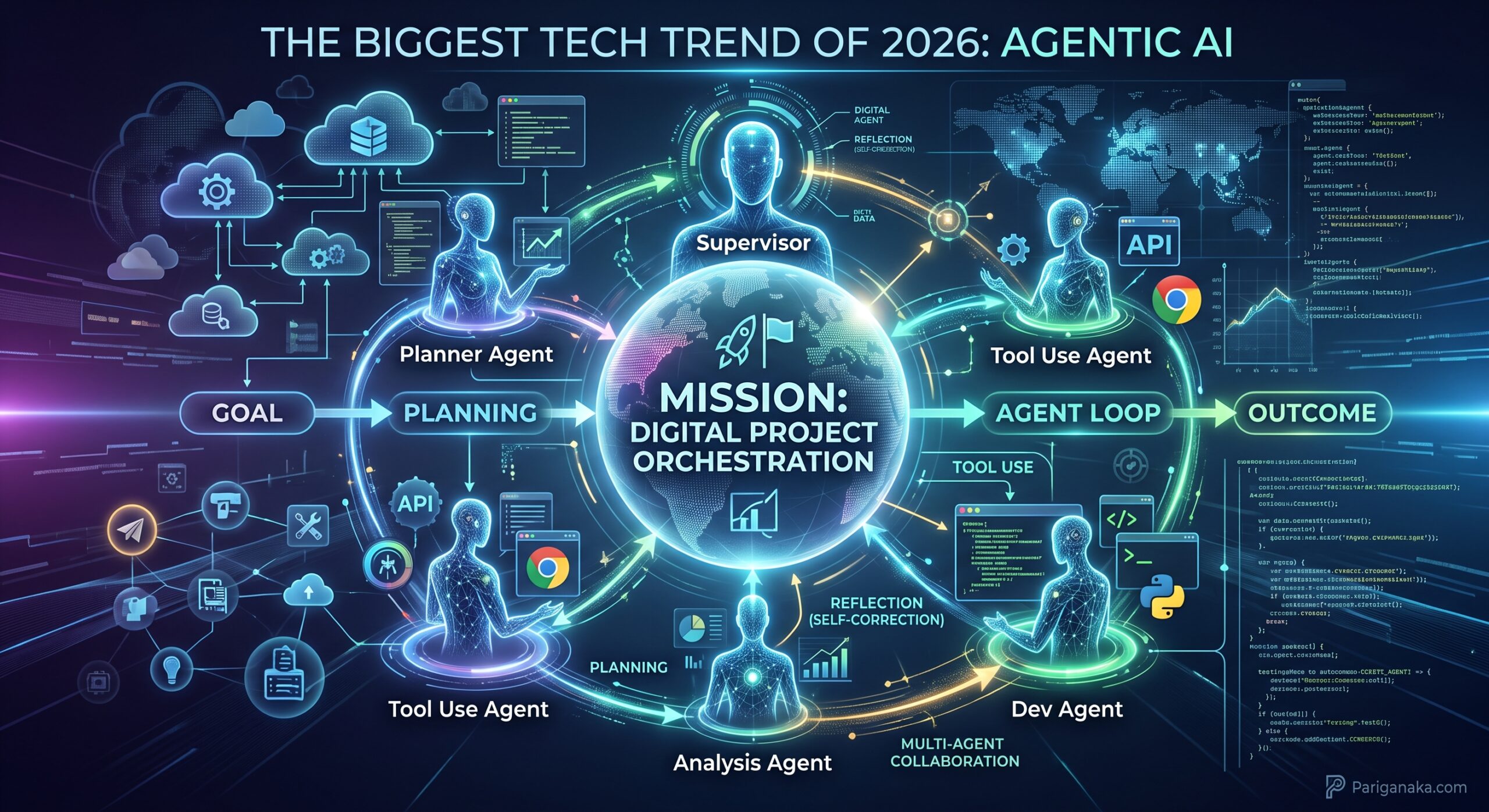
If the past few years were all about talking to AI, 2026 is the year AI starts working on its own. Industry experts are calling this the “Year of Truth for AI,” marking a massive shift from simple chatbots to autonomous systems that can actually get things done.
At the center of this transformation is a concept you are going to hear everywhere: Agentic AI.
But what exactly are AI agents, and why are they replacing the standard generative AI models we’ve grown used to? Let’s break down the technology that is fundamentally changing how software and businesses operate.
From Chatbots to Digital Coworkers
Traditional AI tools (like the early versions of ChatGPT) were highly reactive. You type a prompt, it generates an answer, and the interaction ends there. If you want it to do something else, you have to write another prompt.
Agentic AI, on the other hand, is proactive and autonomous. Instead of just answering questions, an AI Agent is given a goal, and it figures out the steps needed to achieve it. It can write code, test it, realize there is an error, rewrite it, and deploy it—all without a human holding its hand.
How Does Agentic AI Actually Work?
To move from simply predicting the next word in a sentence to independently solving complex problems, Agentic AI relies on four fundamental pillars:
- Planning: The AI can break down a massive, complex goal (e.g., “Research our top 3 competitors and build a presentation”) into a logical sequence of smaller, manageable tasks.
- Tool Use: Just like humans use calculators, web browsers, or spreadsheets, AI agents are given access to external tools. They can browse the live internet, query your company’s private databases, run Python scripts, or send emails.
- Reflection (Self-Correction): This is the game-changer. An autonomous agent can evaluate its own work. If it writes a piece of code and the code fails, the agent will read the error message, figure out what went wrong, and try a new approach.
- Multi-Agent Collaboration: In advanced setups, multiple specialized AI agents work together. A “Researcher Agent” might gather data, pass it to an “Analyst Agent” for crunching, who then hands it to a “Writer Agent” to draft the final report.
To see these concepts in action and understand how this shifts the software landscape, check out this brief breakdown of the agentic architecture:
Why 2026 is the Tipping Point
According to recent tech forecasts, software development is shifting from “writing code” to “expressing intent”. Developers and IT professionals are no longer just writing manual scripts; they are orchestrating intelligent agents that self-assemble and self-heal.
For businesses, this means intelligent operations are becoming the standard rather than the exception. Companies are investing heavily in hybrid and multi-cloud architectures (often called Cloud 3.0) specifically to provide the backbone needed to run these resource-heavy AI agents securely on their own proprietary data.
What This Means for IT Professionals
For the Pariganaka community, this trend highlights a crucial career pivot. Knowing a specific programming language is still valuable, but the competitive edge will now belong to those who understand AI orchestration, system architecture, and governance. The future of IT isn’t just about building software; it’s about managing teams of digital agents and ensuring they act securely and accurately.
Leave a Reply