
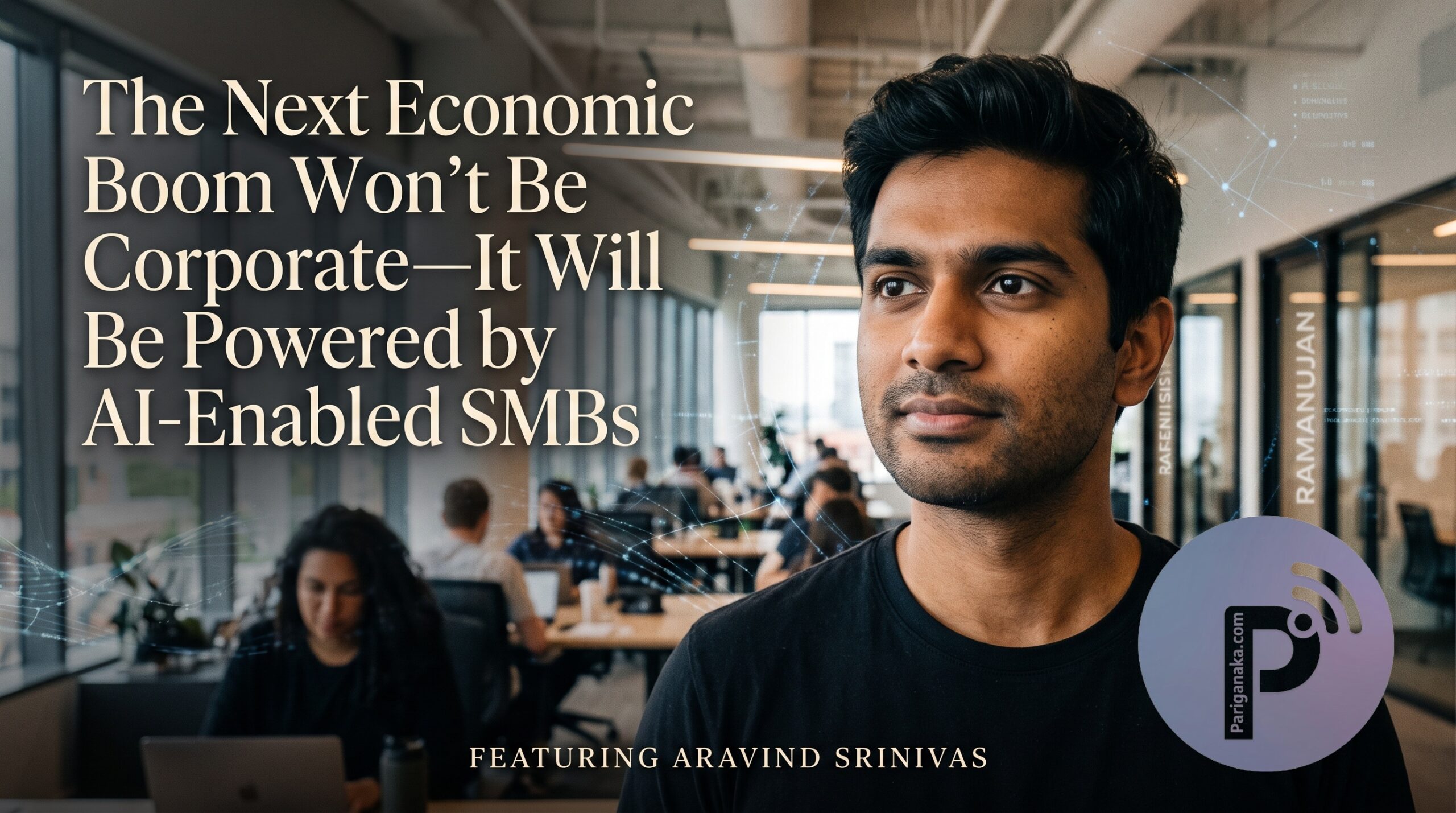
In the rapidly evolving landscape of artificial intelligence, the metrics for success are shifting. According to Aravind Srinivas, CEO of the AI-powered search and orchestration platform Perplexity, the future of the American economy doesn’t necessarily lie in the hands of massive Fortune 500 tech conglomerates. Instead, the next great economic boom could be driven by hyper-productive small and medium-sized businesses (SMBs) and “solopreneurs” wielding AI to do the work of entire departments.
In a recent wide-ranging interview with Molly O’Shea on Sourcery, Srinivas outlined a bold vision for the future of work, AI product philosophy, and why the “American Dream” is more alive today than ever.
“Recursive Effects” Over Network Effects
For the last two decades, the tech industry has been obsessed with “network effects”—the idea that a product like a social media platform only becomes valuable when it has billions of users. Srinivas believes applying this framework to AI is a fundamental mistake.
In his “hottest take” of the interview, Srinivas argued that AI relies on recursive effects, not network effects. “The depth of usage and the quality of users matters a lot more than the quantity,” he explained.
An AI company doesn’t need a billion casual users to be massively valuable; it needs highly engaged users who rely on the platform to run their businesses and generate real revenue. Srinivas highlighted a startling example of this recursive value: a single-person company (a “solopreneur”) that makes $3 million a year by automating newsletters for clients, spending roughly $1 million annually on Perplexity’s infrastructure to power those agentic workflows.
When users use AI to make money, the AI company makes money. It is a deeply intertwined, recursive cycle of productivity.
The Rise of the Micro-Enterprise
This hyper-productive solopreneur is a microcosm of a larger macroeconomic shift. While enterprise sales to Fortune 500 companies are traditionally what growth-stage investors want to see, Srinivas predicts that future GDP growth will be fueled by much smaller organizations.
Future companies will be “far more productive, capital efficient, headcount efficient, and create value way faster using these tools by being more AI-native and less bureaucratic,” Srinivas noted. By providing these smaller players with enterprise-grade research, reasoning, and orchestration tools, AI platforms are democratizing the ability to scale.
A Neutral Orchestrator in a Fragmented Market
While competitors are racing to build massive data centers or exclusive ecosystems, Perplexity is leaning into a different strategy: becoming a neutral orchestrator.
Srinivas pointed out that the data center bottleneck—plagued by power grid limitations, permitting, and hardware shortages—is slowing down AI deployment. Meanwhile, there are gigawatts of untapped computing power sitting on our desks and in our pockets.
Perplexity’s strategy is to orchestrate across the entire ecosystem. By partnering with hardware giants like Apple and Nvidia, they aim to seamlessly route AI workloads. Need raw, massive intelligence? The query goes to the cloud. Handling highly sensitive legal, financial, or personal data? The orchestration layer pushes the workload down to local hardware (like Apple Silicon) to ensure data sovereignty and privacy.
This flexibility caters heavily to enterprises and sovereign wealth funds that are eager to adopt AI but terrified of exposing their proprietary data to frontier models.
Celebrating Human Curiosity
Despite the heavy focus on enterprise productivity and hardware, Srinivas insists that Perplexity’s core brand is deeply human. Inspired by tech legends like Steve Jobs and DeepMind’s Demis Hassabis, Perplexity is designed around a singular mission: accelerating human curiosity.
Even the conference rooms at Perplexity’s new office are named after scientists and mathematicians, like Srinivasa Ramanujan, to constantly remind the team that every great invention starts with a single question.
“As AIs get better and better… it’s not necessarily cool to be a know-it-all anymore because an AI can answer everything,” Srinivas reflected. “Your purpose is to actually lean into your curiosity even more and not be afraid of asking whatever questions they may be.”
The American Dream, Reimagined
For Srinivas, who came to the US from India as a student, Silicon Valley remains the ultimate manifestation of the American Dream. It is a place where outsiders are not only welcomed to solve hard problems but are actively funded and rewarded for doing so.
As AI tools continue to lower the barrier to entry for building a business, that dream is expanding. We are entering an era where you don’t need a massive team or a vast network to build a wildly successful company. You just need curiosity, the right AI tools, and the ambition to ask the next great question.
Leave a Reply