
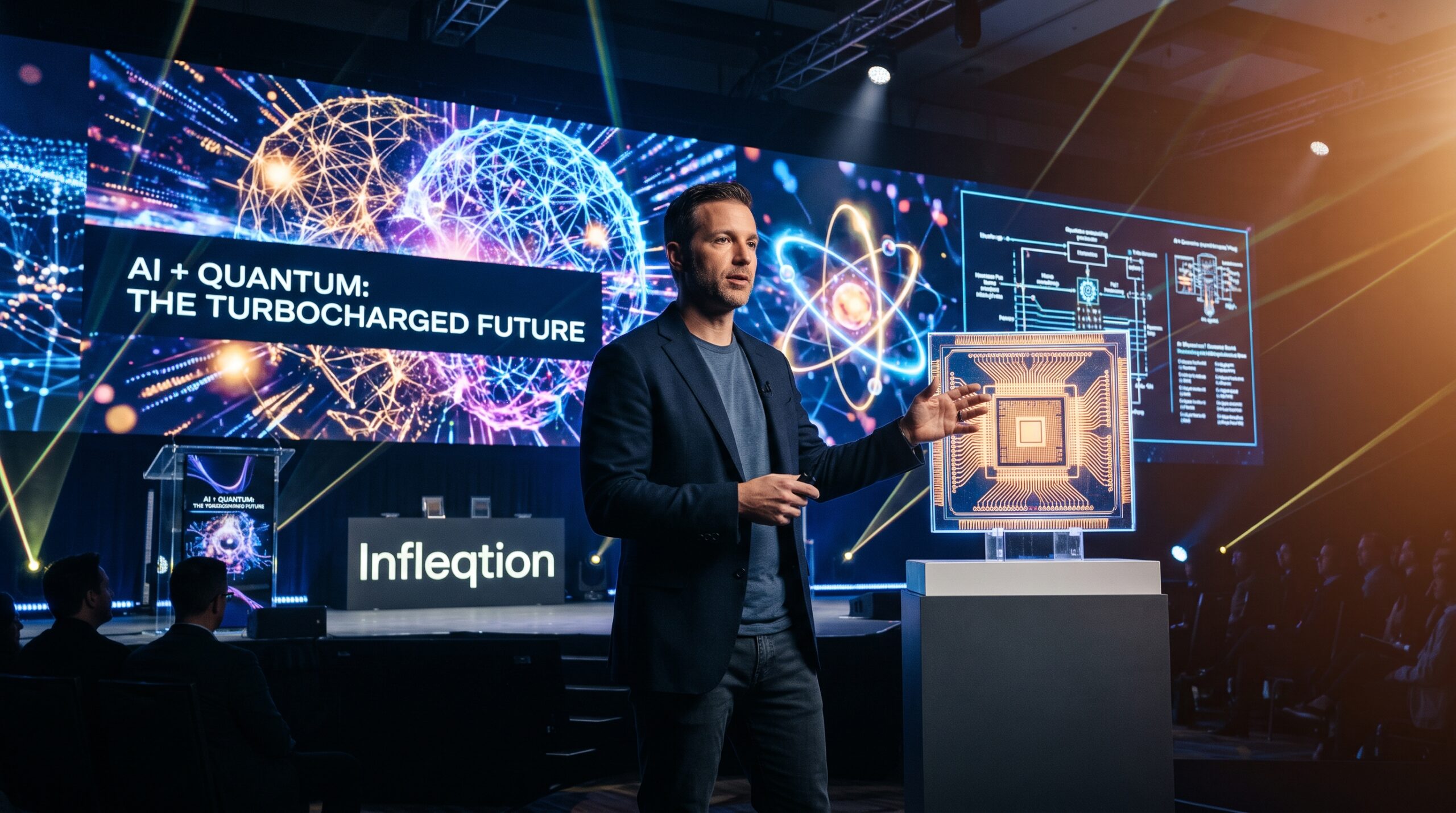
Not long ago, experts predicted that quantum computing was still 15 to 20 years away from becoming a functional reality. Today, that timeline is accelerating at a breakneck pace. Major tech corporations, billionaire investors, and even the US government are aggressively investing in the sector, recognizing quantum computing not just as a technological leap, but as a critical component of national and economic security.
One of the companies at the forefront of this revolution is Infleqtion, which recently signed a $100 million letter of intent with the US Department of Commerce to accelerate American leadership in the quantum space. In a recent interview, Infleqtion CEO Matt Canella outlined the underlying mechanics of this technology, the transition from theoretical physics to commercial products, and the inevitable convergence of quantum computing and artificial intelligence.
Moving Beyond Zeros and Ones
To understand the power of quantum computing, you have to look at the limitations of our current technology. Even the most advanced GPU clusters—like those powered by Nvidia’s latest chips—ultimately rely on the binary logic of zeros and ones.
“Nature doesn’t work in zeros and ones,” explains Canella. “No matter what we’re doing on a classical computer, we’re sort of using a heuristic or a simulation of nature.”
Quantum computing operates at the atomic and subatomic levels. By trapping atoms inside quantum chips and using lasers to manipulate their quantum mechanical properties, companies like Infleqtion are creating products that process information the way nature actually works. Because a quantum bit (or qubit) can exist as a zero, a one, or any state in between simultaneously, the underlying architecture enables calculations that classical computers could never perform.
Real-World Applications and Milestones
While “Q-day”—the hypothetical moment when quantum computers become powerful enough to break current cryptographic systems—often dominates the headlines, quantum technology is already generating real-world value today.
According to Canella, the commercialization of quantum technology is advancing on two primary fronts:
- Quantum Sensors: Currently driving the majority of Infleqtion’s revenue, quantum sensors are already outperforming classical sensors in fields like inertial sensing and advanced atomic clocks.
- Logical Qubits: For quantum computing to reach its full potential, scaling up stable, logical qubits is essential. Infleqtion recently announced they had achieved 30 logical qubits, with a roadmap to reach 100 logical qubits by the end of 2028. Reaching the 100-qubit milestone is widely considered the threshold where quantum computers will begin solving problems that classical computers cannot.
The Convergence of AI and Quantum
As Wall Street debates whether the current AI investment boom is reaching its peak, those deep in the tech sector believe we haven’t even left the dugout. The fourth industrial revolution is still in its infancy, largely because the true potential of AI has yet to be combined with the processing power of quantum architecture.
“AI and quantum will have a lot of collaboration between the two of them, and they will self-reinforce and effectively turbocharge each other,” says Canella.
While quantum computing has yet to make a significant impact on the current AI landscape, the intersection of these two revolutionary technologies promises to unlock computing capabilities previously thought impossible. For developers, businesses, and digital strategists closely watching the evolution of generative AI and computing hardware, the message is clear: the hardware foundation of tomorrow will look fundamentally different from the silicon of today.
Leave a Reply