
For the last twenty years, when we saved a file to the “cloud,” it wasn’t actually floating in the sky. It was sitting on a spinning hard drive inside a massive, air-conditioned concrete warehouse in Nevada, Ireland, or Singapore. But the exponential boom of Artificial Intelligence in the mid-2020s created an insurmountable physical problem: terrestrial data centers simply became too hot and too hungry for Earth to sustain.
By late 2026, the tech giants realized that to power the next generation of AI, they had to leave the planet. We are now witnessing the largest infrastructure migration in human history: the launch of Orbital Data Centers.
Welcome to the Astro-Cloud Era. For the readers of Pariganaka.com, here is a deep dive into why the internet’s backend is currently orbiting 500 kilometers above your head, and how space became the ultimate hard drive.
1. The AI Thermal Crisis and the Vacuum of Space
Training advanced Agentic AI models requires millions of next-generation GPU clusters. On Earth, keeping these processors from melting down requires billions of gallons of fresh water and massive amounts of electricity, putting unbearable strain on national power grids.
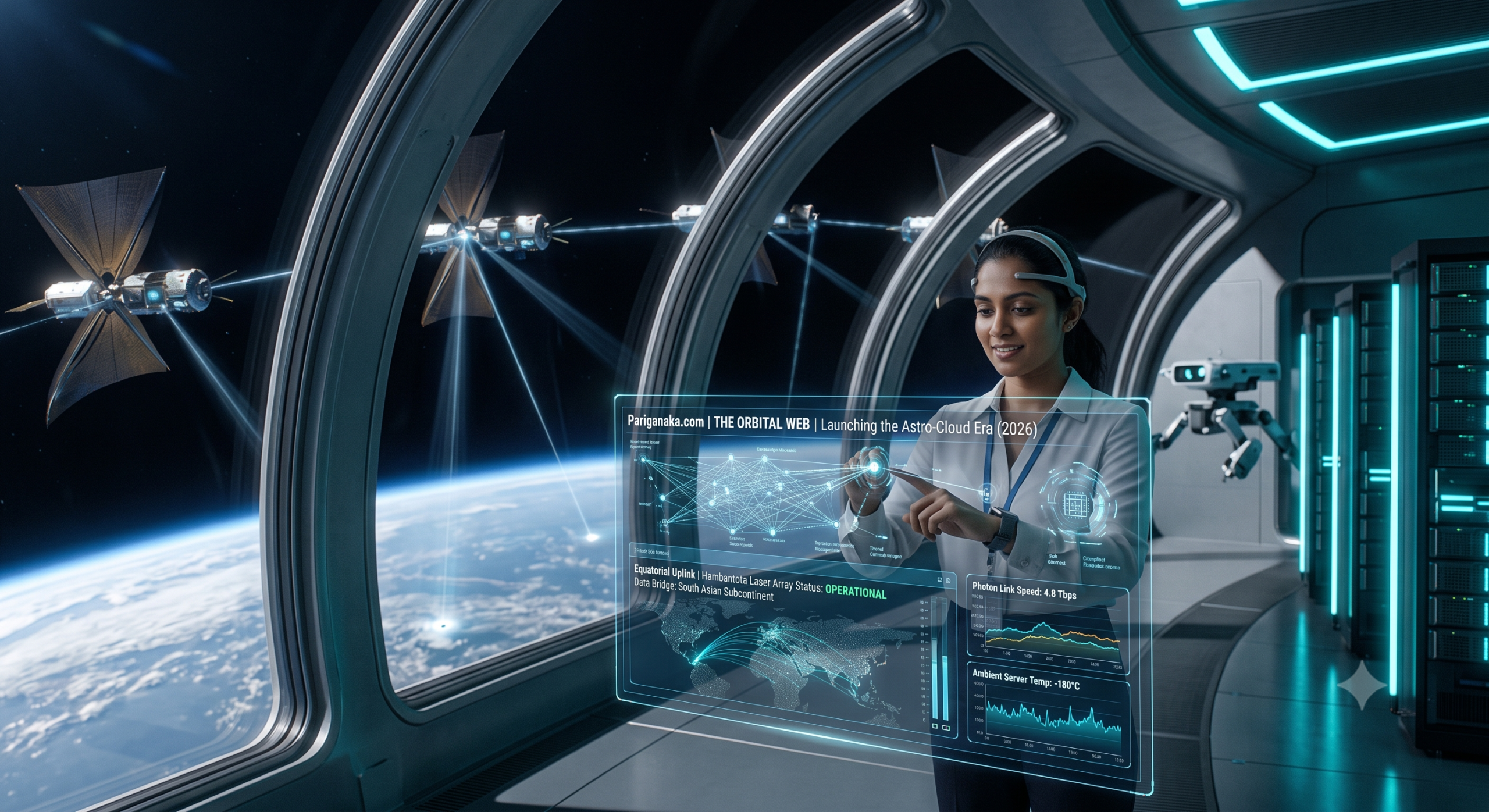
- The Ultimate Heatsink: Low Earth Orbit (LEO) provides the perfect environment for hyperscale computing. In the shadow of the Earth, ambient temperatures plunge to near absolute zero. Orbital data centers use the vacuum of space as a natural, infinite heatsink, radiating thermal energy away from the servers with zero need for water cooling or energy-intensive HVAC systems.
- Solar Abundance: In space, there are no cloudy days and no night cycles if positioned correctly. Orbital server farms unfurl massive, ultra-thin solar sails that capture raw, unfiltered solar energy 24/7, making them 100% green and completely detached from the fragile terrestrial power grid.
2. The Photonic Web: Laser-Linked Constellations
If the servers are in space, how does a YouTube video or an AI query reach your device without crippling lag? The answer is the death of traditional radio frequencies and the rise of Photonic Laser Communication.
- Beaming Data with Light: Instead of relying on vulnerable undersea fiber-optic cables that are easily damaged by anchors or geopolitical sabotage, LEO data centers communicate with Earth via concentrated, invisible optical lasers.
- Zero-Latency Routing: When you prompt an AI from your neural wearable, the request is shot upward to an orbital node via a laser uplink. The data bounces across a mesh network of satellites orbiting at 27,000 km/h, processes the AI generation in the cold vacuum, and beams the result directly down to a receiver on your roof in milliseconds. It is faster than routing data through physical cables from Asia to America.
3. The Sri Lankan Context: The Equatorial Uplink
Historically, Sri Lanka’s economic strength lay in its strategic geographic position on the East-West maritime shipping route. In 2026, the country has leveraged that exact same geography for the Astro-Cloud era.
- The Equator Advantage: Because Sri Lanka is situated close to the equator, it provides the most direct, energy-efficient line of sight to the densest rings of Low Earth Orbit satellites. The island has rapidly transformed into a premier “Uplink Hub.”
- The Hambantota Laser Array: Rather than just serving as a port for cargo ships, massive tracts of land in the south are now home to advanced Photonic Uplink Arrays. These high-tech laser stations act as a primary data bridge, downlinking petabytes of processed AI data from orbital servers and distributing it across the South Asian subcontinent via regional fiber networks. Sri Lanka is no longer just a shipping hub; it is the data anchor of the Indian Ocean.
Pariganaka.com’s Take: The migration of the cloud to Low Earth Orbit is a brilliant solution to Earth’s energy and climate crises, but it introduces a terrifying new vulnerability. Terrestrial servers were protected by national borders, laws, and armies. Orbital servers float in a jurisdictional gray area. If a global conflict arises in 2026, the first strike won’t be on land—it will be “Kessler Syndrome,” a tactical debris strike targeting the laser-linked constellations. We have solved the thermal crisis of AI, but we have placed all of humanity’s accumulated knowledge in the most hostile environment known to man.
Leave a Reply