
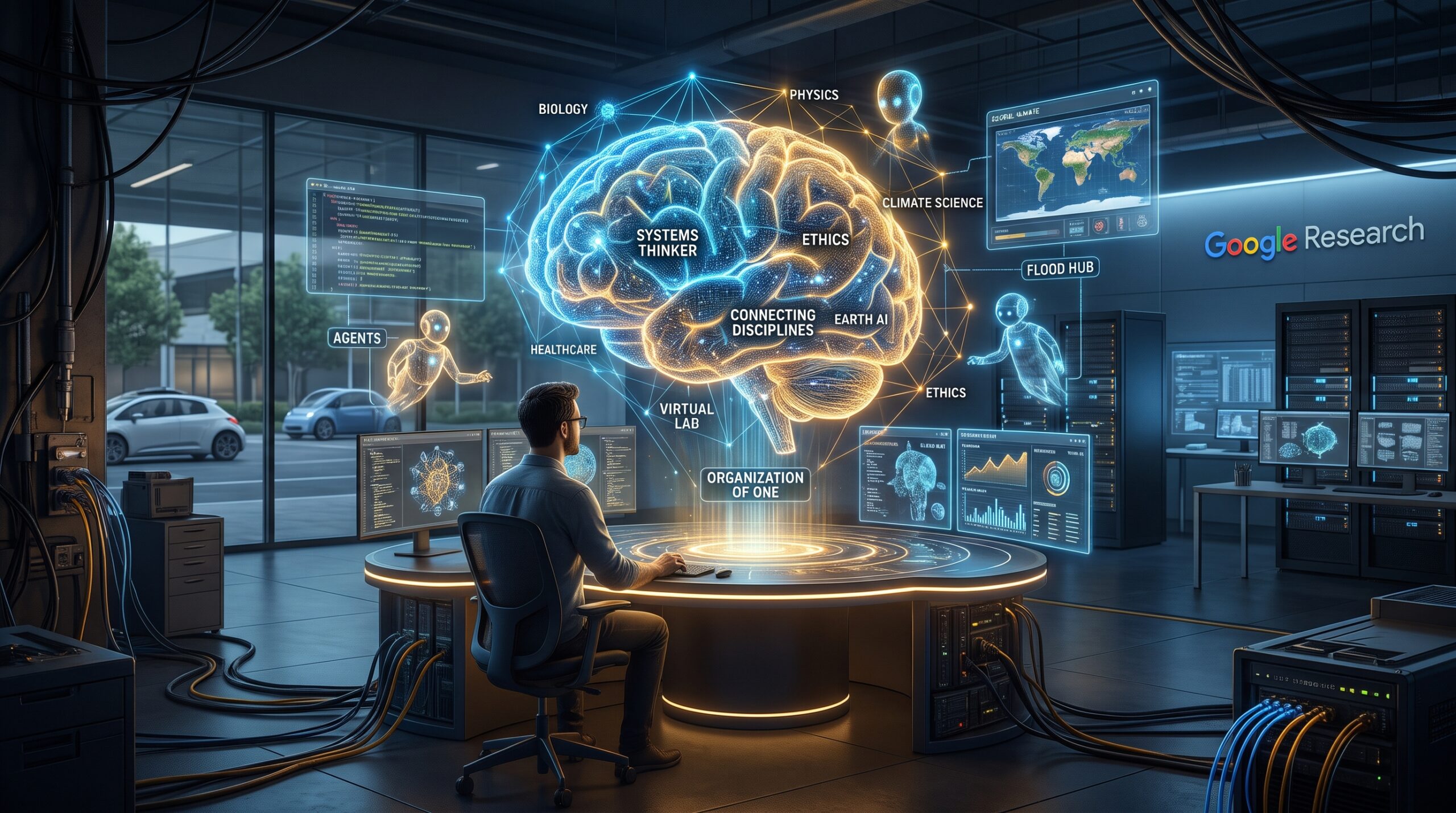
The artificial intelligence revolution is no longer just a story about immense computational power or generative chatbots; it is a fundamental restructuring of how humanity approaches problem-solving, scientific discovery, and the very nature of work. As AI capabilities accelerate, the skills required to thrive are shifting away from rigid technical specialization and toward adaptable systems thinking.
In a recent deep-dive discussion, Yossi Matias, Vice President and Head of Google Research, outlined a profound vision for the coming decade. From the emergence of “ambient intelligence” to the democratization of software building, the future belongs to those who can connect disparate disciplines and wield AI as a collaborative polymath.
The Rise of the “Organization of One” For decades, the technology industry heavily favored deep specialization. Building software or launching a product required armies of specifically trained engineers, designers, and project managers. Today, generative AI is actively dismantling those barriers.
Matias highlights the emergence of what can be described as the “organization of one”—a single professional empowered by AI to act as a miniature company. With tools like AI-assisted “vibe coding,” individuals without formal computer science backgrounds can conceptualize, design, and deploy functional products. Consequently, the most valuable skills in the AI era are not purely technical. Google Research is increasingly looking for “systems thinkers”—individuals who excel at asking the right questions, identifying unique opportunities, and applying rigorous ethical judgment. Soft skills, such as listening, effective communication, and the ability to evaluate complex trade-offs, are becoming the ultimate hard skills.
The Scientist as a Polymathic Explorer The traditional trajectory of a scientist involves years of tedious data collection, extreme specialization, and slow, incremental progress. However, Matias predicts that the role of the scientist is about to undergo a radical transformation. In the near future, even early-career researchers will operate much like today’s senior advisors or lab directors.
Equipped with an AI collaborator that functions as a personal “virtual lab,” researchers will be free from the heavy lifting of raw data processing. Because these AI agents are inherently polymathic—capable of reading and synthesizing information across vast and distinct disciplines—scientists will be able to easily bridge the gaps between physics, mathematics, biology, and computer science. Matias likens this to the era of historical greats like David Hilbert and Albert Einstein, where cross-disciplinary collaboration drove the most profound leaps in human understanding. AI will enable a return to this holistic, exploratory style of science, allowing researchers to focus purely on invention and strategic inquiry.
The Era of Ambient Intelligence As AI models become increasingly reliable, they will transition from novel tools we actively consult to invisible infrastructure we take for granted. Matias refers to this as “ambient intelligence.” Just as we no longer think about the mechanics of electricity when we flip a light switch, we will soon stop thinking about the AI powering our environments.
This shift is already visible in places like Palo Alto, where fully autonomous Waymo vehicles navigate the streets seamlessly, turning what was recently science fiction into a mundane daily commute. But ambient intelligence goes far beyond convenience; it is a powerful tool for crisis management. Google’s Flood Hub, leveraging Earth AI, has evolved from simply mapping past floods to accurately predicting them. Recently, the Nigerian government utilized this predictive API to preemptively disburse millions of dollars in aid to vulnerable villagers before a catastrophic storm hit. In a fully realized ambient future, this intelligence could seamlessly interface with city infrastructure, sending automated evacuation alerts and funds without requiring a human to manually connect the dots.
Meeting the Moment: The Challenge of Prioritization With technology capable of addressing societal challenges ranging from healthcare diagnostics and crisis resilience to education and energy, the opportunity space is paralyzingly vast. For leaders at the vanguard of AI research, the primary challenge is no longer capability, but prioritization.
How do organizations ensure they are meeting the moment? According to Matias, the mandate is twofold: execute on the innovations that can save and improve lives today, while simultaneously dedicating deep focus to what lies just over the horizon. The technologies that will define the next five years are likely concepts that are not yet on the mainstream radar.
Ultimately, the AI era will not replace human ambition; it will uplevel it. The thinkers who will thrive in this new paradigm are those who maintain relentless curiosity, embrace continuous adaptation, and leverage these extraordinary new tools to ask bigger, more profound questions than ever before.
Leave a Reply