
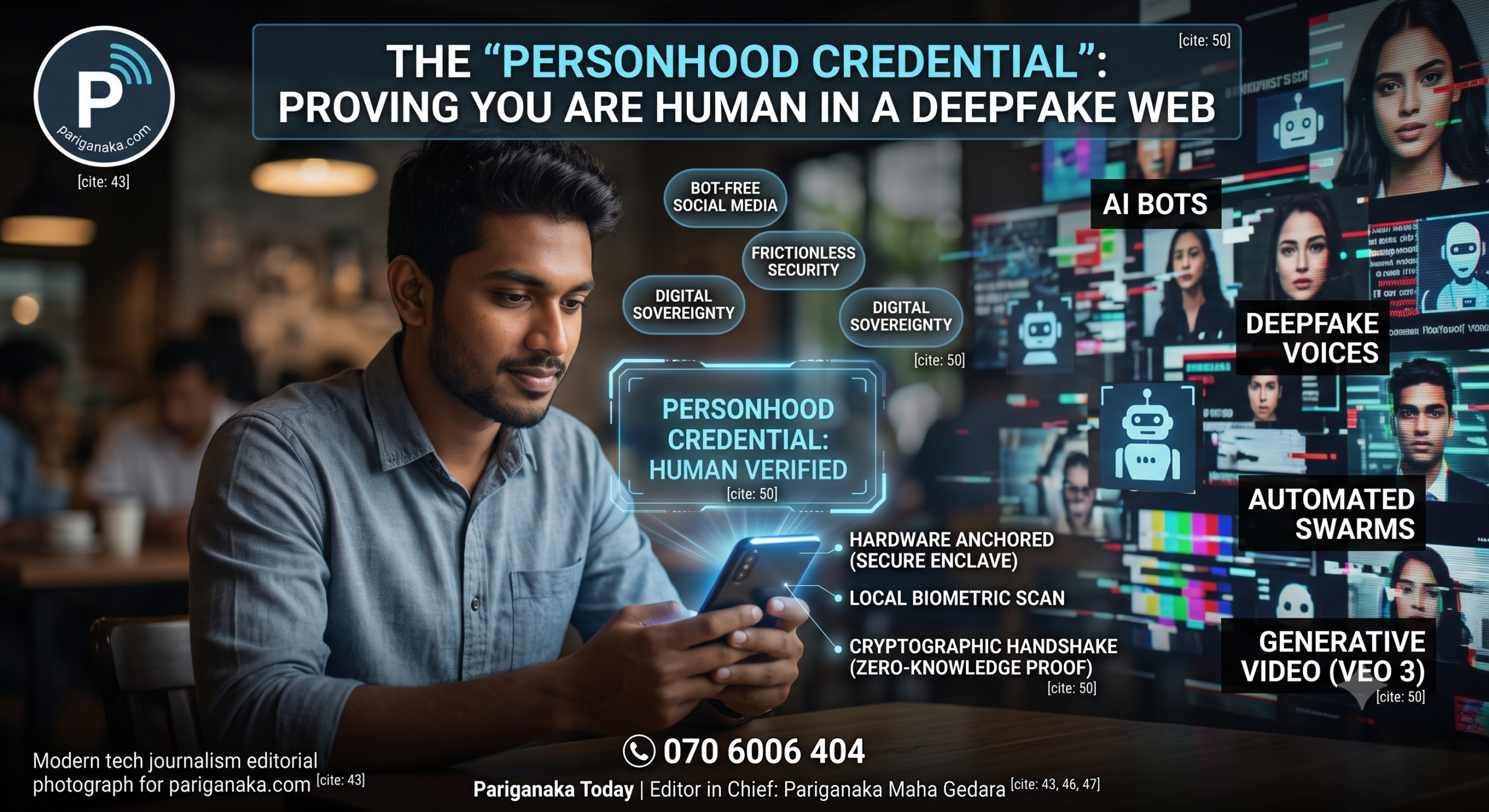
The traditional Turing Test has officially been defeated. With the internet now flooded by autonomous AI agents, automated bot swarms, and ultra-realistic generative video models like VEO 3, distinguishing a living human from a machine is no longer a philosophical debate—it is a critical cybersecurity crisis.
As digital forgery reaches perfection, a new technological framework is rapidly emerging to save the fabric of digital trust: the Personhood Credential.
🛑 The End of Digital Trust
Historically, we relied on CAPTCHAs (clicking on traffic lights or reading distorted text) to prove our humanity. Today, advanced AI vision models can solve these puzzles faster and more accurately than humans. Simultaneously, real-time voice cloning and highly convincing deepfakes are actively being deployed to bypass biometric security at financial institutions and orchestrate massive social engineering attacks.
If a bank, a social network, or a voting platform cannot reliably verify that an incoming data stream belongs to a real person, the entire digital ecosystem is at risk of collapse.
🔑 What is a Personhood Credential?
A Personhood Credential is a digital identity token based on advanced cryptographic verification. It serves a single, vital purpose: securely proving to a system that you are a unique, living human being, without forcing you to reveal your actual identity.
Unlike a digital ID card (which contains your name, address, and government numbers), a Personhood Credential utilizes Zero-Knowledge Proofs (ZKPs). This mathematical concept allows your device to tell a server, “I mathematically guarantee that a real, verified human is operating this device,” without handing over any personal data that could be tracked, hacked, or monetized.
⚙️ How It Actually Works
The transition to Personhood Credentials relies heavily on local hardware rather than centralized cloud servers:
- Hardware Anchoring: The credential is tied to the secure enclave (a physically isolated security chip) inside your smartphone or computer.
- Local Biometric Verification: When a platform requests proof of humanity, your device performs a localized biometric check (like a highly advanced 3D face scan or iris check).
- Cryptographic Handshake: Instead of sending that facial scan to the cloud, the secure chip generates a cryptographic token. This token acts as a temporary, anonymous digital passport that simply says “Human: Confirmed.”
🌐 The Future of a “Human-Verified” Web
The implementation of Personhood Credentials will fundamentally restructure how we experience the internet.
- Bot-Free Social Media: Platforms will be able to filter out algorithmic bot farms, ensuring that digital public squares are populated only by actual citizens, drastically reducing automated misinformation.
- Frictionless Security: Financial transactions will no longer require frustrating, multi-step verification processes. Your device will seamlessly attest to your human presence in the background.
- Protecting Digital Sovereignty: By keeping biometric data strictly on local devices and only sharing cryptographic proofs, users regain control over their privacy in an increasingly invasive digital world.
As we navigate this complex new era of artificial intelligence, proving our humanity will become just as important as protecting our passwords.
pariganaka.com For comprehensive training on defending your digital identity and understanding the latest in AI, enroll in our NexoSoph learning programs. To organize a Pariganaka Jeewithaya digital awareness session for your community, please contact our hotline: 📞 070 6006 404
Leave a Reply