
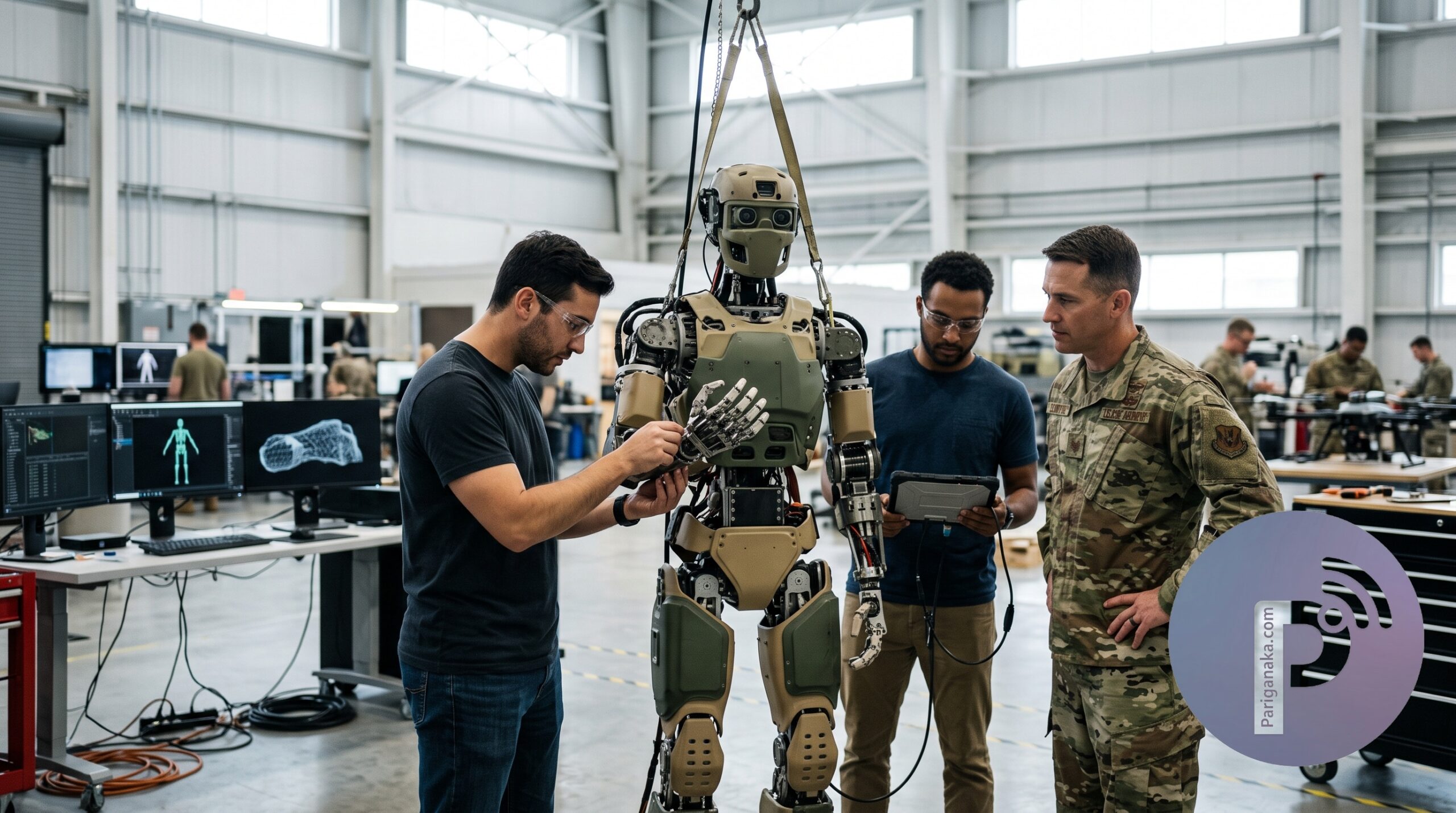
The most dangerous moments in combat—clearing unfamiliar buildings, searching hostile terrain, and confronting unknown threats—have historically relied on the bravery and sacrifice of human soldiers. Today, military leaders and defense contractors are looking toward an option once relegated to science fiction: sending humanoid robots to the front lines first.
As the push for 21st-century technological supremacy accelerates, the United States is investing heavily in autonomous ground vehicles, advanced drones, and robotic warriors designed to absorb the highest risks of war. The shift represents a massive evolution in AI applications, raising complex questions about ethics, global competition, and the future of armed conflict.
Built in Our Image
The logic behind deploying humanoid robots is rooted in practicality. The modern military’s infrastructure—from weapons and vehicles to tools and tactics—is designed entirely around the human shape.
Mike LeBlanc, a former Marine and co-founder of Foundation Future Industries, is at the forefront of this development. According to LeBlanc, humanoid robots are the only form factor capable of seamlessly integrating into existing arsenals. The ultimate vision is for these machines to drive Humvees, fire M4 rifles, and man heavy machine guns without requiring the military to reinvent its entire hardware ecosystem.
While the image of an armed humanoid machine inevitably draws comparisons to dystopian films like The Terminator, advocates emphasize the alternative. “Everybody thinks that it’s scary to have a Terminator out there,” LeBlanc notes, “until they think of the alternative is someone’s son or daughter”. By replacing soldiers with machines, the primary goal is drastically reducing human casualties.
The AI Imperative and “Push-Button” Wars
The integration of artificial intelligence and autonomous weapons systems comes with profound ethical challenges. Can a machine be trusted with lethal decision-making?
Defense developers argue that AI-driven machines could actually represent an ethical improvement over traditional, indiscriminate weapons. LeBlanc compares autonomous systems to “passive weapons” like landmines, arguing that an AI system will be capable of making far better, more discerning decisions than a hidden explosive. Implementing “responsible AI” guardrails and continuous assessment will be crucial before these machines see active combat.
However, critics warn that reducing the human cost of war could inadvertently increase its frequency. When warfare shifts from human risk to a purely economic contest of “who can afford the best robot,” the natural deterrents to armed conflict—namely, the fear of death and public backlash over casualties—are removed. This so-called “push-button” warfare lowers the cost for the attacker, potentially bypassing the restraints that prevent conflicts from breaking out in the first place.
The Global AI Arms Race
Whether policymakers fully support autonomous combat or not, the global arms race will likely force their hand. Adversaries are actively pursuing this technology without necessarily adhering to the same ethical boundaries.
China has already demonstrated rapid progress in robotics, recently showcasing over 2,000 advanced machines at the World Humanoid Robot Games in Beijing. While the event was publicly focused on sports and tasks, it served as a stark reminder of the speed at which autonomous technology is advancing worldwide. As LeBlanc points out, if adversaries are investing in AI humanoids, holding off out of caution becomes a strategic disadvantage.
Beyond Combat: Logistics and Maintenance
While combat applications dominate the headlines, the initial deployment of humanoid robots will likely be far less dramatic. Current testing shows significant promise in logistics, specifically aircraft maintenance.
Developers envision scenarios where humanoid robots are deployed alongside drones across strategic locations like the Pacific. These robots could perform necessary maintenance, load themselves back onto the drone, and fly to the next location to repeat the process.
To achieve this, engineers are focusing on immense hardware challenges, particularly the development of robotic hands capable of complex tasks. By feeding these machines massive datasets of video showing humans performing real-world tasks, developers are training the AI not just to execute pre-programmed movements, but to genuinely understand and adapt to unpredictable environments.
For developers like LeBlanc, the mission is intensely personal. His motivation is to perfect these machines before the next generation—including his own son—reaches military age, ensuring that the most dangerous jobs are left entirely to the machines.
As the technology continues to mature at breakneck speed, the reality of warfare is changing. The question is no longer if AI and robotics will reshape the battlefield, but when and how the world will adapt to it.
To stay updated on the latest shifts in AI, cybersecurity, and emerging tech, keep reading Pariganaka Daily.
Leave a Reply