
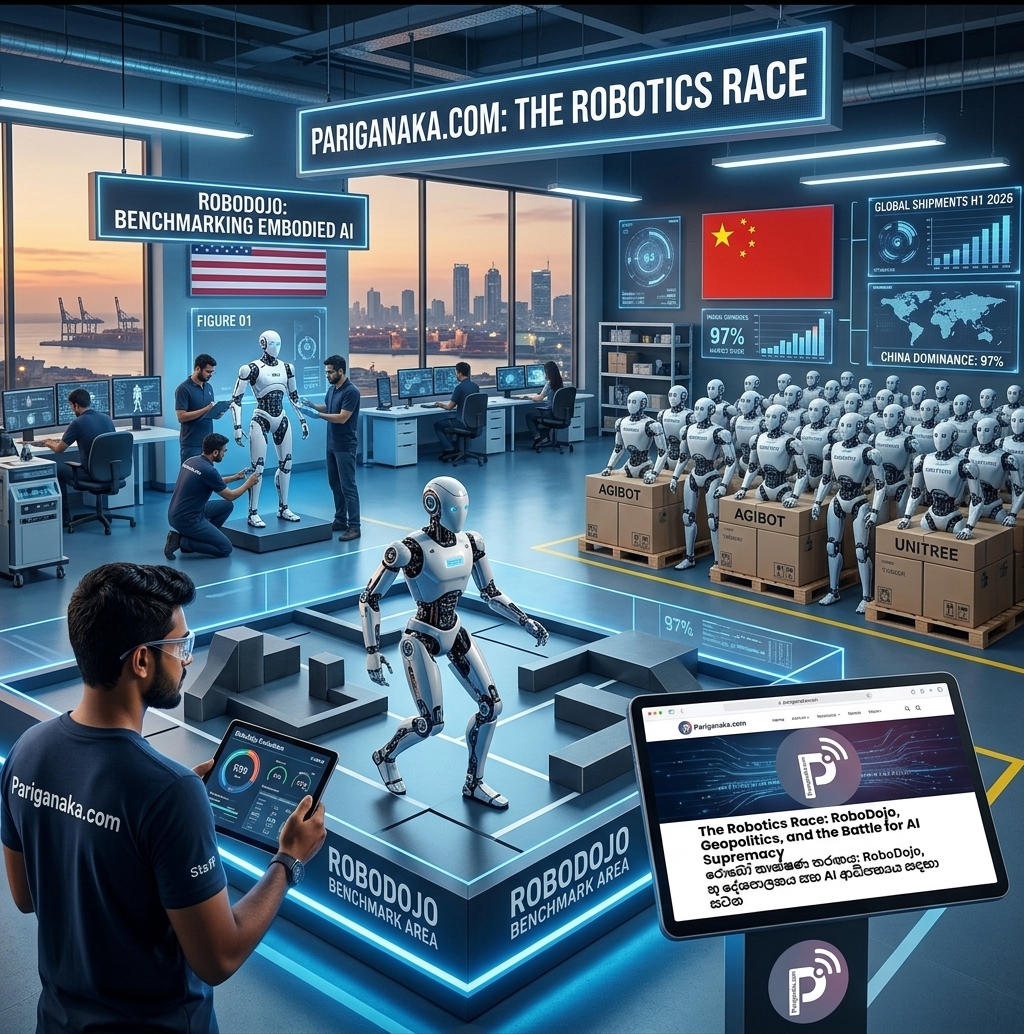
The robotics industry in 2026 is experiencing a dramatic collision of cutting-edge scientific innovation and intense geopolitical rivalry. Here is a deeper look into the recent developments defining the physical AI landscape for our readers at Pariganaka.com.
The Science: Benchmarking Embodied AI with RoboDojo
To advance the capabilities of physical AI, researchers recently introduced ‘RoboDojo,’ a unified simulation and real-world benchmark platform designed to comprehensively evaluate generalist robot manipulation policies.
- Solving Fragmentation: Previously, the embodied AI field suffered from fragmented research with disparate benchmarks and incompatible tooling, making it difficult to fairly compare different models.
- A Unified Platform: RoboDojo addresses this by providing a shared framework that aggregates tasks, metrics, and interfaces. It includes 42 simulation tasks and 18 real-world tasks that evaluate capabilities like generalization, memory, precision, and long-horizon execution.
- Accelerating Progress: By standardizing evaluation protocols across simulated environments and physical robots, RoboDojo aims to accelerate advancements in reinforcement learning and embodied intelligence.
The Geopolitics: US Bans Chinese Humanoid Robots
While scientists push for standardized progress, global superpowers are drawing battle lines. On July 28, 2026, the US Federal Communications Commission (FCC), under the Trump administration, announced a ban on the import of new foreign-made humanoid and quadruped robots.
- National Security Risks: The FCC stated that these “advanced robotic devices” pose “unacceptable risks” to US national security. Officials warned that data collected by the robots could be leveraged by malign actors to surveil Americans or remotely commandeer the machines.
- Protecting Supply Chains: The ban, which also includes connected power inverters, reflects the administration’s broader goal of securing critical supply chains and elevating domestic technology manufacturing.
The Market Reality: China’s 97% Market Share
The US ban clearly targets China, which has rapidly established dominance in the global robotics supply chain.
- Unprecedented Dominance: According to research firm Smart Analytics Global (SAG), global humanoid robot shipments reached approximately 19,100 units in the first half of 2026, with Chinese manufacturers commanding over 97% of this market.
- Leading the Pack: Shanghai-based Agibot claimed the top spot with 8,400 units shipped, followed closely by Unitree Robotics with 5,900 units.
- Outpacing US Rivals: The massive scale achieved by these Chinese firms has left US competitors like Tesla, Figure AI, and Agility Robotics far behind in terms of actual shipment volumes.
The Big Picture: The robotics race of 2026 is no longer just about who can build the smartest AI; it is fundamentally about commercial scalability, supply chain dominance, and national security.
Do you believe that banning foreign-made humanoid robots is a necessary step for national security, or will it ultimately stifle global technological collaboration?
Leave a Reply