
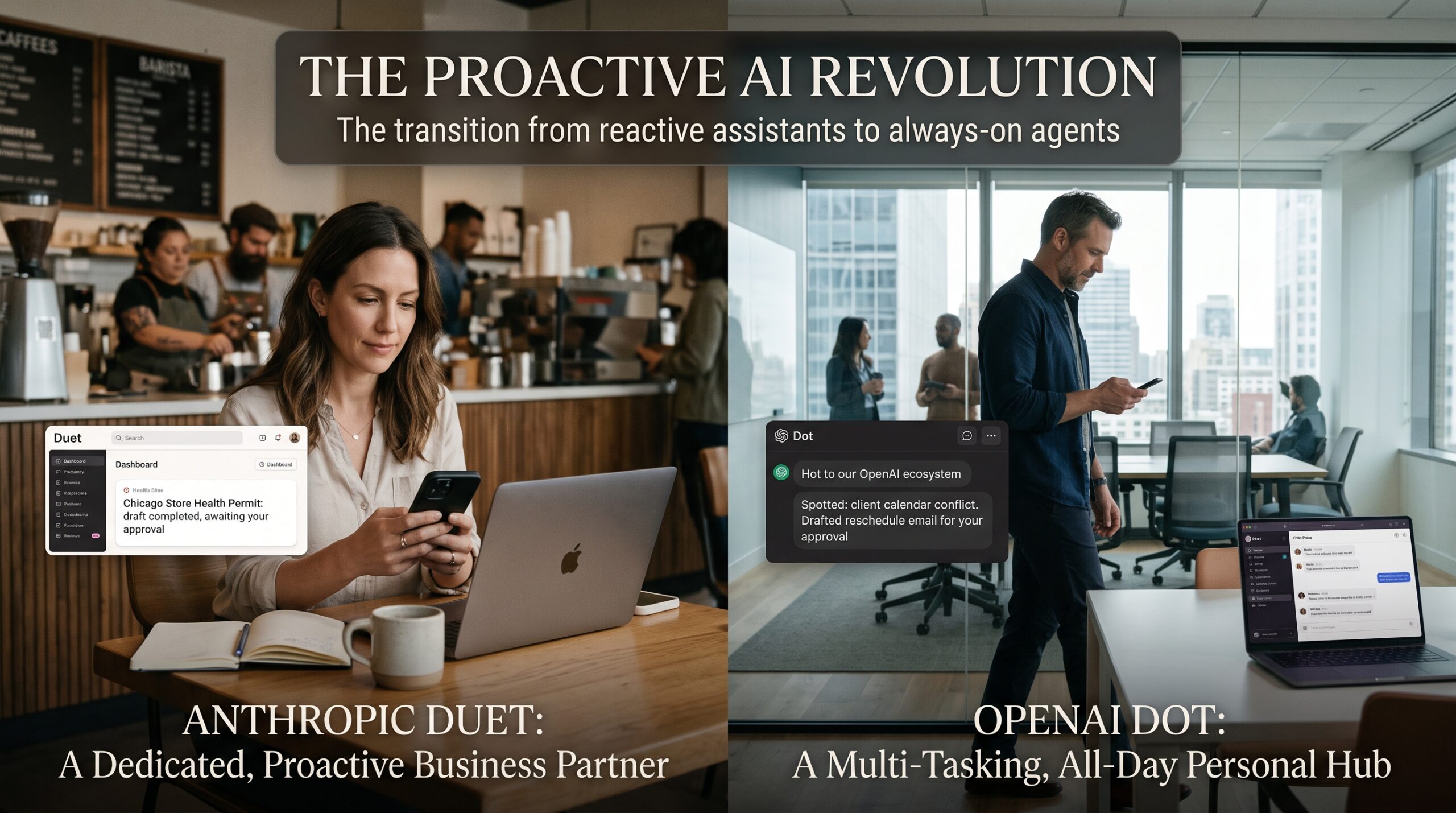
The transition from “reactive” assistants that wait for prompts to “always-on” agents that proactively work in the background.
While both agents are designed to relieve users of daily, multi-step digital burdens, they approach autonomy, platform integration, and user interaction through distinct philosophies.
1. Underlying Brains & Power
- Anthropic Duet: Powered by Claude Opus 5.5, Duet is built around Anthropic’s flagship reasoning model. It focuses on highly nuanced logic, multi-step “thinking ahead,” and parsing complex, qualitative text (like interview feedback, emails, and multi-app visual dashboards).
- OpenAI Dot: Built on OpenAI’s latest GPT-6 Astra architecture, Dot leverages OpenAI’s high-speed, highly integrative foundation. Dot’s task processing can also utilize OpenAI’s cost-efficient models like GPT-6.1 Sol (which handles recurring checks at a fraction of the token cost).
2. Focus: Professional Workflow vs. All-Day Personal Hub
- Duet’s Focus: Very heavily geared toward professional, business-centric operations—especially small-to-medium business owners and solo entrepreneurs. Its primary target is automating heavy back-office administration (e.g., pulling POS and bank data, drafting legal permits, and arranging HR compensation files).
- Dot’s Focus: Acts as an all-day “personal agent” integrated deeply into your everyday life and productivity. While it handles work, OpenAI also positions Dot to be a seamless, day-to-day companion—managing personal schedules, catching missed alerts, and orchestrating everyday personal tasks alongside professional ones.
3. Application Design and Interface
- Duet’s Interface: Operates primarily as a separate, standalone app on iOS, Android, and the web (claude.ai), detached from the main Claude chatting interface. It runs its own ongoing background thread, which continues on its own dedicated virtual machine even if you shut your phone or close your laptop.
- Dot’s Interface: Lives directly inside your ChatGPT account (though also extensively accessible on mobile, Slack, and Microsoft Teams). Like Duet, Dot handles asynchronous background work (which carries on independently on cloud servers), but it is firmly anchored inside the existing ChatGPT ecosystem rather than existing as a disjointed separate utility.
4. Proactive Logic and Timing
- Duet’s Timing: In order to avoid burn-through of user plan limits, Duet doesn’t watch your apps 24/7. It batches checks every few hours to seek out changes, generate morning briefings, prep tasks, and notify you when a decision is needed. Its proactivity relies on detecting missed timeline items (like a permit due in 26 days).
- Dot’s Timing: Also relies on structured, continuous background tasking. Dot is highly optimized for “always-on” timeline and communication watchfulness, heavily integrating with Microsoft, Slack, and Google tools to act as an active, constantly ticking automation hub.
5. Security, Approvals, and Safety Guardrails
- Duet’s Safety: Highly strict and rule-bound.
- Explicit Stops: Categorically refuses to perform certain activities (like moving money or trading securities) even if you approve them.
- Pre-Action Hold: Drafts messages, invoices, and offers but halts completely before sending, paying, or deleting anything until you tap a literal “approval” button.
- Visual and Text Shields: Introduces dedicated classifiers to actively block sensitive data like credit cards and national IDs from outbound drafts, requiring explicit user prompts to send even marginally personal data (e.g., health/finance records).
- Dot’s Safety: Focuses on secure credential management and external monitoring.
- Credential Safety: OpenAI keeps saved passwords/credentials in a separate system flow, preventing the active AI model from ever viewing or accidentally leaking raw token or login data.
- Supervision: Utilizes a strict monitoring system that can pause, check, or halt agents if suspicious activity or unexpected network egress is detected. Unlike Duet, Dot relies more on background review than strict pre-generation outbound block filters.
6. Integration Ecosystem & Data Erasure
- Duet’s Integration: Relies on Claude Marketplace’s growing library of over 6,000 plugins and connectors (from HubSpot and Stripe to QuickBooks and Canva). Data Retention: While you can disconnect any third-party app from Duet at any time, Anthropic has been less explicit about exactly how much historical memory Duet retains once you sever an app.
- Dot’s Integration: Utilizes the vast, sprawling ChatGPT plugin and custom GPT ecosystem. Because OpenAI has deep enterprise partnerships (especially with Microsoft on Agent 365), its integrations across Microsoft Teams, Office, and corporate workflows are exceptionally native. Data Retention: Dots have clearly documented rules: if you disconnect an app, learned memory persists unless you trigger a full reset, which wipes conversations, memories, and scheduled tasks simultaneously.
Summary
If you need sophisticated back-office automation, legal/financial draft handling, and a strict, cautious safety paradigm, Anthropic’s Duet currently feels like the more meticulous business analyst.
If you are looking for an omnipresent, highly integrated hub that plays nicely with your existing workspaces (like ChatGPT, Slack, or Teams) and can keep continuous, high-speed pace with your busy days, OpenAI’s Dot offers the broader, everyday personal ecosystem.
Leave a Reply