
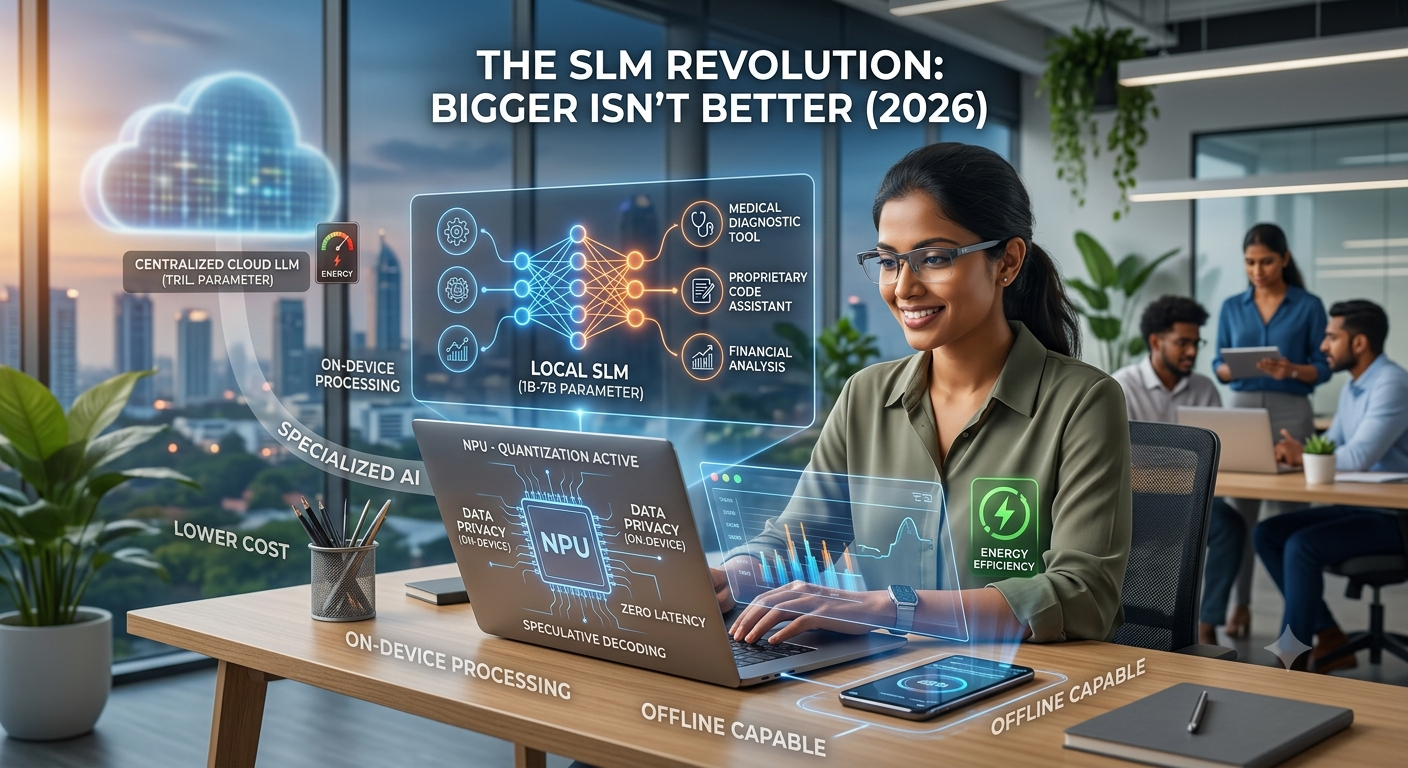
For the past few years, the AI industry was dominated by a singular race: building massive, trillion-parameter Large Language Models (LLMs) locked behind cloud data centers. But as we move through 2026, the paradigm has shifted dramatically. The tech world is discovering that for everyday workflows, enterprise apps, and privacy-first computing, Small Language Models (SLMs) are quietly taking over.
Instead of routing every query through energy-hungry cloud servers, compact models ranging from 1 billion to 7 billion parameters now run directly on laptops, smartphones, and local servers—delivering instant responses without sacrificing accuracy.
What is a Small Language Model?
While a traditional LLM tries to be an all-knowing polymath that knows everything from ancient history to quantum physics, an SLM is a hyper-specialized precision tool.
Through advancements in model compression, speculative decoding, and high-quality synthetic training data, modern SLMs achieve benchmark scores rivaling massive 2024-era cloud models while occupying a fraction of the memory footprint.
Why SLMs are Winning in 2026
The shift toward smaller, localized AI models isn’t just a technical preference—it’s driven by four critical real-world demands:
1. Absolute Data Privacy and Zero Latency
When an SLM runs locally on your machine’s Neural Processing Unit (NPU), your data never leaves your RAM. Financial records, proprietary codebases, and personal notes stay completely offline. Furthermore, because there is no round-trip network request to a remote server, token generation happens instantly at zero network latency.
2. Drastic Cost & Energy Reduction
Running massive cloud API calls for millions of routine tasks is financially unsustainable for startups and enterprise teams alike. SLMs cut inference costs down to near zero after deployment, running on localized silicon using a fraction of the wattage.
3. Deep Domain Specialization
A 3-billion-parameter model fine-tuned purely on medical diagnostic data or legal documentation will consistently outperform a generic 70-billion-parameter cloud model in that specific domain. By trimming away unnecessary knowledge, SLMs focus all their parameters on the task at hand.
Cloud LLMs vs. On-Device SLMs in 2026
| Feature | Cloud LLM (Trillion Parameter) | On-Device SLM (1B–7B Parameter) |
| Execution | Centralized Data Centers / Cloud | Local NPUs, GPUs, and Edge Devices |
| Latency | Network-dependent (200ms–2s+) | Instantaneous (<10ms initial response) |
| Privacy | Data processed on third-party servers | 100% On-device, fully offline capable |
| Inference Cost | Pay-per-token API fees | Zero marginal cost after setup |
| Primary Use Case | Broad reasoning, creative brainstorming | Task automation, local coding, data filtering |
The Tech Behind the Magic: Quantization & Speculative Decoding
How did engineers squeeze model performance into consumer hardware without losing quality? Two major breakthroughs paved the way:
- Low-Bit Quantization (4-bit & 2-bit): Model weights are compressed from standard 16-bit floating points down to 4-bit or 2-bit integers with negligible loss in accuracy, reducing a 14GB model down to a lean 2GB file that fits effortlessly into standard RAM.
- Speculative Execution: Modern operating systems use an SLM as a “drafting engine” to guess output rapidly, using a slightly larger local model only when verification is required—maximizing both speed and accuracy.
What This Means for Developers and Tech Enthusiasts
For developers and readers following Pariganaka.com, the SLM movement unlocks brand-new architectural possibilities. You no longer need thousands of dollars in cloud computing credits to build intelligent, autonomous applications. You can ship privacy-focused software that runs entirely inside the user’s browser or desktop environment.
As hardware manufacturers continue boosting NPU TOPS (Tera Operations Per Second) across consumer devices this year, the boundary between local software and intelligent software has officially vanished. The future of AI isn’t floating in a distant server farm—it’s running right on the silicon on your desk.
Leave a Reply