
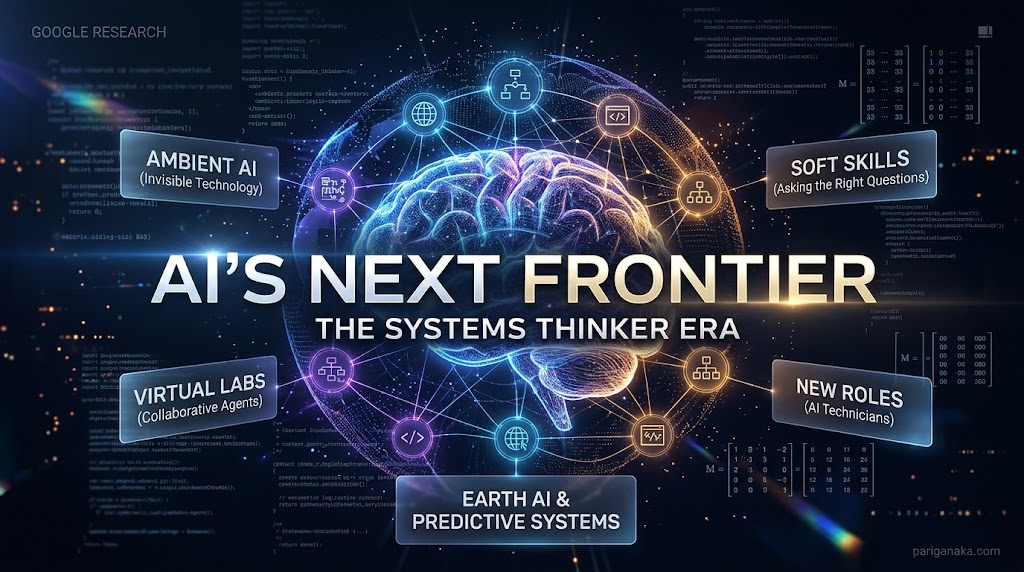
In an in-depth conversation hosted by tech futurist Sinead Bovell at Google’s Palo Alto headquarters, Yossi Matias—Vice President and Head of Google Research—shared a compelling vision of how artificial intelligence is reshaping science, human careers, and daily life.
Rather than replacing human intelligence, Matias argues that AI is elevating human roles, transforming workers into “systems thinkers” and researchers into directors of polymathic virtual laboratories.
1. The Evolving Role of Scientists: Virtual Labs and AI Polymaths
Traditionally, scientific research required endless hours of manual data processing and siloed specialization. Matias envisions a paradigm shift by 2030, where every scientist operates a mobile, virtual laboratory driven by AI collaborators.
- Cross-Disciplinary Synergy: Because AI models read and reason across vast scientific fields—from quantum physics to organic chemistry—they act as polymaths. This allows researchers to break out of hyper-specialization and solve complex interdisciplinary problems holistically.
- From Execution to Directing: Scientists will increasingly resemble senior principal investigators or advisors, focusing their energy on asking the right questions, formulating hypotheses, and guiding research direction rather than performing routine execution.
2. Ambient Intelligence: Technology That “Disappears”
Matias highlighted the concept of “Ambient Intelligence”—the state where technology functions so seamlessly and reliably that users stop paying attention to the underlying infrastructure and simply interact with its outcomes.
- Invisible Technology: Similar to how automated language translation or autonomous Waymo vehicles transitioned from science fiction to everyday occurrences, ambient AI operates in the background of smart homes, workspaces, and devices.
- Frictionless Integration: As model capabilities reach critical thresholds of reliability, the operational friction disappears, leaving users empowered to achieve higher-level goals without needing to understand the underlying technical mechanics.
3. Real-World Impact: Earth AI, Flood Hub, and Predictive Healthcare
Google Research is applying this ambient intelligence model to critical global challenges:
- Predictive Flood Forecasting (Flood Hub): A decade ago, sudden flooding in rural regions caught communities completely unprepared. Today, Google’s Flood Hub utilizes satellite imagery and predictive AI to forecast flood locations days in advance. In a recent deployment, the government of Nigeria utilized Flood Hub data to distribute emergency funds directly to villagers prior to an impending flood.
- Earth AI & Climate Resilience: By allowing users and policymakers to ask natural language questions (e.g., “Which infrastructure will be impacted by tomorrow’s storm?” or “Where should emergency medical supplies be deployed?”), Earth AI turns complex environmental data into actionable disaster response strategies.
- Preventative Healthcare: On-device AI processing converts subtle biological signals from consumer wearables into proactive healthcare alerts, advising users to consult medical professionals before acute symptoms manifest.
4. The “Organization of One” and Essential Soft Skills
As AI lowers technical barriers through innovations like “vibe coding” (using natural language to generate software code) and automated product design, job requirements are fundamentally shifting.
Matias emphasizes that the most critical workforce skills in the AI era are what were traditionally labeled “soft skills”:
- Systems Thinking: Employees will operate like a “miniature company”—a single individual who applies ethics, critical judgment, product design, and strategic questioning across multiple domains simultaneously.
- Curiosity & Question Formulation: The primary value of human talent is no longer memorizing facts or writing raw code, but knowing which questions to ask and identifying meaningful problems worth solving.
- Adaptability & Continuous Learning: Because technological capabilities evolve rapidly, the ability to adapt, learn new workflows, and apply ethical judgment across trade-offs is paramount.
5. New Technical Roles: The “AI Electrician”
Just as the proliferation of electrical grids created the need for residential electricians rather than just electrical engineers, ambient AI will give rise to entirely new vocational careers.
Matias predicts the emergence of “AI Technicians” or “AI Electricians”—specialized professionals called upon to troubleshoot, tune, and repair embedded AI agents, ambient smart-home systems, and local edge devices when background intelligence malfunctions.
Balancing Immediate Impact with Long-Term Breakthroughs
When asked what keeps him up at night, Matias pointed to the urgency of opportunity selection. With vast computing power and world-class talent available, Google Research constantly balances near-term societal impact (such as healthcare and climate resilience) with horizon breakthroughs—uncovering novel paradigms that are not yet on the public radar.
Ultimately, Matias remains deeply optimistic: AI will not make humanity passive or lazy, but will continuously raise the bar for what humans can imagine, build, and accomplish.
Leave a Reply