
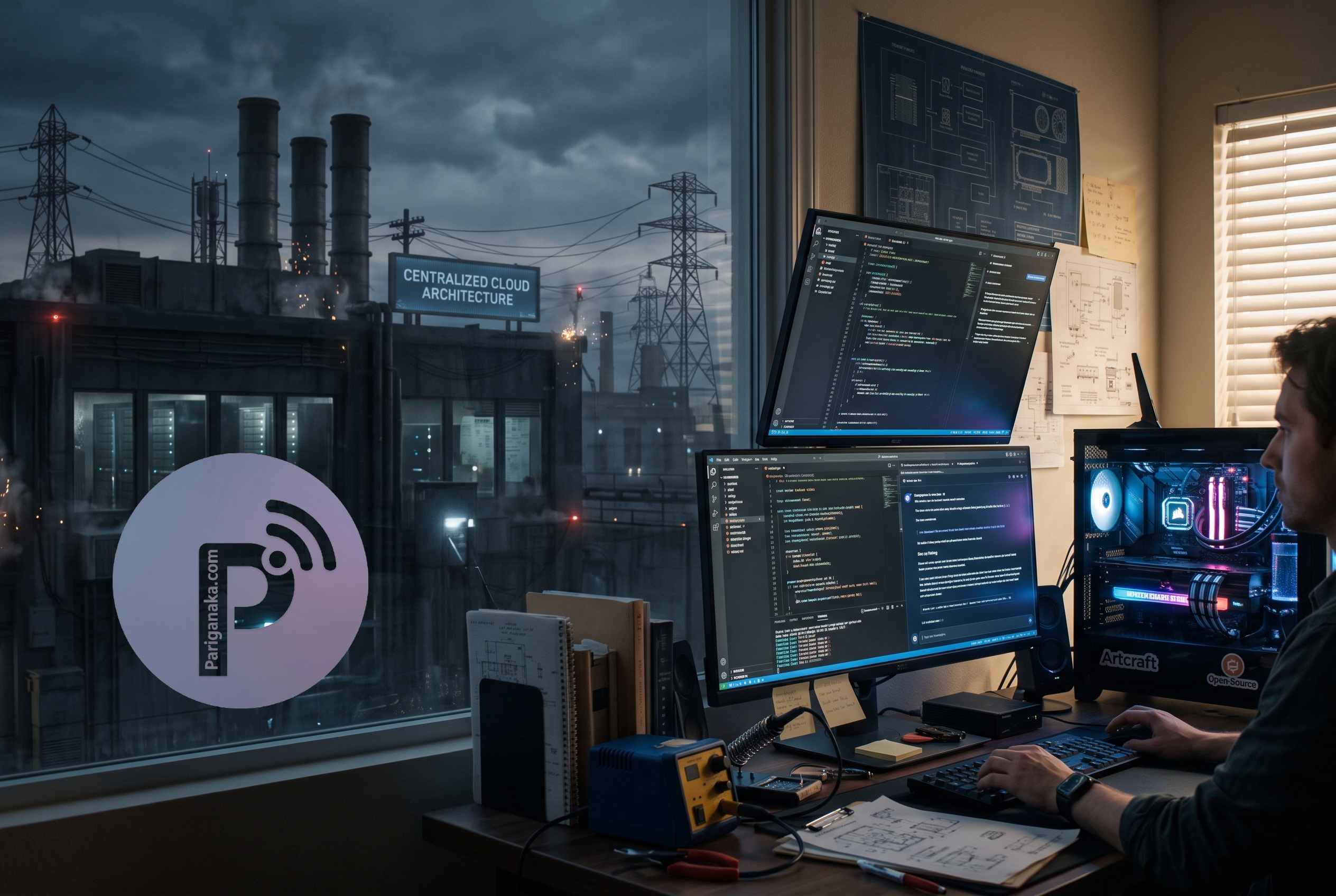
The tech industry bet $2 trillion on a simple premise: you will rent artificial intelligence from their colossal cloud empires forever. But in 2026, the cracks in that empire are widening into chasms.
While giant corporations spend billions trying to convince the world that AI exists to summarize corporate emails, independent developers and modders are using open-source models in their bedrooms to crack walled gardens wide open. We are witnessing the death of corporate cloud AI as we know it, giving way to a grassroots, localized technological revolution.
The Grassroots Rebellion: David vs. Goliath
The starkest contrast in the AI landscape today is what individuals are achieving compared to corporations. The walls that companies spent decades building around their code are proving to be made of paper when faced with AI.
Take the gaming industry. Modders have used AI language models to do the grueling grunt work of translating architectures and reverse-engineering undocumented systems. The result? Unhackable consoles like the PlayStation 5 were cracked open in weeks, with native emulators shipping at speeds that used to take teams of engineers years to achieve.
But the most terrifying wake-up call for Big Tech came in the form of Artcraft. Born out of frustration with Adobe’s controversial terms of service, hidden fees, and monopolistic practices, a developer named Brandon Thomas used AI to pull off the ultimate tech heist: he rebuilt seven open-source Adobe alternatives in pure Rust.
Using clean-room reverse engineering—the exact same legal loophole that allowed Compaq to clone IBM’s BIOS in the 1980s and birth the modern PC market—an AI model wrote brand new code based purely on how the software behaves. In one swoop, a single developer with an AI model cloned the core of a $24 billion monopoly. No subscriptions. No cloud access required.
The Corporate Cash Incinerator
Meanwhile, the corporate adoption of AI has largely become a slow-motion financial disaster. Driven by a desperate need to appear “AI-native” to Wall Street, companies engaged in toxic incentive structures like “token maxing,” where engineers were literally rewarded with promotions for burning through the most AI compute tokens. One Microsoft audit revealed an employee burning $28,000 in AI tokens in just 28 days.
What did this burnt capital actually buy? Almost nothing.
- A 2025 MIT study found that 95% of generative AI pilots delivered zero measurable impact on profit and loss.
- Harvard economists analyzed 300 million work events and found that while AI agents helped engineers write 30% more code, companies didn’t ship any more software. Why? Because human review times jumped by 49%.
Corporations essentially built massive “slop factories” that require thousands of extra babysitting steps, plugging expensive chatbots into old workflows without seeing revenue go up.
Behind closed doors, the financials are a house of cards. AI labs like Anthropic are locked into billion-dollar infrastructure commitments for the next decade, while their own prospectuses admit their biggest clients aren’t locked into long-term contracts. The industry is trapped in a cyclical shell game where hardware giants hand money to AI companies, who immediately hand it back to buy more compute, inflating a bubble reminiscent of Cisco and the fiber-optic dot-com crash of 2000.
The Physical World Fights Back
Silicon Valley has long operated under the delusion that the physical world runs on software timelines. But the AI cloud requires giant, concrete warehouses consuming apocalyptic amounts of electricity—and the power grid simply cannot keep up.
To feed this beast, tech giants are doing the unthinkable. Microsoft funded a $1.6 billion resurrection of a nuclear reactor at Three Mile Island (expected online in 2027), only to realize the local transmission grid can’t handle the power until 2030. Oracle had to invoke an “Act of God” clause to delay a multi-billion dollar New Mexico data center simply because they couldn’t get a natural gas pipeline permitted on time.
Furthermore, concentrating billions of dollars of compute into singular, massive data centers has created a catastrophic security vulnerability. With the rise of cheap, flat-pack drones, bad actors don’t need to hack a firewall; they just have to target cooling systems or power insulators. The cloud is not an untouchable fortress; it is a highly centralized, fragile physical target.
The Doomer Myth and Regulatory Capture
When tech CEOs take the stage to warn Congress that AI might “end humanity,” they aren’t afraid of Skynet. They are afraid of democratization.
They are terrified of the developer in his apartment cloning Adobe. They are terrified of modders running open-source models on their own hardware. Every time capable AI runs on a machine the user actually owns, the justification for a trillion-dollar cloud monopoly disintegrates. The AI “doomer” narrative is a calculated attempt at regulatory capture—trying to make open-source linear algebra illegal so that AI can be strictly licensed, metered, and trapped inside corporate data centers.
The Future is Local
The era of the AI cloud is giving way to the era of Local AI. When the Chinese lab DeepSeek released an incredibly cheap, open-source model that went toe-to-toe with the best American equivalents in early 2025, Wall Street panicked, briefly wiping out over half a trillion dollars of Nvidia’s market cap in a single day. They saw a future where trillion-dollar cloud empires were obsolete.
Even cloud-obsessed Microsoft is pivoting, developing laptops with dedicated chips to run AI locally. Local AI wins on almost every metric: it has zero latency, requires no subscription, and most importantly, guarantees absolute privacy. Your data and intellectual property never leave your machine to secretly train someone else’s model.
As for the human workforce? The robots aren’t taking over. If your job is complex and mistakes have real-world consequences—like engineering machinery or writing meaningful analysis—you aren’t being replaced anytime soon. Instead, the real danger is corporate greed. Companies will use AI tools as an excuse to lay off fractions of their workforce, demanding that the remaining humans do twice the work for the same pay.
Corporate AI is a bloated, trillion-dollar bubble desperately trying to sustain itself. But the true power of artificial intelligence doesn’t belong in a desert data center. It belongs on your desk.
Leave a Reply