
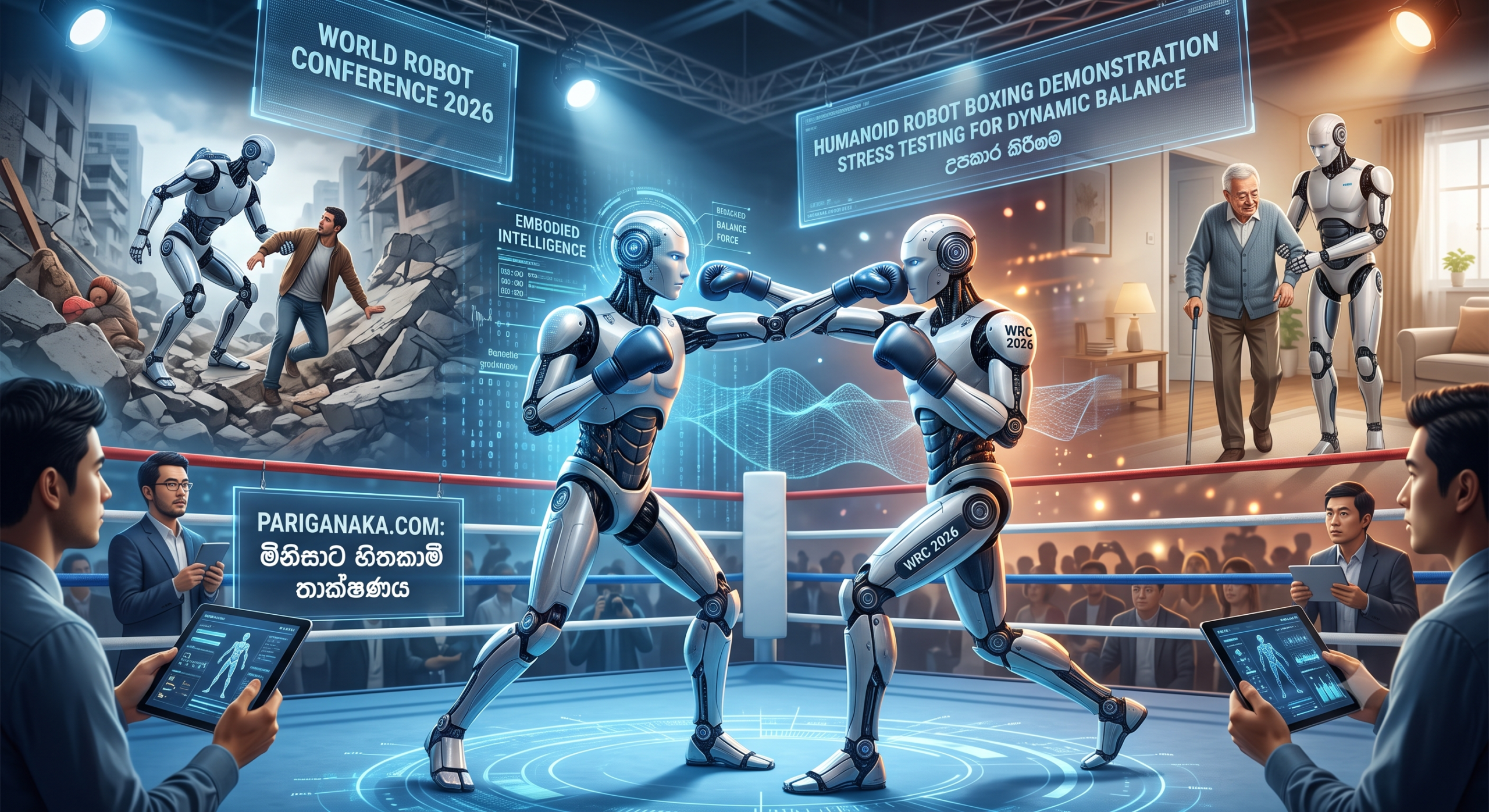
A viral phenomenon has recently taken global social media by storm, capturing the attention of tech enthusiasts and curious viewers alike: a humanoid robot boxing match that seemed to defy the limits of current technology. This event, which showcased two bipedal machines sparring, has raised fundamental questions about the rapid evolution of “embodied intelligence” and high-dynamic stability.
Here at Pariganaka.com, the Maha Gedara of human-friendly technology, our mission is to cut through the viral noise to understand the science shaping our digital future. Why are engineers teaching AI to spar, and what does it mean for us?
The Viral Moment in Beijing
The captivating footage originates from the World Robot Conference 2026 (WRC 2026) and the concurrent World Humanoid Robot Games 2026, held recently at Beijing’s National Speed Skating Oval.
While the Games featured dozens of events, including sprints (where the ‘Tiangong Ultra’ robot famously beat Usain Bolt’s 100m world record time), it was the kickboxing and boxing demonstrations that truly went viral. The core viral moment captured a humanoid robot attempting a high-dynamic maneuver—a “spinning head kick”—only to lose its center of gravity and collapse face-first onto the mat. Perhaps most startlingly, its opponent, upon witnessing the fall, immediately initiated what can only be described as a “victory dance”. This unscripted, highly human-like reaction solidified the clip as a viral sensation.
The Science Behind the Spectacle
This was not merely a metallic fight club for entertainment. The boxing ring serves as the ultimate “stress test” for the most advanced hardware and software being developed for humanoid robots.
To spar effectively, these machines must integrate multiple cutting-edge technologies:
- High-Dynamic Motion Control: These boxing humanoids demonstrate impressive real-time motion control skills. Unlike standard industrial robots that perform rigid, repetitive tasks, a boxing robot must continuously calculate its posture, center of gravity, and balance while reacting to unpredictable physical disturbances—such as a received hit or its own miscalculated kick.
- Embodied Intelligence: The WRC 2026 demonstrations spotlit the maturity of embodied intelligence. This means the AI is not just processing data on a screen; it is learning from human motion data to understand spatial awareness, physical balance, and mechanical impact within a real-world environment.
Beyond the Ring: Why This Matters
“A robot that can maintain its high-dynamic stability while receiving a hit in a boxing ring can maintain its stability while navigating treacherous rubble in a disaster zone or assisting a falling patient.”
The profound value of these boxing demonstrations lies entirely in their real-world implications. The exact same technology allowing a bipedal robot to throw or dodge a punch is what will eventually empower humanoid tools to serve humanity in critical areas.
The high-dynamic balance tested in the ring is a prerequisite for:
- Search and Rescue: Navigating unstable, uneven terrain in disaster zones to rescue survivors without toppling over.
- Dangerous Manual Labor: Performing complex tasks in hazardous manufacturing or construction environments.
- Healthcare and Elderly Care: Gently assisting patients with mobility challenges, providing physical stability without the risk of accidentally falling.
The Human-Friendly Perspective
It is natural to watch machines sparring and feel a sense of unease. However, it is essential to remember that these are controlled demonstrations meant to push the boundaries of dynamic stability and unscripted AI reasoning. We are not building robotic warriors; we are testing the resilience of our next generation of tools.
This viral boxing match is a testament to extraordinary human engineering. It is a critical stepping stone toward a future where our digital tools possess the physical dexterity and resilience needed to navigate our complex, messy, and unpredictable physical world safely and efficiently, ensuring they can protect and assist us when it matters most.
Stay tuned to Pariganaka.com—The Human-Friendly Tech Hub—for deep insights into the technology shaping our tomorrow. What are your thoughts on Embodied AI and high-dynamic robotics? Share your view in the comments below!
***
Leave a Reply