
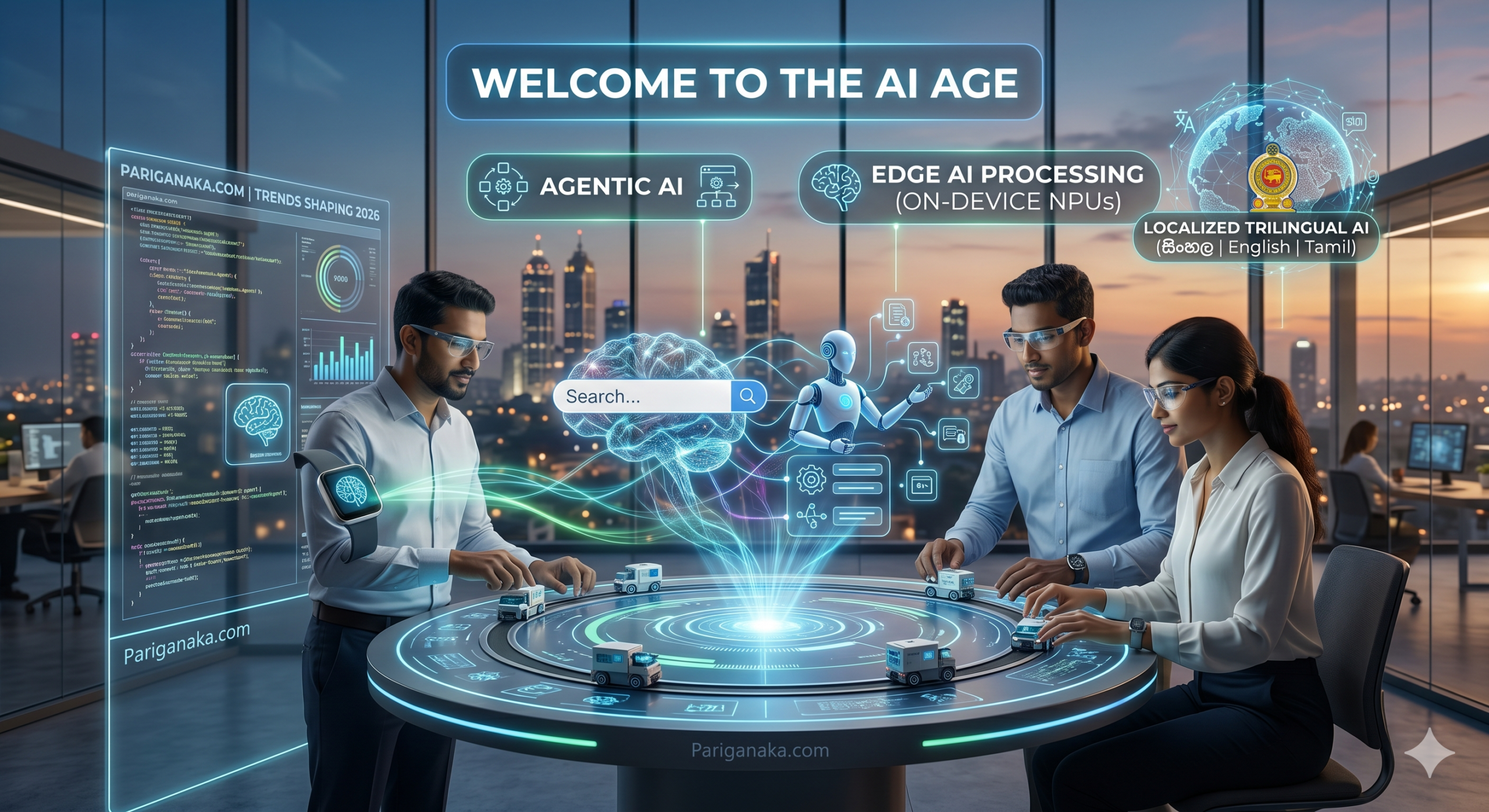
For decades, humanity lived in the “Information Age.” The primary goal of technology was to connect us to data—giving us search engines, social media, and cloud storage to access human knowledge instantly. But over the last few years, a silent, profound shift has occurred. We are no longer merely accessing data; the data is now acting, reasoning, and anticipating our needs.
Welcome to the AI Age.
In 2026, Artificial Intelligence is no longer just a party trick or a chatbot answering trivia questions. It has evolved into the invisible infrastructure of our daily lives, as fundamental as electricity or the internet. For the readers of Pariganaka.com, understanding the AI Age means recognizing the shift from AI as a tool to AI as an autonomous collaborator.
Here is a breakdown of exactly what the AI Age is, and the latest tech trends defining our reality today.
What Exactly is the “AI Age”?
The AI Age is defined by the transition from Reactive Computing to Cognitive Computing. In the past, computers only did exactly what you programmed them to do. In the AI Age, systems possess the ability to perceive their environment, learn from unprecedented volumes of unstructured data, and make autonomous decisions to achieve complex goals.
It is an era where language barriers are obliterated, physical and digital realities merge, and human productivity is multiplied exponentially.
The Latest AI Trends Dominating 2026
As we navigate this new era, several groundbreaking trends have emerged, completely reshaping industries in Sri Lanka and across the globe.
1. The Rise of “Agentic AI” (Autonomous Agents)
The biggest leap from the early 2020s to 2026 is the shift from Generative AI to Agentic AI.
- From Prompts to Delegation: Instead of prompting an AI to “write an email,” users now deploy AI Agents to “manage my inbox, draft responses based on my past communication style, and automatically schedule meetings on my calendar.”
- Multi-Agent Ecosystems: We now see digital agents communicating with other digital agents. Your personal AI travel agent seamlessly negotiates with an airline’s AI pricing agent to secure the best ticket, settling the transaction instantly via smart contracts.
2. Edge AI and Neural Processing Units (NPUs)
The cloud is no longer the sole brain of AI operations.
- Zero-Latency Intelligence: To solve the lag and privacy issues of cloud-computing, AI is moving to the “Edge.” Modern smartphones, laptops, and wearables now feature hyper-advanced NPUs (Neural Processing Units).
- On-Device Privacy: Your biometric data, financial patterns, and private conversations are processed entirely on your local device. This means powerful AI models can run offline, offering instant, private insights without needing an internet connection.
3. Spatial Computing and Multimodal Understanding
The screen is disappearing. AI is stepping out of the 2D monitor and into the physical world.
- AR Integration: Paired with lightweight AR glasses, AI can now “see” what you see. Mechanics can look at a broken engine, and the AI will overlay 3D holographic instructions directly onto the physical parts.
- True Multimodality: AI models today natively process text, voice, live video, and spatial data simultaneously, allowing for natural, fluid conversations with our environment.
4. Sovereign AI and Trilingual Large Language Models (LLMs)
For Sri Lanka, the AI Age is profoundly localized.
- Cultural Context: We have moved past relying on Western-centric AI models. The development of “Sovereign AI” means Sri Lanka now runs localized LLMs natively trained on Sinhala, Tamil, and local English dialects.
- Preserving Heritage: These models deeply understand our cultural nuances, idioms, and legal frameworks, empowering everything from local e-Governance systems to automated customer service in rural businesses.
Pariganaka.com’s Take: The AI Age is not about machines replacing human creativity; it is about elevating it. By automating the mundane, the repetitive, and the complex logistical tasks, AI is freeing up humanity to focus on what we do best: innovate, empathize, and dream. In 2026, the question is no longer “What can AI do?” but rather, “What will you build with it?”
Leave a Reply