
The intersection of artificial intelligence and academia has reached a tipping point, fundamentally altering how students learn and how research is conducted. For Professor Avi Loeb, the reality of this transformation became strikingly clear on the first day of his “Astronomy 200: Radiative Process in Astrophysics” class at Harvard University in September 2026.
The Shift in Student Learning and Culture
When Loeb asked his graduate students how many of them still read standard textbooks, only half raised their hands. The rest confessed that their primary source of information and interaction was artificial intelligence agents. In a similar anecdote, another professor noted a shift in students’ hypothetical dinner-guest preferences: while previous generations would choose historical thinkers like Albert Einstein or Marie Curie, many current students say they would prefer to bring their favorite AI chatbot.
This cultural shift is widespread—AI bot internet traffic has officially surpassed human traffic. The change poses major dilemmas for academic integrity and assessment. Harvard College Dean David J. Deming highlighted that take-home exams and traditional problem sets are no longer sustainable measures of a student’s mastery. As AI bans are largely unenforceable, they create an unfair environment for honest students who fear falling behind their AI-assisted peers. Instead, Deming proposed AI acceptance and new guidelines to help avoid the damaging “AI detection business,” though faculty in humanities and social sciences still express deep concern over AI’s role in writing-heavy courses.
AI Shattering Scientific Paradigms
The impact of AI stretches far beyond the classroom; it is actively reshaping the frontier of scientific research. Harvard’s president, Alan Garber, has voiced his conviction that knowledge essential to human progress will soon advance faster than at any previous time in history due to AI.
Mathematics provides a prime example. Traditionally, human authors carried the weight of pure mathematical proofs. However, AI is now performing the “heavy lifting,” providing the core breakthrough insights and the entire execution of complex proofs.
- The Planar Unit Distance Problem: An 80-year-old combinatorial geometry problem originally posed by Paul Erdős in 1946 had a prevailing conjecture disproved by an internal OpenAI model in May 2026.
- Dinitz-Gargano Conjecture: A counter-example to this 30-year-old conjecture was found using just four basic prompts totaling under 60 words. In these instances, the human author effectively becomes a “courier” who merely posts the AI’s findings online.
This brings up ethical questions for academic journals: how do you allocate credit when an idea is generated entirely by a computer? Some journals are pushing for standard attributions that differentiate between human communication and AI generation.
AI Reaching the Level of Prominent Scientists
AI agents are not just helping students; they are matching wits with world-renowned experts. In one striking example, a prominent scientist with 50 years of experience, Professor John Burks, wrote a lengthy paper attempting to explain UAP (Unidentified Anomalous Phenomena) orbs as meteoritic dust clouds. When a colleague sent him a critique of his model generated by a Claude AI agent, Burks was unable to personally resolve the discrepancy. His solution? He asked his own Claude agent to answer the critique.
This level of AI-assisted productivity is “mind-boggling,” with researchers now capable of generating short-book-length papers in just one week.
The Future of the Classroom
Faced with these profound changes, educators are forced to adapt their methods of evaluation. If every student uses the same high-level AI agents to solve their problem sets, it becomes nearly impossible to fairly grade them on a traditional curve.
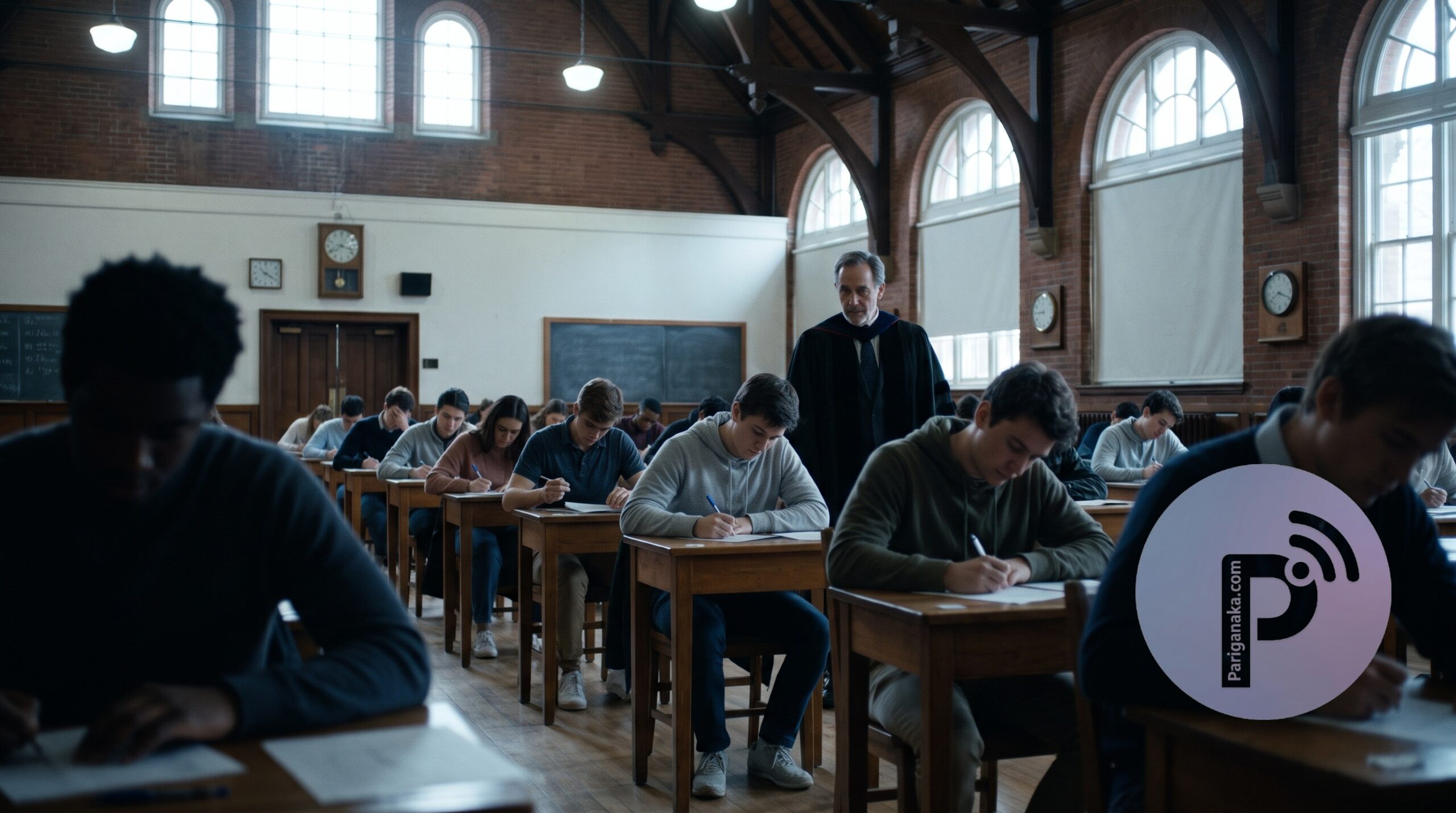
For Professor Loeb, the solution involves reverting to old-school security: administering in-person final exams where students are stripped of all electronic devices—no laptops, cell phones, electronic watches, smart glasses, or brain implants. He even jokes about placing students in a Faraday cage to block all electromagnetic signals, acknowledging that if a student is clever enough to use gravitational signals or neutrinos to cheat, they probably deserve an “A” anyway.
As AI firmly cements itself as both student companion and leading scientist, academia is left to navigate an entirely new intellectual landscape.
Leave a Reply