
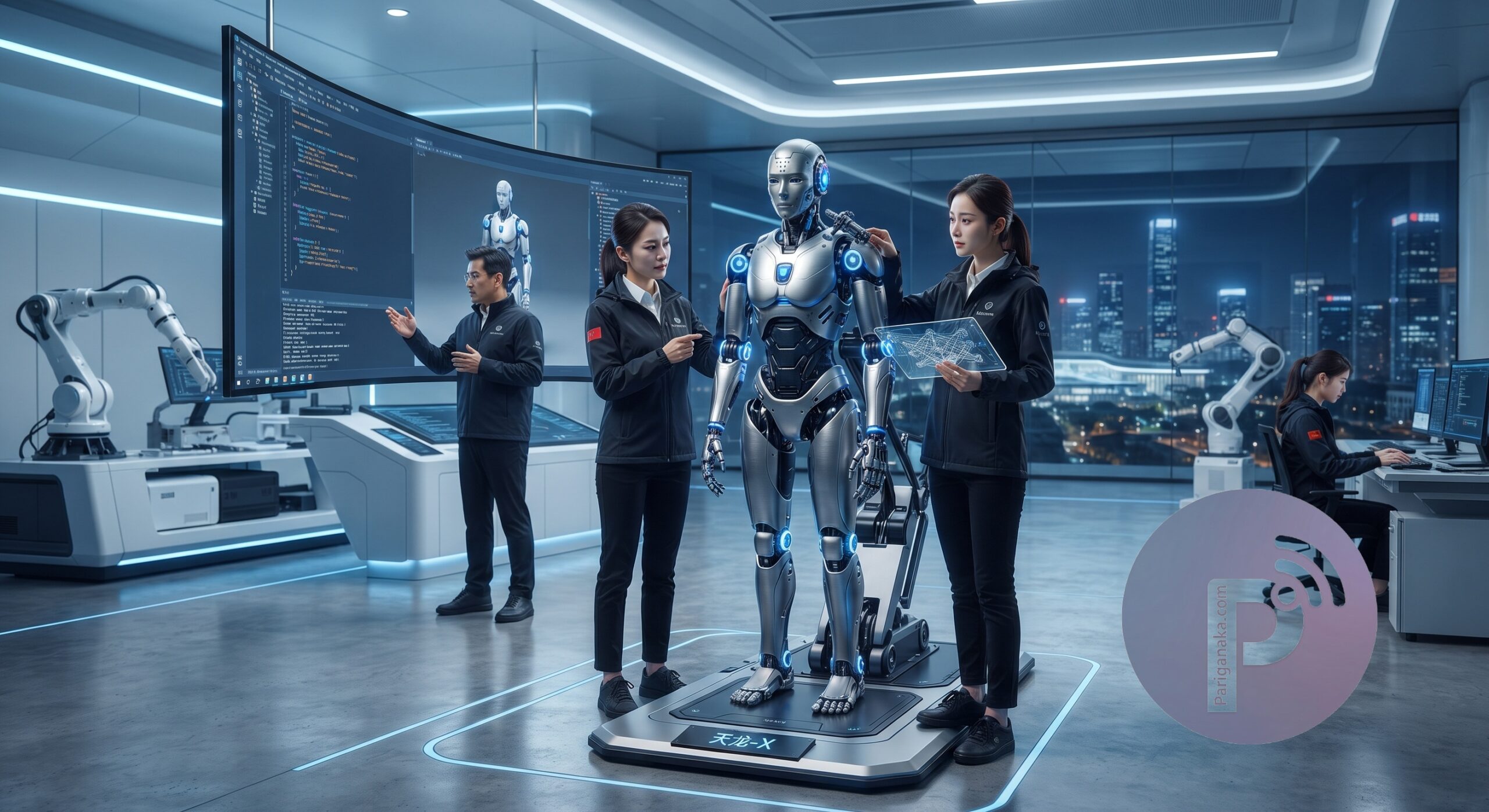
As digital AI continues to reshape our virtual lives—drafting texts, generating imagery, and managing schedules—a profound physical transition is underway. We are moving from disembodied intelligence to embodied AI: equipping machines with artificial brains capable of sensing, reasoning, and physically interacting with the real world.
Nowhere is this evolution more accelerated or strategically prioritized than in China, where humanoid robotics has officially become one of the nation’s key industries of the future.
The Hardware Boom: Scaling Up at Unprecedented Speeds
China’s push into embodied AI is characterized by staggering growth metrics. According to data from Morgan Stanley cited in the report, China accounted for an overwhelming 90% of the 13,000 to 16,000 humanoid robots shipped globally in 2025. This momentum exploded further into 40,000 shipments during just the first half of 2026.
While early iterations of these robots could occasionally appear clumsy, rapid hardware and software integrations are bridging the gap. To build physical dexterity, domestic humanoid robots are undergoing intensive real-world training:
- Learning how to securely pick up and manipulate various objects
- Preparing complex meals, from operating rice cookers to handling kitchen equipment
- Interacting with factory machinery and navigating dynamic environments
Supporting Infrastructure: Powering the Physical Intelligence Revolution
Building a nation of active humanoid robots requires immense computational and energy infrastructure. China is heavily backing this transition through sweeping national investments:
- Hyperscale Data Centers: In mid-2026, reports revealed a $295 billion USD commitment over five years dedicated to expanding national data center capacity.
- Next-Gen Energy Solutions: To meet skyrocketing energy demands, China is exploring innovative power generation—including offshore wind-powered underwater data centers alongside a rapid expansion of nuclear power stations.
- Connectivity: To eliminate operational latency in robots, the state has prioritized the rollout of a 6G communications network, with second-phase trials actively underway.
Public Sentiment, Policy, and the Vision of “Recursive Innovation”
A core differentiator in China’s AI landscape is the overarching philosophy governing its development. While Western frontier labs are largely driven by private enterprise market capitalization, China’s framework treats AI as a global public good.
To build public trust and bridge the gap between disruptive technology and everyday acceptance, authorities and developers frequently host public challenges and robot showcases, allowing citizens to interact directly with machines.
Looking toward the horizon, futurists envision a world populated by billions of robots operating in homes, factories, and transportation grids. Some experts point to the concept of recursive innovation—where robots not only assist with human labor but actively build and refine smarter generations of robots. Proponents suggest this could ultimately lead to a state of high abundance, described by some as breaking the traditional chains of physical labor.
The Road to AGI and 2049
Humanoid robots serve as a crucial physical testing ground for achieving Artificial General Intelligence (AGI)—the point at which machines match or surpass human capabilities across broad reasoning and adaptive tasks. While physical coordination brings science closer to true general intelligence, experts emphasize that higher-order traits like genuine creativity, emotional depth, and complex ethical reasoning remain critical hurdles.
With the People’s Republic of China eyeing its centenary in 2049, the overarching national strategy places science and technology at the core of escaping the middle-income trap and establishing global leadership. Balancing rapid state-backed innovation with global cooperation and safety safeguards will remain the defining challenge as humanity steps into the age of embodied intelligence.
Source Material & Video Reference:
Leave a Reply