
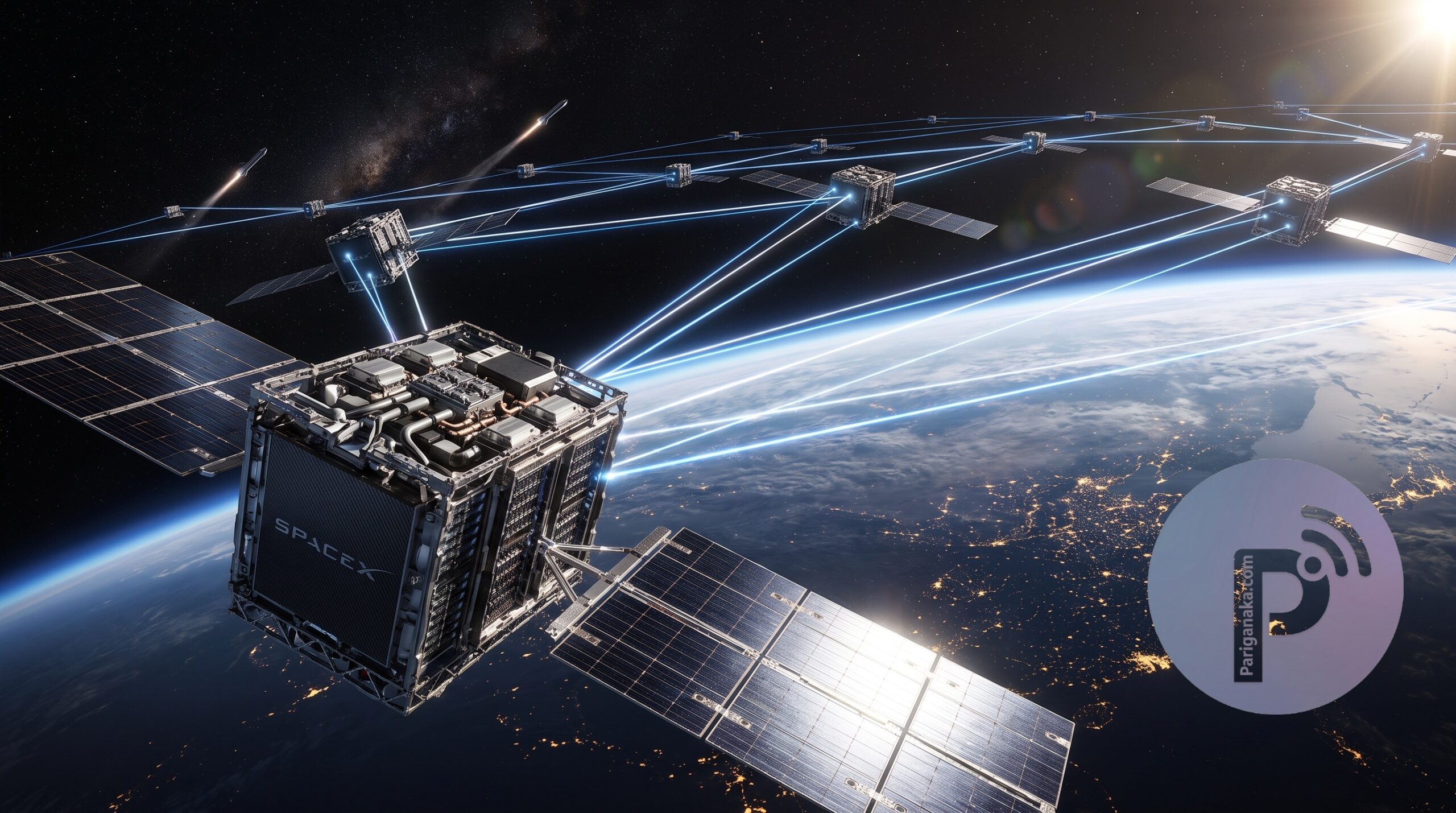
n early 2026, SpaceX filed a seemingly absurd application with the FCC: permission to put up to 1 million AI satellites into orbit. The goal isn’t to beam internet back to Earth like Starlink. Instead, Elon Musk wants to turn space itself into one gigantic, interconnected AI data center.
While the 1-million mark is an authorization ceiling rather than a strict production promise, the architecture behind this proposal is very real. It signals a paradigm shift: AI’s extreme electricity demands may soon make launching our computers into space cheaper than keeping them on Earth.
The Terrestrial Bottleneck: Power and Infrastructure
The hardest part of building a massive AI data center today isn’t acquiring the chips—it’s finding enough electricity to turn them on.
Modern AI models demand power on a scale that is reshaping electrical grids. For context, xAI’s “Colossus” supercomputer in Memphis requires roughly 130 megawatts to run 100,000 Nvidia H100 GPUs. By 2030, the International Energy Agency projects global data center electricity consumption could reach 950 terawatt-hours.
The problem is deeply physical. A massive AI cluster needs continuous power, transmission lines, substations, water for cooling, and years of land permits. The digital chips are advancing faster than the physical world can build the infrastructure to accommodate them.
The Orbital Advantage: Uninterrupted Sun
SpaceX’s solution skips the grid entirely.
On Earth, solar farms are limited by the day/night cycle, cloud cover, and atmospheric scattering. However, a spacecraft placed in a dawn-dusk sun-synchronous orbit can remain illuminated almost continuously. Google’s own orbital computing research, “Project Suncatcher,” estimates that a solar panel in the right orbit could produce up to eight times more energy than an equivalent panel on Earth.
By moving the computer to the energy source, you bypass the need for power stations, grid interconnections, and massive transmission corridors.
The Extreme Challenges of Space Computing
Space may have abundant solar energy, but it is deeply hostile to computing hardware. Launching processors into orbit trades Earth’s bottlenecks for a new set of extreme engineering challenges:
- The Heat Problem: Space is cold, but it’s a vacuum—meaning there is no air for convection cooling. A 120-kilowatt AI computer acts essentially as a 120kW heater inside a thermos. To get rid of that heat, spacecraft must use massive radiator panels to emit infrared energy. Removing 120kW requires roughly 86 square meters of radiator space.
- Radiation Damage: Earth’s atmosphere and magnetic field act as shields against solar radiation. In orbit, energetic particles constantly strike electronics, flipping bits in memory or gradually damaging components. Google’s tests showed that while the core processors can survive surprisingly well, high-bandwidth memory modules are highly vulnerable.
- Hardware Obsolescence: On Earth, you simply pull out an old GPU and replace it with a new one. In orbit, a processor might survive five years of radiation perfectly, only to become economically worthless because a newer, faster chip was invented on Earth. Orbital data centers require disposable, replaceable ecosystems rather than long-term server racks.
- Laser Networking: To train frontier AI models, thousands of chips must communicate constantly. Without physical fiber-optic cables, orbital data centers must rely on lasers to exchange tens of terabytes of data per second while moving at orbital velocities.
The Transport Reality: Bending the Launch Curve
None of this is possible without solving the most expensive bottleneck of all: the rocket.
Building gigawatt-scale orbital computing could mean transporting roughly 1 million metric tons of hardware into space annually. Even if SpaceX’s massive Starship rocket carried 100 metric tons per flight, that would require 10,000 launches a year (about 27 launches a day).
Google’s Project Suncatcher estimates that orbital computing only approaches the economics of Earth-based data centers if launch costs fall below $200 per kilogram. SpaceX’s million-satellite bet is fundamentally a bet that Starship will make hauling heavy industrial infrastructure into space routine and cheap.
A Second Industrial World
This is no longer just an Elon Musk moonshot. Google is planning prototype launches with Planet by 2027. Startup StarCloud already successfully operated an Nvidia H100 in orbit in late 2025. Nvidia itself is designing space-specific hardware like the “Space 1 Vera Rubin” module.
For all of human history, industrial expansion meant finding more land and extracting more fuel across the surface of one planet. Artificial Intelligence may become the first industry whose sheer demand for energy forces humanity to build a second industrial footprint in the sky.
Leave a Reply