
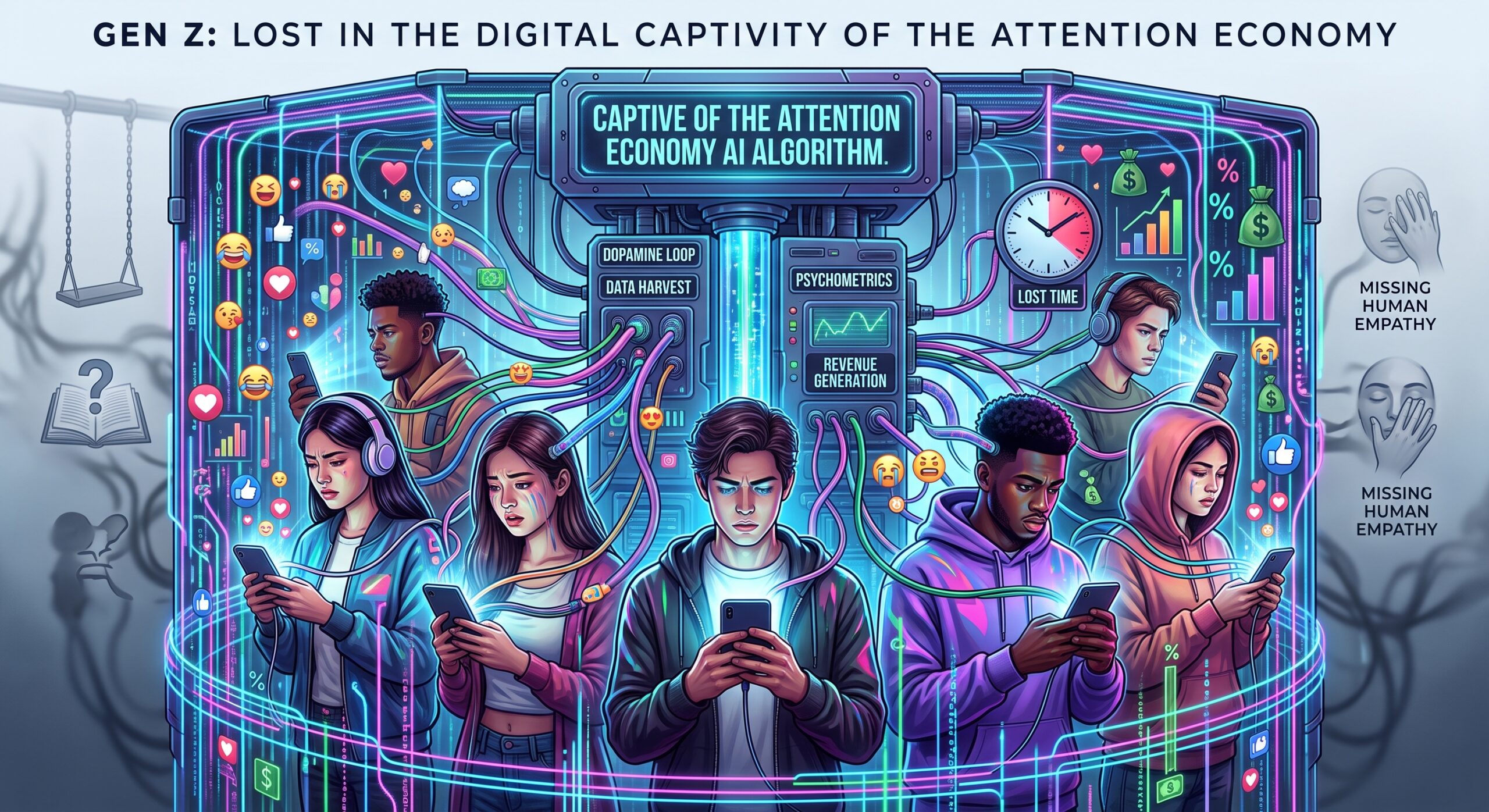
There is a growing conversation in today’s society about how Generation Z thinks, acts, and views the world. They exhibit distinct differences from previous generations—not merely as a standard generational gap, but as a direct result of rapid technological and digital transformation.
Millennials (born in the 1980s) experienced the massive shift from an analog world to a digital one, and they actively participated in building many of the technological systems we use today. However, it has become increasingly apparent that they largely failed to teach Gen Z how to use this new technology safely and effectively.
Here is a deep dive into the scientific, psychological, and social reasons behind the behavioral shifts seen in Gen Z.
1. The Loss of “Reading the Room” and Passive Communication
In the past, when people gathered in a physical space—like a meeting room—they possessed a natural ability to sense the emotional and mental states of others without a single word being spoken. Scientific research shows that in these physical environments, human heart rates and even hormone levels can naturally sync up.
This is known as passive communication. However, particularly following the COVID-19 pandemic and the complete normalization of digital communication, Gen Z has largely missed out on developing this crucial human skill. Communicating primarily through screens makes it incredibly difficult to accurately read tone of voice, facial expressions, and unspoken emotional cues.
2. The “Gen Z Complex”
Living constantly in a digital world has forced Gen Z to confront a unique set of psychological and social challenges:
- Context Collapse: In the past, people maintained distinct social circles—family, close friends, teachers, and colleagues—and adjusted their behavior accordingly. Today, Gen Z operates in a single digital space with a unified audience. When all social circles merge onto one platform, maintaining a coherent personal identity becomes highly stressful and challenging.
- The Digital Paradox: Despite being hyper-connected to numerous groups online and constantly interacting in virtual spaces, many individuals in Gen Z suffer from severe isolation and loneliness in the real, physical world.
- Information Overload & Cognitive Exhaustion: There is a constant pressure to be online. The endless scrolling of social media feeds, combined with the continuous mental effort required to determine what is true and what is fake, completely drains their cognitive load and mental energy.
- Financial and Future Anxiety: The combination of an unstable global economy, the rapid rise of Artificial Intelligence (AI) threatening job security, and the soaring cost of living has placed this generation under immense pressure.
3. The Attention Economy
The most profound impact on Gen Z’s behavior comes from the current digital economic model. In the 1990s and 2000s, the internet was primarily a tool; people used search engines to find specific information and then logged off.
Today, social media platforms and their algorithms are designed with a single goal: to capture and hold user attention for as long as possible to generate ad revenue.
- Humanity Converted to Data: Algorithms do not understand human empathy, compassion, or kindness. They operate strictly on behavioral signals—likes, shares, watch time, and outrage.
- Psychometrics and Dopamine Loops: Platforms analyze our likes, dislikes, personality traits, and emotional triggers to build precise psychological profiles. This data is then used to serve highly targeted ads and content, creating a dopamine loop that deeply addicts younger generations to their screens.
4. Rebuilding Human Connection: Where Do We Go From Here?
We cannot reverse the rapid advancement of technology. However, to minimize the social damage and protect future generations (like Gen Alpha), several practical steps must be implemented urgently:
- Screen Time Management: Regulating social media usage for children under 18 is essential. This must start at home, prioritizing activities that foster natural human bonding (driven by serotonin and oxytocin rather than dopamine).
- Educational Reforms: School curriculums must adapt to teach “attention as a skill” and introduce cognitive strategies. Young people need to be taught how to manage the mental stress that comes with digital consumption.
- Workplace Redesign: In professional environments, managers must protect “deep work” by setting clear boundaries around communication and minimizing constant digital interruptions.
- Intentional Software Design: Tech companies must be pushed to design software ethically. Applications should be built without manipulative “dark patterns,” making it easy for users to turn off notifications and disconnect without feeling penalized.
Conclusion
It is fair to say that Gen Z is the first casualty of a massive, unregulated technological experiment. Their distinct differences are not a flaw in their character, but rather the result of having their attention continuously hijacked by a profit-driven digital economy. Technology should be a tool that makes human life easier, not a machine that erodes human connection. Restoring that balance is a responsibility that falls on all of us.
Leave a Reply