
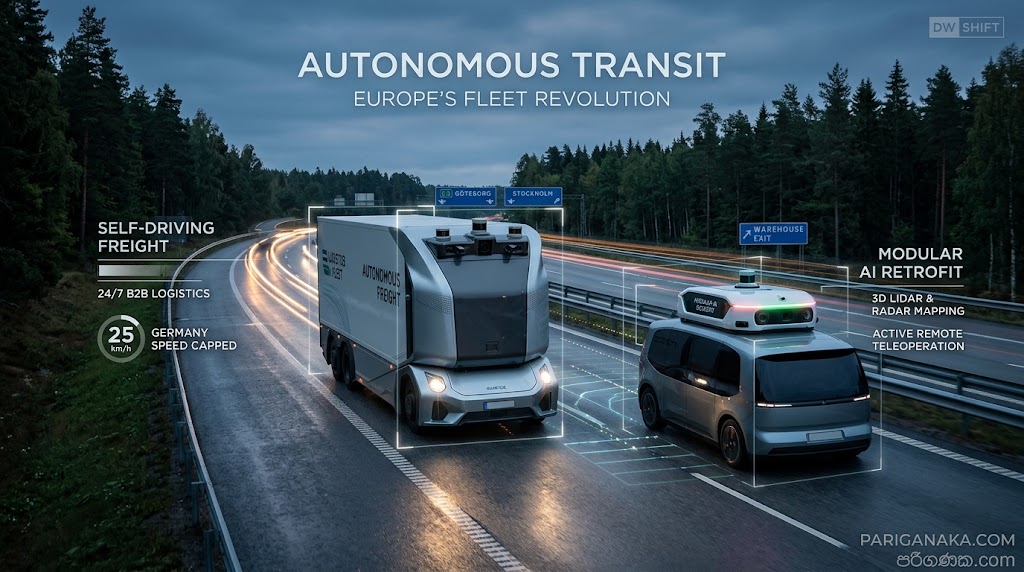
While commercial robotaxis have populated select American cities for years, Europe is quietly forging its own distinct path toward autonomous mobility. From electric self-driving trucks shuffling goods between Swedish warehouses to modular roof-mounted AI units converting standard cars into driverless shuttles in Estonia, Europe’s autonomous vehicle (AV) ecosystem is rapidly gaining momentum.
Reported by DW Shift, European innovation prioritizes industrial logistics, modular B2B fleet conversions, and stringent human-in-the-loop safety oversight as it navigates the continent’s rigorous regulatory framework.
1. Autonomous Freight: B2B Logistics Leading the Charge
Unlike consumer-facing robotaxis, European autonomous driving is seeing its fastest commercial deployment in B2B supply chains—specifically short-to-medium distance, high-frequency, repetitive routes.
- Sweden’s Einride & Apotea: Electric self-driving trucks developed by Swedish freight technology firm Einride are actively operating between two major warehouses for online pharmacy Apotea.
- Predictable Efficiency: By focusing on high-volume, point-to-point routes between factories and fulfillment hubs, logistics operators eliminate driver fatigue, lower carbon emissions, and optimize freight flow without navigating unpredictable city centers.
2. Modular Roof-Mounted AI: Turning Any Car Into a Driverless Vehicle
Rather than manufacturing expensive bespoke autonomous vehicles from scratch, European hardware startups are focusing on modular retrofitting.
German startup Blee (Bleke) has engineered an integrated AI control module mounted directly on top of standard passenger cars:
- Hardware Suite: The roof-mounted pod combines optical cameras, light/LiDAR sensors, and an embedded high-performance processing unit that translates sensor data into real-time steering and acceleration commands.
- Universal Integration: The module can be integrated into virtually any modern vehicle platform for personal chauffeur services or corporate fleet management.
- Empowering Service Workforces: In Estonia—which legalized driverless passenger transport testing on public roads in May—business founders are testing the system to transport freelance workers (such as home cleaners) to client locations, removing the financial burden of personal car ownership.
3. Human-in-the-Loop Safeguards and Teleoperation
Safety remains the paramount concern for European regulators and developers. Test tracks outside Tallinn, Estonia, rigorously test algorithm reaction times to prevent pedestrian collisions and emergency stops in high-risk scenarios.
To bridge the gap to full autonomy, European AV platforms rely heavily on remote control centers and teleoperation:
- Remote Monitoring: Human teleoperators sit in centralized command stations, viewing real-time video and sensor streams broadcast directly from the operating vehicles.
- Corner-Case Guidance: When an autonomous vehicle encounters a blind curve or an unexpected road obstruction, it brings itself to a controlled stop and requests a manual confirmation or path clear signal from the human monitor before proceeding.
4. Europe vs. US: The Regulatory Landscape
The primary difference between the American and European autonomous vehicle markets lies in regulatory philosophy:
| Metric / Dimension | United States Framework | European Union Framework |
| Deployment Focus | Commercial urban robotaxis (e.g., Waymo) | Logistics, B2B fleets, and modular mass transit |
| Commercial Availability | Fully driverless public rides in designated cities | Customer testing permits; teleoperation mandatory |
| Speed Caps & Testing | Standard city speed limits in approved zones | Capped speeds for autonomous freight (e.g., 25 km/h in Germany) |
| Safety Oversight | State-by-state self-certification & permits | High safety thresholds, strict EU-wide type-approval rules |
Germany, known for having some of the world’s strictest automotive regulations, approved autonomous electric trucks on public roads running at a capped speed of 25 km/h. While European progress may appear slower on paper, closing the loop with regulatory authorities ensures that when full autonomous disconnects are approved, the underlying systems will meet unprecedented safety standards.
The Horizon: Scaling Beyond the Remote Interface
As teleoperation protocols mature and algorithmic reaction times improve, European autonomous developers are working closely with national transport authorities to gradually disconnect remote monitoring interfaces.
By combining electric freight logistics, modular retrofitting, and robust safety validation, Europe is building a sustainable, highly controlled foundation for the future of autonomous transport.
Leave a Reply