
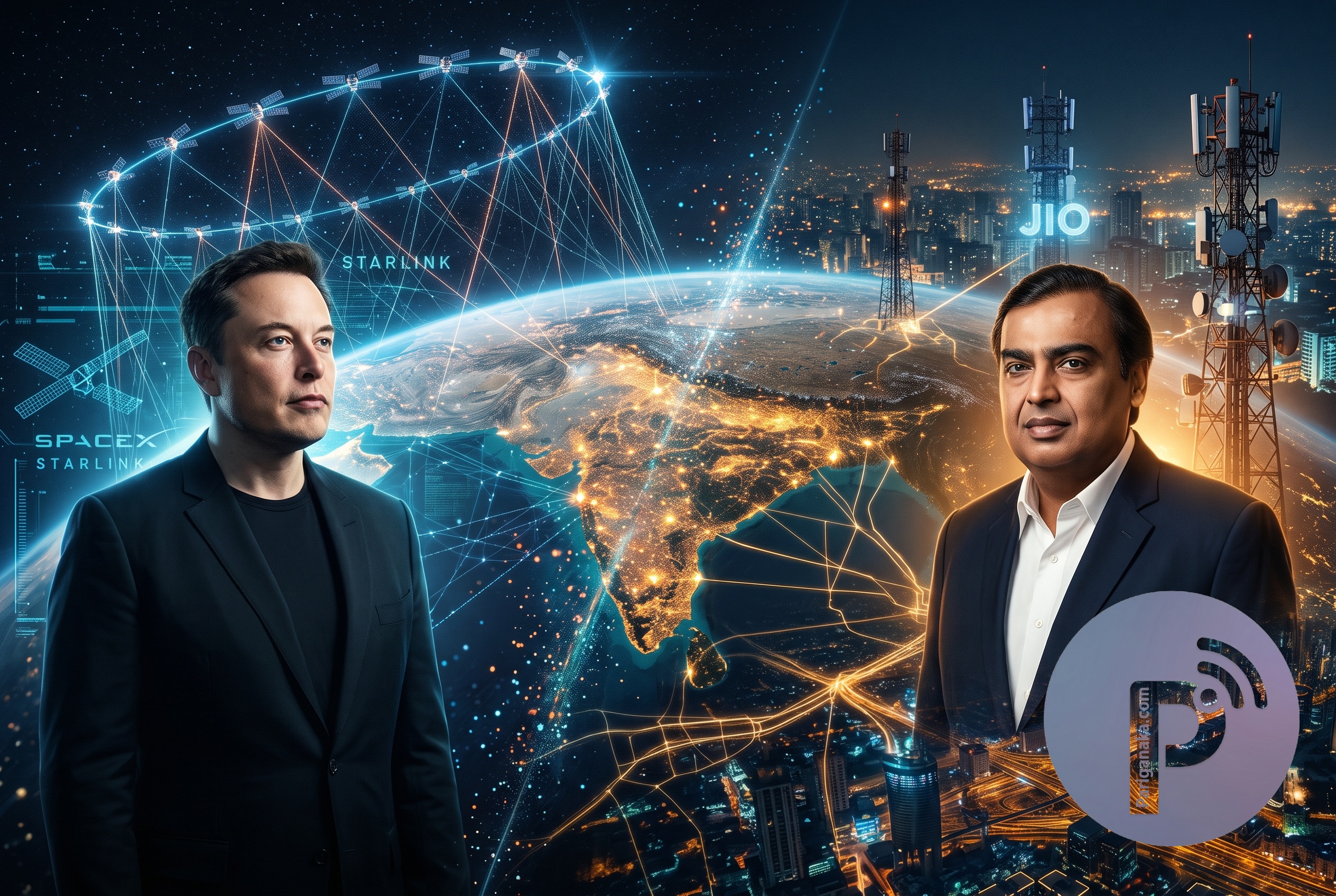
In one of the most high-stakes confrontations in modern telecommunications, tech billionaire Elon Musk (SpaceX / Starlink) and Asia’s telecom titan Mukesh Ambani (Reliance Jio) are locked in a battle over satellite internet access in India.
The feud reached a boiling point following posts by Musk on X (formerly Twitter), mockingly questioning if Ambani is the “real boss of India” and alleging that “certain oligarchs” were blocking Starlink’s regulatory approval to maintain a market monopoly. Beyond the public drama, this feud highlights a shift in global connectivity: the clash between Low Earth Orbit (LEO) Satellite Broadband and Terrestrial Fiber/5G Networks.
1. The Core Infrastructure Battle
India represents the world’s largest unpenetrated internet market, boasting over 1.2 billion connected users alongside millions in remote areas who lack broadband connectivity. The two tech giants approach this market with radically different infrastructure philosophies:
- Reliance Jio (Mukesh & Akash Ambani): Built on an extensive ground infrastructure of fiber optic backbones and tens of thousands of cell towers. Jio serves over 533 million subscribers, including more than 285 million active 5G users. At the India Mobile Congress (IMC) 2026, Jio unveiled its own plans for a “Sovereign Satellite Connectivity” constellation consisting of 1,600 LEO satellites and 23 ground stations.
- SpaceX Starlink (Elon Musk): Operates a global constellation of thousands of Low Earth Orbit (LEO) satellites orbiting roughly 550 km above Earth. Starlink beams internet directly to user terminals (dishes), making it suitable for remote villages, maritime vessels, aviation, and disaster-hit zones where physical cables cannot easily reach.
2. Regulatory Standoff: Spectrum Allocation & Security Clearances
Starlink has sought to enter the Indian market since 2021. However, regulatory approvals have been stalled by security assessments and spectrum policy disputes:
- Spectrum Allocation Controversy:
- Jio’s Position: Argued that satellite spectrum should be auctioned to ensure a fair playing field with terrestrial operators who paid billions for frequency bands.
- Starlink’s Position: Insisted that satellite spectrum should be allocated administramptively in line with International Telecommunication Union (ITU) guidelines, as satellite frequencies are shared rather than exclusive.
- Security & Launch Clearance:While Starlink, Jio Satcom, and Bharti-backed Eutelsat OneWeb have secured preliminary Global Mobile Personal Communication by Satellite (GMPCS) licenses, commercial launches remain pending security clearance from India’s Ministry of Home Affairs (MHA). The Indian government has rejected claims of bias, maintaining that security protocols apply equally to all operators.
3. Fiber Optic vs. Starlink: Deep Technical Breakdown
From an engineering perspective, Fiber Optic broadband and LEO Satellite networks exhibit distinct characteristics across Speed, Latency, Bandwidth, and Reliability:
| Technical Parameter | Terrestrial Fiber Optic | Starlink (LEO Satellite) |
| Transmission Medium | Optical Glass / Plastic Fiber Cables | Radio Frequency Electromagnetic Waves (Ku/Ka Band) |
| Download Speed | 100 Mbps – 10 Gbps+ (Symmetrical) | 50 Mbps – 200 Mbps (Asymmetrical) |
| Upload Speed | 50 Mbps – 10 Gbps+ | 10 Mbps – 25 Mbps |
| Latency (Ping) | 1 ms – 10 ms (Ultra-low) | 25 ms – 60 ms (Moderate LEO delay) |
| Network Capacity | Virtually unlimited via WDM multiplexing | Shared beam capacity per orbital cell |
| Weather Resilience | Immune to rain, fog, and atmospheric noise | Vulnerable to heavy atmospheric Rain Fade |
Physics of Latency:
In Fiber Optic cables, light signals propagate through optical glass at a speed of:
$$v \approx 2 \times 10^8 \text{ m/s}$$
Because physical cables follow direct terrestrial routes to local Internet Exchange Points (IXPs), latency remains between 1 ms and 10 ms.
In contrast, a Starlink data packet must travel vertically ~550 km up to an LEO satellite, route across inter-satellite optical laser links, and travel back down to a ground gateway station before reaching the target server. This travel distance through the atmosphere limits round-trip latency to a baseline of 25 ms – 60 ms—a performance leap compared to legacy Geostationary (GEO) satellites (~600 ms), yet still higher than direct fiber optic lines.
4. Regional Impact: South Asia and Sri Lanka
This satellite clash carries implications for South Asia, including Sri Lanka:
- Bridging the Digital Divide: LEO satellite networks can connect rural schools, remote hospitals, and island communities across Sri Lanka and India without requiring expensive fiber optic installations.
- Disaster Resilience: When cyclones, floods, or landslides knock down land-based cell towers and sever underground fiber cables, satellite internet terminals remain operational as long as they have power and a clear line of sight to the sky.
- Market Competition: Increased competition between local telecom providers and global satellite operators will likely drive down data costs and accelerate infrastructure upgrades across the region.
Pariganaka Tech Verdict:
The future of telecommunications is no longer grounded strictly in physical cables. As SpaceX expands Starlink’s global footprint and Reliance Jio prepares its indigenous 1,600-satellite constellation, the line between terrestrial and space-based internet is disappearing. Ultimately, the winner of this race will be whichever provider delivers reliable, high-speed data at a price point accessible to everyday consumers.
Leave a Reply