
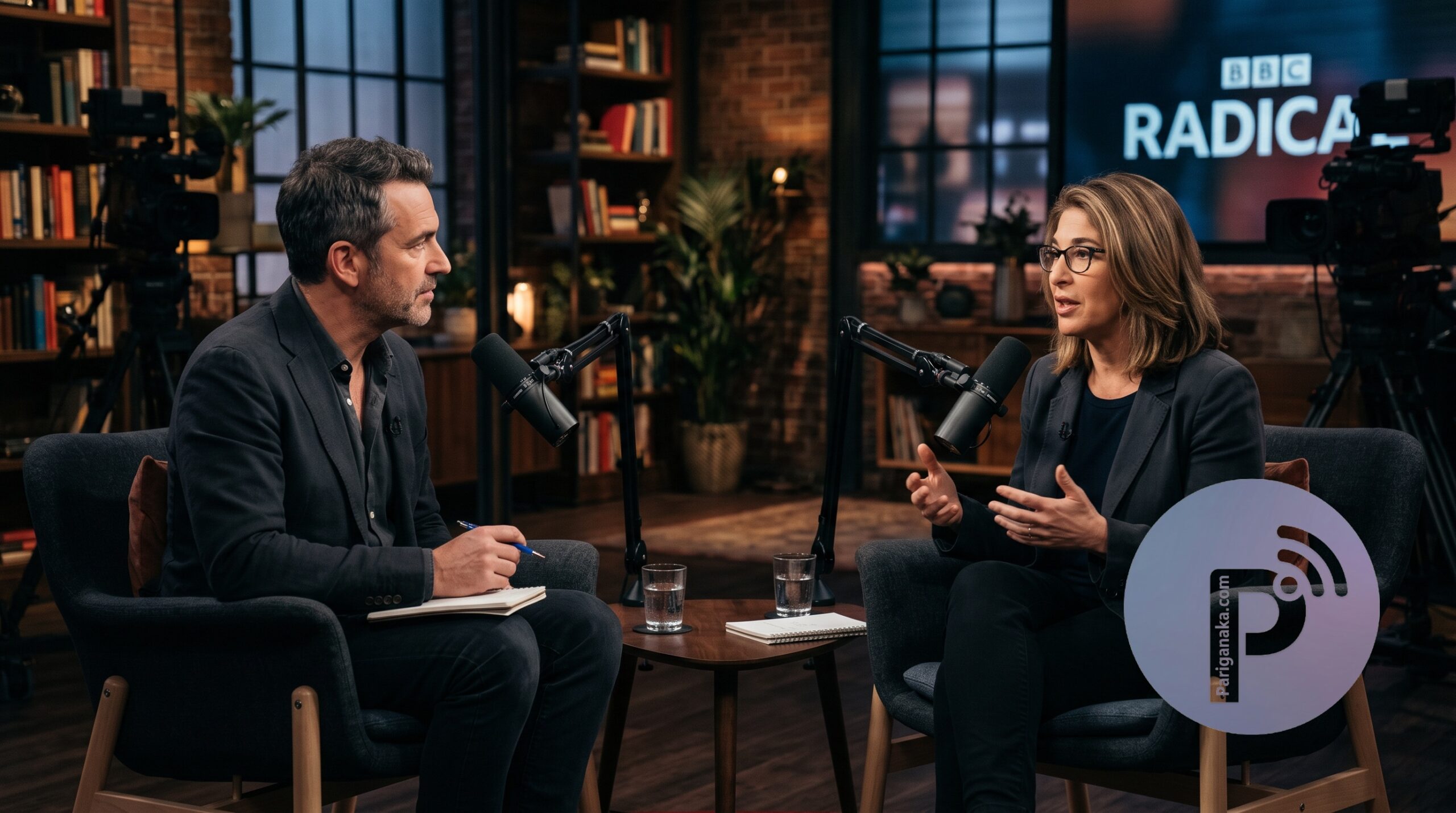
In an episode of BBC’s Radical podcast, host Gabriel Gatehouse sits down with renowned author, journalist, and public intellectual Naomi Klein to examine the trajectory of modern capitalism, the rise of extreme political movements, and the existential risks posed by unchecked technology.
Co-authoring her latest book, End Times Fascism, alongside Astra Taylor, Klein argues that humanity is facing a dangerous convergence of ecological crises, wealth inequality, and political authoritarianism driven by an economic model that refuses to acknowledge its limits.
1. Radical Ideas or a Radicalized Reality?
When asked directly whether she considers herself a “radical,” Klein responds that while she is often categorized as one, her core positions simply reflect an attempt to find stability amidst a political and ecological landscape that has drifted to dangerous extremes.
“The center has moved further to a more radical place, and certainly the right has become more and more radical… The more the crises of capitalism deepen, the more radical the responses need to be just to get us to a stable place.” — Naomi Klein
Klein emphasizes that modern society has begun to normalize once-unthinkable realities: the existence of trillionaires, artificial intelligence systems whose creators admit could pose civilizational threats, and an energy economy rapidly overheating the planet. In her view, current capitalist logic is “driving us off a cliff” by prioritizing endless growth and market bubbles over human survival.
2. From No Logo to The Shock Doctrine: An Intellectual Evolution
Tracing her journalistic background, Klein reflects on how her writing evolved over three decades:
- Personal Background: Born into a family of activists—including a grandfather who was a Disney animator blacklisted during the 1942 Burbank strikes, parents who moved to Canada as Vietnam War resistors, and a mother who made prominent feminist documentary films.
- No Logo (1999): Built on reporting about early service-sector union drives and sweatshop labor, focusing primarily on corporate branding and neoliberal policies rather than a systemic critique of capitalism as a whole.
- The Shock Doctrine (2007): Formulated after reporting in post-invasion Iraq and post-Katrina New Orleans, coining the term “disaster capitalism” to describe how corporations and governments opportunistically exploit natural and man-made crises to privatize public assets.
- Doppelganger (2023): Explored conspiracy culture, shadow political realities, and how legitimate fears about digital surveillance during COVID-19 were redirected into anti-vaccine movements.
3. The Shift to “End Times Fascism” and Accelerationism
In End Times Fascism, Klein and Astra Taylor detail how disaster capitalism has morphed into a far more destructive political coalition. They identify an unholy alliance between:
- Religious End-Timers & Messianic Fundamentalists: Groups that view global conflict and ecological degradation through an apocalyptic lens, actively welcoming collapse to fulfill prophecy.
- Tech Oligarchs & Silicon Valley Accelerationists: Figures like Peter Thiel and Elon Musk, as well as firms like Palantir and Anduril, who build surveillance and autonomous weapons platforms while investing in “escape hedges” like private island city-states (e.g., Próspera), underground bunkers, or space colonization.
- Far-Right Militants & White Supremacists: Groups exploiting border enforcement, mass deportations, and ethno-nationalist narratives.
Klein rejects the media’s tendency to treat tech oligarchs as harmless “trolls” or edge-lords when they express anti-democratic views. She points out that trolling and memetic warfare are deliberate political strategies designed to destabilize public understanding and soften the impact of authoritarian practices.
4. Defining Fascism as Capitalism’s Threat Response
Addressing the heavy weight of the word “fascism,” Klein clarifies how scholars of authoritarianism distinguish it from other forms of dictatorship:
- Capitalist Threat Response: Klein defines fascism as “capitalism’s most ferocious threat response”—a mechanism that emerges during severe economic crises to acknowledge public anger but redirect it downward at vulnerable scapegoats (such as immigrants and minorities) rather than upward at the billionaire class or systemic economic failure.
- Corporate-State Blurring: Unlike pure military dictatorships, fascism relies on a mass base and a tight merger between state power and private corporate monopolies.
5. The AI Bubble and the Coming Economic Bust
A critical focal point of the interview centers on Artificial Intelligence and its staggering energy demands. Tech leaders who previously made high-profile climate pledges—such as Jeff Bezos and Elon Musk—are now scaling up fossil fuel power generation (such as methane turbines) to feed data centers in an arms race to dominate AI.
Furthermore, Klein issues a stark financial warning regarding the current AI boom:
- Unprecedented Stock Bubble: The entire US and global stock market is currently being propped up by a handful of major tech firms competing in the AI race.
- Impending Financial Crash: Klein argues that when this massive valuation bubble inevitably bursts, the resulting financial fallout could be significantly worse than the 2008 financial crisis.
- The Key Question: When the bust occurs, society will face a pivotal choice: whether the financial burden will once again be forced onto working-class citizens or if it will spark a fundamental restructuring of the economy.
6. Finding Common Ground and Moving Beyond Capitalist Logic
Despite the grim analysis, Klein sees emerging opportunities for cross-partisan solidarity.
She notes that at the grassroots level, diverse communities across America are putting aside partisan cultural divides to collectively oppose the construction of power-hungry, noisy AI data centers in their neighborhoods. Furthermore, political organizers who directly address material needs—such as housing affordability and rent freezes—have demonstrated the ability to win over voters across traditional party lines.
Ultimately, Klein advocates for transitioning toward a deliberate economy that prioritizes public well-being over corporate profit. Ending growth-obsessed capitalism, she argues, is not about dismantling societal dynamism, but about ensuring that basic human needs—health, housing, and a livable planet—are protected from the endless pursuit of market expansion.
Leave a Reply